
Photo By Sgt. Wesley Akers | Exercise Tamiok Strike 26 is a U.S. Army Pacific-led bilateral exercise conducted with...... read more read more
LAE, Papua New Guinea — Before the morning heat settled over Igam Barracks, families had already begun gathering outside the Papua New Guinea Defence Force Regimental Aid Post. Mothers cradled young children. Soldiers waited patiently alongside spouses and parents. Others had traveled from surrounding communities, hoping they would finally receive the medical attention they had postponed for weeks—or even months.
Inside the clinic, Capt. Patricia Toro, a Papua New Guinea Defence Force mental health nurse, moved from one patient to the next. It was a scene she knew well. Like many healthcare providers across Papua New Guinea, she was accustomed to working through shortages of staff, medical supplies and equipment while doing everything possible to care for every patient who walked through the clinic doors.
During Exercise Tamiok Strike 26, however, something changed.
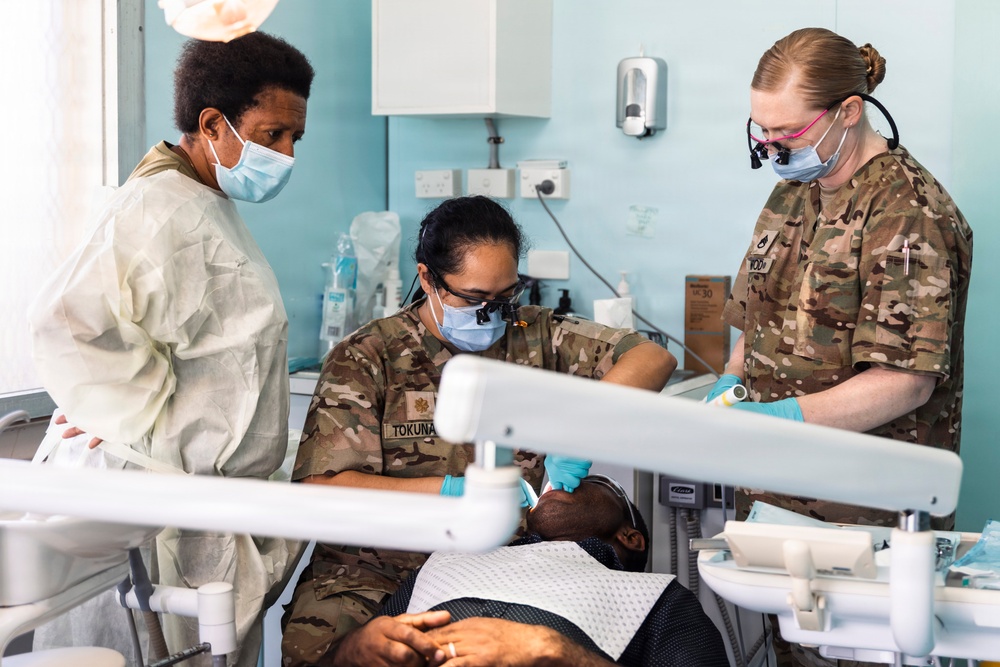
For two weeks, PNGDF medical professionals worked side by side with U.S. Army physicians, nurses, medics and medical specialists, combining their knowledge, equipment and experience to provide care to hundreds of patients while strengthening the enduring relationship between the United States and Papua New Guinea.
According to U.S. Army nurse Lt. Col. Hope Hashimoto, the combined medical team treated an additional 485 patients, providing care valued at more than $250,000 USD during the exercise.
For Toro, those numbers represent something much more meaningful than statistics.
"They helped us see many more patients than we could have on our own," Toro said. "They brought equipment and medications that allowed us to perform examinations we normally cannot do, especially for children."
For years, Toro has watched dedicated healthcare professionals overcome challenges that many hospitals around the world rarely face. Limited staffing often means a handful of clinicians are responsible for caring for an entire military community. When medical personnel deploy, those remaining must work even longer hours. Supplies sometimes run short. Medical equipment wears out. Certain medications are not always readily available. Despite those realities, patients continue arriving every day, trusting PNGDF clinicians to care for them as best they can.
Rather than simply increasing the number of providers inside the clinic, the exercise expanded what the medical team was able to accomplish together. U.S. clinicians arrived with diagnostic equipment, medications and specialized expertise that complemented the experience of PNGDF healthcare professionals.
Children received comprehensive examinations while parents watched clinicians from both nations work together to explain treatment options and provide medications on the spot. For many families, the greatest comfort came from knowing their children had received a thorough examination.
"Some of our patients told us they were happy because they felt they had been thoroughly checked," Toro said. "Some received medication right there, and you could see the relief on their faces. As healthcare workers, seeing our patients leave happy made this experience very fulfilling."
PNGDF Capt. Vasiti Kep, the Lae Area Dental Officer, watched attendance steadily increase as word spread that bilateral medical teams were providing care.
Many patients who normally postpone treatment because of financial concerns decided to seek help while services were available.
"This exercise has benefited many of our patients," Kep said. "Because the services were available, many people came who might otherwise have delayed seeking treatment."
Throughout the engagement, PNGDF and U.S. Army medical professionals shared techniques, discussed treatment plans and learned from one another.
"It has been great working together," Kep said. "They bring their expertise, and I bring my experience. We work together and learn from each other. This should continue."
Toro described the experience not as outside assistance, but as a genuine professional partnership.
"It has opened my eyes," she said. "We are not alone."
PNGDF clinicians introduced U.S. medical personnel to illnesses common throughout Papua New Guinea's tropical climate, while American providers demonstrated different treatment approaches, medications and diagnostic techniques that broadened everyone's understanding.
"It is a learning process for all of us," Toro said. "We learn about different medicines and different ways of treating patients, and they learn from the kinds of illnesses we see here. That exchange helps improve our practice."
Kep hopes future engagements will expand opportunities for PNGDF clinicians to receive additional professional training through exchanges and collaborative programs.
"As clinicians, we don't always have many opportunities for additional training," Kep said. "I hope this cooperation continues so we can keep learning from each other."
For Toro, the greatest takeaway was the friendships formed between healthcare professionals who began the exercise as strangers but finished as trusted colleagues.
"It created a bond between us," Toro said. "Now we can openly discuss cases, share experiences and continue learning together. I am grateful for this opportunity, and I hope to see more of this in the future."
The medical engagement was one component of Exercise Tamiok Strike 26, demonstrating that readiness is measured not only through operational capability but also through the ability to care for people.
As the exercise concludes, both officers believe the lasting legacy will not simply be the hundreds of patients treated. It will be the enduring relationships, shared knowledge and renewed commitment to improving healthcare for Papua New Guineans through continued U.S.-PNG cooperation.
For information visit tamiokstrike.com.
| Date Taken: | 07.21.2026 |
| Date Posted: | 08.07.2026 01:09 |
| Story ID: | 571822 |
| Location: | US |
| Web Views: | 16 |
| Downloads: | 0 |

This work, PNGDF medical officers highlight expanding U.S.-PNG medical cooperation during Tamiok Strike 26, by CPT Avery Smith, identified by DVIDS, must comply with the restrictions shown on https://www.dvidshub.net/about/copyright.


No keywords found.





