NNSY Teams Prepare Pier 5 for Historic First Visit from USS Gerald R. Ford
Photo By Shelby West |
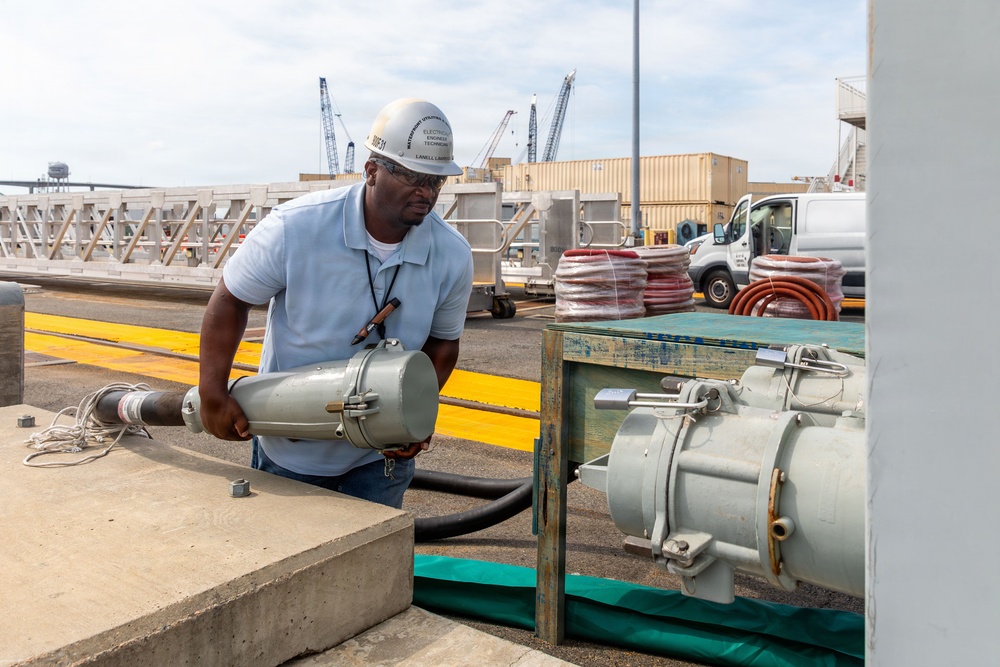
Code 900F.31 Electrical Engineering Technician LaNell Lawrence prepares a high-voltage......read moreread more
Photo By Shelby West | Code 900F.31 Electrical Engineering Technician LaNell Lawrence prepares a high-voltage shore power cable plug on Pier 5. Lawrence and his six-person team conducted rigorous inspections and coordinated transformer testing to ensure the pier's electrical grid can successfully deliver the 13.8 kilovolts of power required by CVN 78, marking the first time this high-voltage system has been energized at the pier for a naval vessel. see less
| View Image Page
NNSY Teams Prepare Pier 5 for Historic First Visit from USS Gerald R. Ford
For the first time in its storied history, Norfolk Naval Shipyard (NNSY) had to prepare to welcome the USS Gerald R. Ford (CVN 78) for its first Planned Incremental Availability. The arrival of the Navy’s newest class of aircraft carrier marks a significant milestone for the shipyard, requiring extensive preparations to ensure the pier and its supporting infrastructure were ready to support the modern warship. Two key teams from the Production Facilities Department (Code 900F) have been at the forefront of this effort: the Temporary Facilities Branch (Code 900F.14) and the waterfront utilities experts of Code 900F.31.
Leading up to Ford's arrival, these teams have been laser-focused on a complete rehabilitation of Pier 5.
Troy Leinart, the supervisor for Code 900F.14, has been leading his nine-person team through a total pier-side remodel of the temporary office and workspaces. “Basically, what we do is we come in after every project and we completely rehab and remodel the units to get it back up to the standard for the next project,” Leinart explained. “New engineered drawings for the setups to meet what each individual code needs, floor polishing, floor repair, leak repair… any type of facility repair to get it back up to the shipyard standard.”
For Leinart, the arrival of a new ship class required immense strategic planning to overcome challenges posed by aging infrastructure and the need for specialized parts. “It's a hectic time,” he admitted. “It usually doesn't stop until we get every personnel in their location settled in.”
While Leinart’s team focused on the physical workspaces, LaNell Lawrence’s team was tackling the pier’s power and utility grid. As an Electrical Engineering Technician in Code 900F.31, Lawrence was tasked with a critical, first-time evolution: ensuring Pier 5 could deliver the 13.8 kilovolts of electrical power the Ford requires.
“This is the Ford’s first time here, so we never had 13.8 energized here before being connected to a naval vessel,” said Lawrence. “Our primary job is to ensure all the utilities for the waterfront are up to par.”
Starting 120 days before the ship’s arrival, Lawrence and his six-person crew began a systematic inspection of the pier’s infrastructure. They coordinated with Naval Facilities Engineering Systems Command (NAVFAC) to have the pier’s massive electrical transformers tested to handle the higher voltage. When funding issues arose, Lawrence’s team was prepared to secure the necessary money through Portfolio Acquisition Executive for Industrial Operations (PAE-IO) to keep the testing on schedule.
“When the boat comes in for its availability, all those services have to be available,” Lawrence emphasized. “If it's not available, we can't do our work, and it makes the availability much harder to complete.”
For Lawrence, a Navy veteran who has been working with shore power since 1988, this project was more than just another task. “It was gratifying to me to be involved in it because this is what I love to do,” he said. “The electrical side of the house, to get involved, especially with the shore power… this is what I was born to do. This is what gets me coming to work every day.”
That sense of shared purpose and teamwork was echoed by Leinart, who noted the necessity of collaboration between the different shops. “We have to work as a team because we have to work around each other to support what each individual code has,” he said.
Thanks to the diligent and proactive efforts of these small, dedicated teams, Pier 5 now stands ready to support the Navy’s most advanced aircraft carrier, ensuring that America’s Shipyard can continue to service the fleet and deliver unparalleled warfighting capability for the nation