
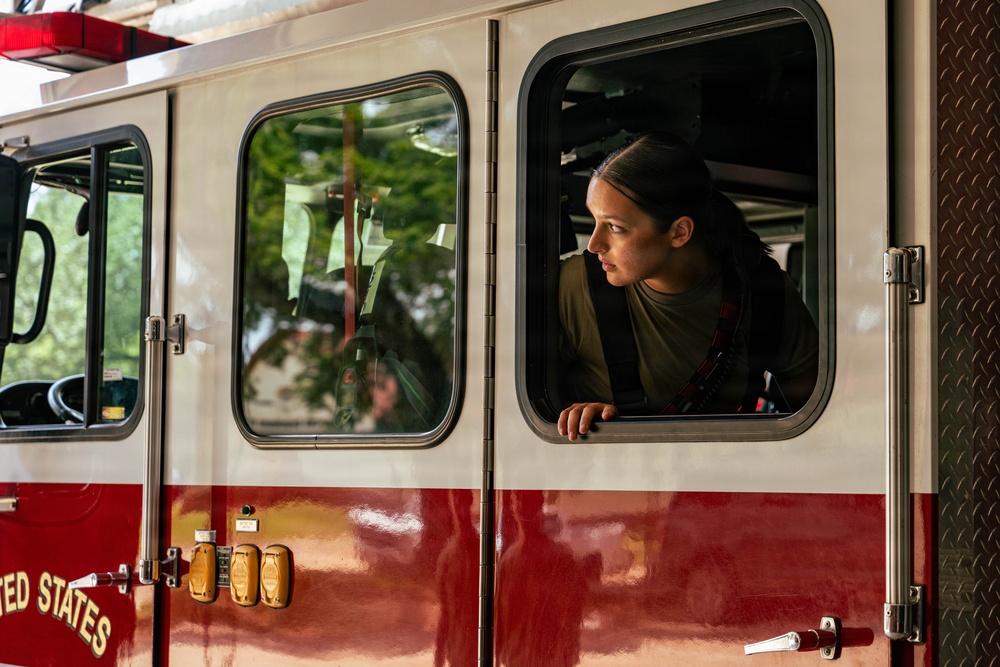
Photo By Senior Airman Rhea Beil | U.S. Air Force Airman 1st Class Madison Neubert, 2nd Civil Engineer Squadron...... read more read more
 Subscribe
BARKSDALE AIR FORCE BASE, La. -- The blaring sound of the alarm rings throughout the fire department. With little knowledge of what incident has occurred, you have 60 seconds to grab all necessary equipment, step onto the truck, and only five minutes to arrive on scene.
For firefighters, this is a normal part of their day.
The 2nd Civil Engineer Squadron is composed of multi-capable Airmen who are a part of the operations section at the fire station. Their day starts before sunrise, full of training, tasks and waiting for the next call.
Although they are primarily known in society for responding to fires, firefighters respond to various other types of emergencies.
Medical emergencies make up a large portion of the operations section's responses, but every alarm can bring something different and unexpected. Emergencies range from hazardous materials incidents, fuel spills, technical rescues and vehicle accidents to aircraft fires, in-flight emergencies and standby support during munitions loading operations on the B-52H Stratofortress.
Firefighters are typically the first to arrive on scene. If emergency medical personnel are not immediately available, they begin triage and stabilize patients until additional responders arrive.
“We do a lot more than people realize,” said U.S. Air Force Staff Sgt. Jacob Wilson, 2nd Civil Engineer Squadron emergency communications center noncommissioned officer in charge. “And it's not really their fault; it's just that they see the specifics of what we do, and there's not a lot of peripheral eyesight on our capabilities.”
There’s a lot that goes on within the fire department. From the Emergency Communications Center answering emergency calls to firefighters in the operations section responding, every section plays a role in protecting the installation. Continuous training keeps teams ready, but in the operations section, that readiness is put to the test everyday.
This section is always on the move. Even firefighters fresh out of technical training school are expected to hit the ground running while continuing to build their skills through on-the-job training.
“They throw you to the wolves, which is really cool,” said Airman 1st Class Madison Neubert, 2nd Civil Engineer Squadron firefighter. “You arrive from tech school expecting to continue training, but instead they put you on a truck day one.”
A firefighter's first emergency response tends to stay with them, their first taste of the high-intensity environment where lives are on the line.
Wilson recalled one of his first calls, involving an A-10 Thunderbolt II experiencing a landing gear and hydraulic malfunction. As the aircraft approached the runway, he and his team immediately recognized something was wrong.
Unable to deploy its landing gear, the aircraft landed on its belly and skidded down the runway, sending sparks into the air. Fortunately, the pilot was able to safely exit the cockpit.
Firefighters secured the scene by checking for secondary hazards while coordinating with supporting agencies to recover the aircraft and clear the runway.
“That's one of the first emergencies I responded to that was a true emergency,” said Wilson. “It stuck with me because it happened early in my career. Most of the emergencies that stay with me all center around helping people, and that's really what I wanted was to help that pilot.”
Firefighters train for a wide range of emergencies, but the situations they encounter are always evolving. One call may require specialized equipment and technical expertise while the next may require them to slow down, listen and help someone through a crisis.
“We see people on one of the worst days of their life,” said Wilson. “It’s important to me that we can be there for them to improve their day and improve their condition.”
One call that stayed with Wilson involved a young Airman who was struggling. The Airman believed nobody cared about him and felt his supervisors weren’t investing time in him or his career.
When Wilson and his team arrived on scene, they assessed the Airman and listened as he explained what he was going through.
“He just thought nobody cared about him, but we showed up for him,” said Wilson. “Not saying that was the reality, but that was his reality. Not only by being there, but by actually pointing him in the right direction and resources. Letting him know who’s here, who cares about him, and who can help him with what he’s going through.”
The 2nd Bomb Wing mission relies on emergency responders who are prepared to act at a moment’s notice. Firefighters play a critical role in protecting Airmen and maintaining the readiness of the installation.
For many firefighters, the impact of the job is seen most clearly through the people they help.
“When people think of Fire, they don't think that firefighters are responding to medical calls,” said Neubert. “But it’s cool because you're directly helping someone. Whereas if it’s a building or a gas leak, everyone’s typically fine and it’s only the building that’s damaged. But with medical, the person’s not fine and hopefully by the time they leave me, they are.”
| Date Taken: | 08.05.2026 |
| Date Posted: | 08.05.2026 13:38 |
| Story ID: | 571630 |
| Location: | BARKSDALE AIR FORCE BASE, LOUISIANA, US |
| Web Views: | 14 |
| Downloads: | 0 |

This work, More than flames, Fire: Barksdale’s emergency responders, by SrA Rhea Beil, identified by DVIDS, must comply with the restrictions shown on https://www.dvidshub.net/about/copyright.


No keywords found.




