Shipyard Resilience Team Builds Desk Guide to Aid in Timely and Accurate DEOCS Results for 2026 and Beyond
Norfolk Naval Shipyard’s (NNSY) Defense Organizational Climate Survey (DEOCS) launches Aug. 3 – providing a tool for shipyarders at all levels to provide their anonymous, valuable feedback in the ongoing effort to bring positive and lasting change to America’s Shipyard. And this year, the Shipyard Resilience Team (SRT) that leads the charge for DEOCS has developed something with GenAI to provide timelier analysis of results so that leadership can take action on those improvement areas.
It all started with a request from former Shipyard Commander Capt. Jip Mosman, who asked the SRT what could they do to improve the survey so that there’s less time overall spending combing through the results so that real tangible change can be made at NNSY. With a goal in mind, members of the SRT and Department Resilience Teams (DRT) began to look for ways to improve the process.
“The original process was a bit archaic and time-consuming, with team members spending weeks on end going over each department’s results manually, piecing everything together to ensure we capture those areas needed to address while ensuring the results remain anonymous,” said SRT member Tarane Parker who has been working with DEOCS Lead Craig Fieldings for years on this annual initiative.
“Timeliness has always been one of the biggest issues we’ve faced with analyzing results for a workforce of more than 10,000 people,” said Fieldings. “As our teams began to grow with new teammates, they brought fresh ideas to the table, and were ready for action.”
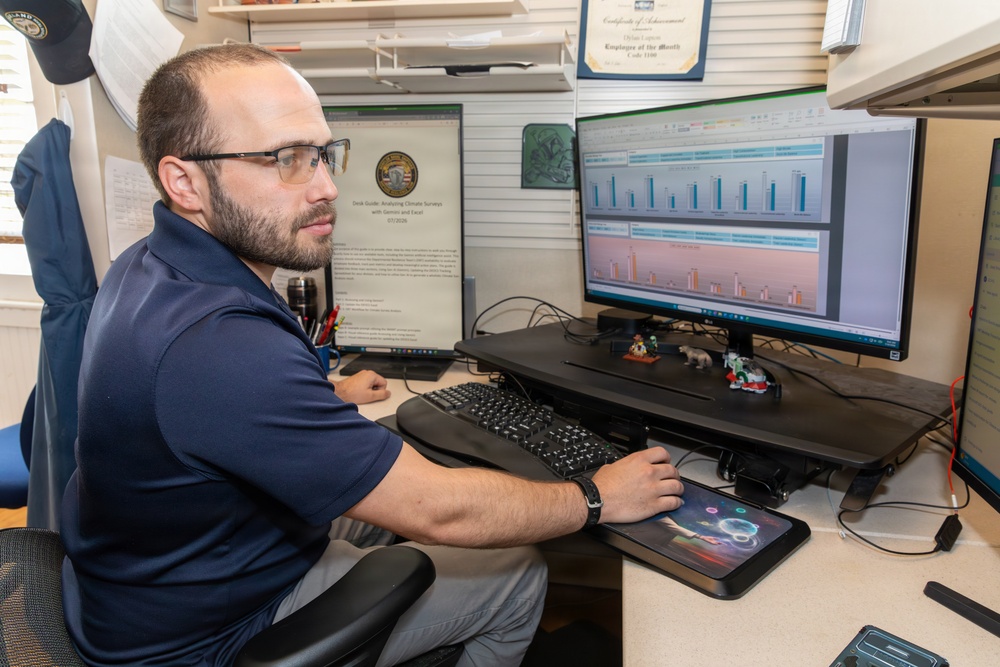
With a call-to-action for improvement and a new form of technology being offered to government employees, the team began to move forward. The Emergency Planning Division (Code 1130) DRT Representative Dylan Lupton had been previously utilizing GenAI in his own code, developing prompts to help him build packages for emergency response. With his learning knowledge of the tool, he began working a prompt alongside the 2025 DEOCS to see if there was an opportunity there to assist with analyzing results.
“When working with GenAI, you create prompts, tweaking it to best fit your desired end result,” said Lupton. “We began using the Executive Support Department (Code 1100) results from the DEOCS to see what worked, what didn’t, and gauging how timely this could help us finalize the results.”
What started as developing prompts for assistance soon generated a full desk guide built with GenAI, its purpose to review each department’s results from the DEOCS, filter and go through each item, and provide a rough analysis of feedback based on qualitative and quantitative data. “It reviews the static data entered and compiles it into a one to two-page summary, giving recommendations of how to address issues logged in the results of the survey,” said Lupton.
SRT Co-Lead Adam Wethington added, “From the initial testing and generation, the SRT then built a committee of reviewers and testers to get multiple points of view of how the guide works, how user-friendly it is, and how accurate it is. We wanted to create a consistent product that everyone could use across our command, with the end result being that it creates a command-wide plan of action for our shipyard to take for action.”
Through testing and tweaking, the SRT is ready to launch the DEOCS Desk Guide with the 2026 survey, which is being offered to the DRT members of each department so that they can submit all results of the survey within their purview into the desk guide for assistance.
“With this guide, it becomes a one-stop shop for everyone to streamline the process so we can analyze results faster than ever before,” said Parker.
Wethington added, “utilizing this tool also removes any unconscious bias for analysis, breaking down the results and pinpointing problem areas as accurately as possible so that nothing gets lost. We still include the human element to review everything and make sure everything is correct and we are the ones that carry out the action items for the results themselves; however, this tools helps us optimize our time by cutting down evaluations, breaking the process down from weeks to mere minutes.”
“What’s more, with this tool at our side, we can produce and show a relationship between actions we’ve taken, results we’ve received, and the correlation,” said Fieldings. “Instead from starting from scratch every year, we fine tune action items and processes. We’re becoming more data driven with our decisions based on real hard data with this guide at our side. This is a game-changer on the way we trend the culture – and it directly helps senior leadership create a sustainable environment where people are heard and cared for.”
The 2026 NNSY DEOCS will continue through the month of August, providing employees the chance to have their voices heard on what the shipyard needs to target for improvement. Once those surveys are completed, the DRT leads are encouraged to utilize the DEOCS desk guide to bring timely and accurate results to the forefront so that the plan of action can be developed and enforced. “This tool is vitally important and a lot of great work was put into it from this team. We often hear folks asking for better tools to make the job easier, this desk guide is one of those tools,” said Fieldings. “It helps us build our shipyard to be at its very best, addressing a lot of the underlying concerns so that we can truly bring positive change to our workplace.”
“It’s an adjustable living document that can be reviewed and revised to better understand how our command and its needs,” said Lupton, who noted that he’s been continuing to test and learn GenAI, working to develop a specialized AI agent that will follow pre-built descriptions, rules, tools and workflows for a specific job. “Using an agent with our future DEOCS will provide us with a hyper-specialized, consistent and time-saving component to help us further streamline and standardize the process overall. I’m excited for us to continue to improve our toolkit so that we can assist our workforce.”
NEWS INFO
Date Taken:
08.03.2026
Date Posted:
08.04.2026 14:00
Story ID:
571514
Location:
PORTSMOUTH, VIRGINIA, US
Web Views:
13
Downloads:
0
PUBLIC DOMAIN
This work, Shipyard Resilience Team Builds Desk Guide to Aid in Timely and Accurate DEOCS Results for 2026 and Beyond, by Kristi R Britt, identified by DVIDS, must comply with the restrictions shown on https://www.dvidshub.net/about/copyright.