
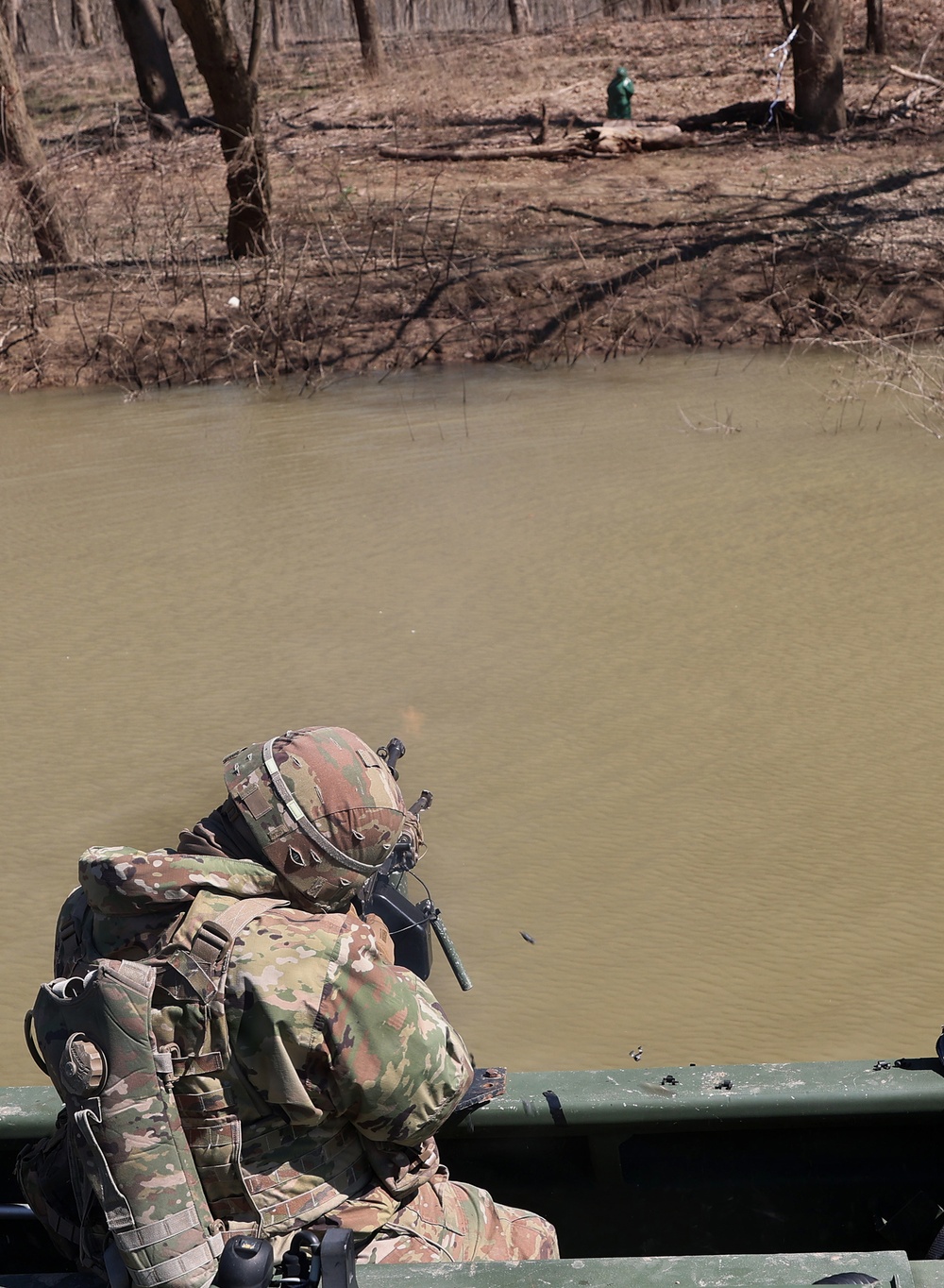
Photo By Eric Pilgrim | The Salt River at Fort Knox provides a unique experience for units, featuring several...... read more read more
FORT KNOX, Ky. — For over a century, Fort Knox’s unmatched terrain and ever‑evolving ranges have made it one of the military’s most sought-after and versatile training destinations.
Despite some big transformations that have reshaped the landscape since the installation began in 1918, training remains at its core, and its ranges have proven to be a versatile powerhouse of readiness and lethality.
“We have the ability to train almost anybody here with anything,” said Arlin Kramer, Target Systems supervisor at Fort Knox Range Control: “tanks, small arms, aviation, river operations and more give us a unique advantage.”
According to Kramer, Fort Knox is well postured for whatever training the War Department requires, now or in the future.
“One of our advantages is our terrain,” said Kramer. “All the steep inclines and declines provide for natural berms. A lot of our ranges are built in little valleys and draws, where it's a lot easier to control bullets. The terrain makes us a much better training post: a better controlled, safer environment for live-fire training.”
Because of this, almost all ranges can be operated simultaneously where many other installations will have to close portions of the range complex for safety reasons.
Fort Knox has over 108,000 total acres of land in Central Kentucky, with 101,000 devoted to training. That equates to more than 157 square miles of thick forests, rolling hills and steep, rugged ravines – even a river.
As an example, over 649,000 residents live within the city limits of Detroit, Michigan, which spans 138.7 square miles. However, the sheer size of Fort Knox’s training ranges is not what makes it such a unique DoW asset.
For that, you would need to also consider its centralized location, ever-expanding capabilities and evolving history, said Ken Boeglen, Fort Knox deputy garrison commander.
“We have a lot of capability, and a lot of untapped capacity,” said Boeglen.
Working seamlessly to capitalize on these strengths are the staff members, said Boeglen, who go above and beyond to support all units who train at the post.
“My range team has done a great job of listening to commanders in the field,” said Boeglen. “When all those external customers come here, they regularly give us great accolades for our staff coordination with them – literally to the point they say they wish their range control worked as good as ours. We provide a lot of cooperation to do things out of the box, but safely, so units can execute the training they need.”
Boeglen said some of that has to do with the post’s customer service-based approach to range support.
“Commanders are responsible for the training, so our job is to facilitate their execution of training as best we can,” said Boeglen. “Rather than them saying, ‘I need Range X,’ we ask them, ‘Tell me what you want to do, and I’ll give you the best facility to do it.’”
Kramer agreed, saying they not only do they strive to meet the intent of all commanders, they work diligently to maintain the ranges for peak performance.
“There are installations with really big ranges, but units that come here brag to us about how well we take care of our ranges, including targetry,” said Kramer. “Our targets stay at 100%, and if they don’t, we fix them immediately.”
Established in 1918 as an artillery training site, Fort Knox rapidly adapted to the rise of mechanized warfare, officially becoming the Army's primary tank training post by 1932.
To accommodate increasingly powerful tanks, the installation continuously expanded its footprint, purchasing more land in 1942 and adding 53,000 acres in 1952 to double its training capacity. By the 1990s and 2000s, some of these vast areas were repurposed into highly specialized simulation environments, designed to look and feel like key parts of the world. Among them was the Zussman Urban Combat Training Center, focused on complex, modern asymmetric warfare.
The installation's core mission faced a major shift in 2010 when the Army relocated its armored training programs to Fort Benning, Georgia. Rather than letting the infrastructure sit idle, Fort Knox leadership leveraged the adaptability of its diverse range complex to pivot toward modernization and multi-echelon support.
“We have a completely different mission set now,” said Manson. “It’s the difference between training a Soldier to go into the armored force versus training a Soldier to go into combat.”
At the heart of all this modernized warfare training are three ranges, which combine to make Fort Knox a one-stop shop of lethality. One of those is Zussman. Range officials refer to it as Fort Knox’s Universal Studios because of its high-tech systems, which feature pyrotechnics, realistic location-centric sounds that match what street you are on and even smells that enhance the overall experience.
“If you walk by the bakery, it smells like pastries or bread baking. If you go down into the sewers, it smells like a sewer,” said Manson.
“The designers had a little bit of foresight in the ‘90s to figure out that this was something the armored force needed,” Manson continued. “Now, we have this dynamic facility that allows us to get after specialized urban combat training.”
The pyrotechnics include battlefield explosions, rocket-propelled grenades that impact on certain buildings, and flames that shoot from the gas station: all operated from the control tower.
Manson said controllers can also provide limited pyrotechnics at other ranges with their mobile package, depending on commanders’ needs.
The second range is the Digital Air-Ground Integration Range, or DAGIR, at Yano. It stretches across a massive valley and combines armored vehicle live fire, dismounted small arms and crew-serve weapon operations, Apache firing lanes and even unmanned aerial vehicle operations, all at one location, all synched under one mission.
“We can just about do anything on it,” said Manson.
The third is not even a traditional range. It’s the Salt River itself.
Units from the U.S. Army, Navy and other branches regularly take advantage of its 360-degree riverine live-fire course – the only range of its kind on an active military installation – which allows units to fire at popup targets on both sides of the river in either direction while traversing it day or night.
The river is also uniquely suited to engineer bridging operations at any time without the need for special considerations or permissions.
Fort Knox has 284 total ranges, training areas and facilities at which training is conducted. Each can provide 242 use days of training annually; 68,528 total use days. Since Oct. 1, 2025, Range Operations has used 170 different training sites, averaging 53 events per day. Of the 110 live-fire sites, Fort Knox has used only 52.
“We’re only using about 25% of our capacity and capability, so the capabilities are here for us to expand,” said Manson. “We can probably accommodate up to 1,500 Soldiers at any given time.”
Word is apparently getting out to some. Manson said their ranges have been used an additional 1,600 times compared with last year. With so many diverse ranges to choose from, the excellent terrain, vast capabilities and room to grow, Manson said his team is poised to provide military units with more crucial lethality training than before.
“Our mentality is that we truly look at all our facilities as multipurpose. Units can accomplish different missions on them, depending on what they need,” said Manson. “Whether it’s a platoon battle course, riverine operations or the DAGIR, all our facilities can handle it.
“That’s the biggest advantage of all.”
| Date Taken: | 08.04.2026 |
| Date Posted: | 08.04.2026 13:40 |
| Story ID: | 571508 |
| Location: | FORT KNOX, KENTUCKY, US |
| Web Views: | 23 |
| Downloads: | 0 |

This work, Forging lethality: Fort Knox delivers world-class training capabilities to warfighters, by Eric Pilgrim, identified by DVIDS, must comply with the restrictions shown on https://www.dvidshub.net/about/copyright.


No keywords found.





