Photo By Dani Johnson |
Aerial Delivery Readiness and Safety Team Member, Sgt. 1st Class Jesse Norris......read moreread more
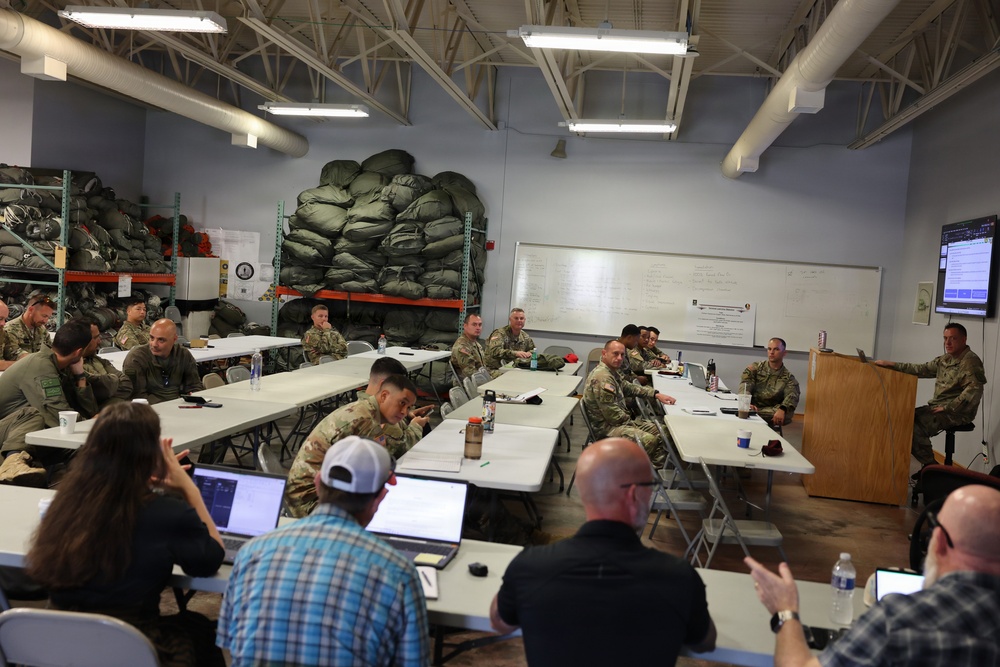
Photo By Dani Johnson | Aerial Delivery Readiness and Safety Team Member, Sgt. 1st Class Jesse Norris facilitates discussion during the 178th Airdrop Malfunction and Safety Analysis Review Board July 26-30 at Fort Lee, Va. The ADRST, U.S. Army Quartermaster School Aerial Delivery and Field Services Department, hosted the biannual safety forum designed to analyze aerial delivery and personnel parachute failures, detect equipment or training trends, and develop solutions to prevent future accidents. (U.S. Army photo by Dani Johnson) see less
| View Image Page
FORT LEE, Va. – The U.S. Army Quartermaster School Aerial Delivery and Field Services Department, Fort Lee, Virginia, hosted the 178th Airdrop Malfunction and Safety Analysis Review Board (AMSARB) from July 28-30 to improve aerial delivery operations and to increase battlefield lethality.
The AMSARB is a biannual Department of War-sanctioned safety forum designed to analyze aerial delivery and personnel parachute mishaps, detect equipment or training trends, and develop solutions to prevent future incidents.
“The AMSARB started in the late 60s, early 70s, and at that time was held four times a year,” said Frank Badalucco, director, ADRST. “Through advancements, we don't have to come to the table four times a year; it went to three times a year in the late 80s and 90s, and now with technology, we're doing it every six months.”
The primary goal of the board is safety, accident prevention and process improvement. It aims to determine the root cause of an air item not performing as designed or a method to improve operations for more effective and efficient aerial delivery.
The board brings together subject matter experts from across the globe to include enterprise partners which include: parachute riggers, loadmasters, foreign partners and allied nations, U.S. Army Combat Capabilities Development Command, Defense Logistics Agency, U.S. Army Tank-automotive and Armaments Command, safety centers from all Services, Defense Contract Management Agency quality assurance specialists, and equipment program managers across the Army, Navy, Air Force, Marine Corps, and Coast Guard. This board had representatives from Australia, Netherlands, Czech Republic, Israel, United Kingdom, Singapore, and Belgium, all who operate similar systems and as well as U.S. systems to foster interoperability.
“The primary reason for my visit is to have a look at safety systems and look at areas where alignment can be gained, where we can exchange information and ideas related to issues that occur within the Australian Defense Force and the United States military, as well as coalition partners, and prevent those incidents from reoccurring,” said Warrant Officer Class One Matthew Hawkins, Australian Defense Force. “We also look at the collaborative engagement of other nations to look at the capability piece and see how we can engage better and leverage off each other in order to provide maximum effects to sustain the forces.”
The Aerial Delivery Readiness and Safety Team (ADRST), led by Badalucco, goes out and inspects all the facilities in the field as well as hosting the AMSARB. “Throughout all the services and the enterprise everything aerial delivery comes here,” said Jason Hanifin, director, ADFSD. “Every business transaction with DLA, TACOM, safety centers come here, and then we synchronize efforts across the aerial delivery community.
Hanifin explained that ADFSD is more than an instructional facility as it has the Headquarters, Department of Army G4 proponent activity for aerial delivery which covers the DOTMLPFP (doctrine, organization, training, materiel, leadership and education, personnel, facilities, and policy) spectrum. As a result, ADFSD serves as the hub for everything from test and development through training and education to war time planning.
“The testing and development is done at the Special Operations Test Directorate at Fort Bragg, N.C., and if it's for free fall, it's down at Yuma Proving Grounds in Arizona,” Hanifin added.
ADFSD sends personnel out to be involved with the testing and development and bring the results back to ADFSD to speed along the technical manual production to get it into the hands of the riggers faster.
Whether in testing or operational, there's a requirement for all services that conduct aerial delivery operations, to report any mishap within five reporting days to the ADRST.
“We have our thumb on the pulse of what's going on out there, utilization rates and malfunctions, and we can get you know stand downs or the word out immediately if it's going to affect the field and if it's categorized as a catastrophic issue,” said Badalucco. “We can get notes out to the field and share lessons learned immediately, but we still like to come here and discuss which is why we still have the biannual in-person AMSARB. There are so many sidebar conversations that just lead to more solutions, techniques and updates.”
Every AMSARB has the goal of sharing information and reviewing every incident to develop a workable solution for the field. To accomplish this, preserving and reviewing evidence from any incident is key to the analysis portion of the forum. When a malfunction is investigated on the drop zone, the malfunction officer is strictly instructed never to untangle, twist, or unpack the parachute components. The physical evidence must remain exactly as it landed to preserve the scene for the technical SMEs who report back to the review board. By joint regulation, investigating an airdrop malfunction is given the highest priority, secondary only to administering medical aid to injured personnel. It supersedes all other aspects of the operation, including active ground tactical exercise play.
At the end of each review board, the Quartermaster commandant is briefed on the trends, analysis and findings and a report is sent to the entire Aerial Delivery Community as well as direct reports to the HQDA G-4 and the Army Airborne Board.