
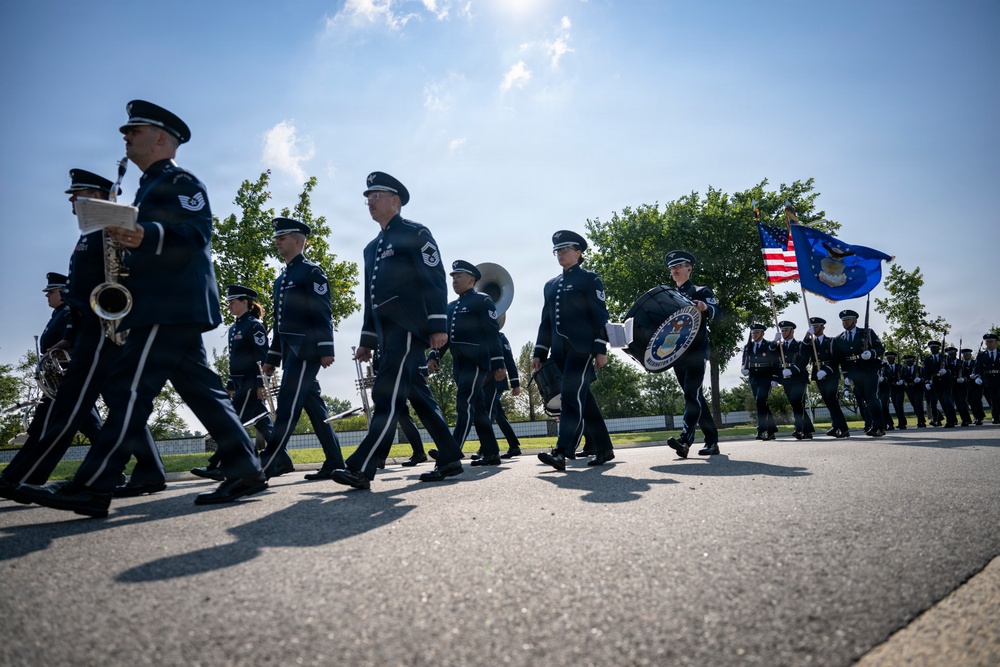
Photo By Elizabeth Fraser | Airmen from the U.S. Air Force Honor Guard, airmen from the U.S. Air Force Band’s...... read more read more
 Subscribe
Lorrie Stirm remembered when her father left home for Vietnam in 1966, but the entire country would remember when he returned home in 1973. Lorrie’s father, U.S. Air Force Maj. Robert “Bob” Stirm, was shot down over Hanoi, North Vietnam, on Oct. 27, 1967. He spent more than five years—1,966 days—as a prisoner of war.
Before Stirm left his home outside of San Francisco, he told his four children to listen to their mother and do well in school. Then he hugged nine-year-old Lorrie, eight-year-old Bo, six-year-old Roger and five-year-old Cynthia. “We didn’t understand the gravity of the situation,” Lorrie recalled.
On March 17, 1973, Lorrie, her mother, Loretta, and her siblings sat in an Air Force station wagon on the tarmac at Travis Air Force Base in California, waiting for an aircraft to arrive with their father and other Vietnam POWs. When the driver told the family they could get out, they jumped out of the station wagon and ran to Stirm. Fifteen-year-old Lorrie, in the lead, threw out her arms to hug her father. In that instant, Associated Press photographer Slava “Sal” Veder snapped a photograph that would appear in publications across the United States and win the 1974 Pulitzer Prize for photography. https://apnews.com/article/vietnam-pow-photo-family-homecoming-stirm-eb6c56f2f2259f0ae10cb782c927d5c8
On July 29, 2026, Lorrie (now Kitching), her surviving siblings and their families said goodbye to their father one last time at Arlington National Cemetery. Stirm, who retired from the Air Force as a colonel, passed away at the age of 92. Lorrie wore her father’s watch and a Vietnam POW/MIA bracelet to the service, while other family members wore POW lapel pins.
In Vietnam, Stirm was shot down by a surface-to-air missile while leading a flight of F-105 fighters. When his aircraft was hit, jet fuel streamed into his cockpit, burning most of his body. He hit the eject button, but his canopy jammed, forcing him to eject through the glass. His parachute opened, but the wind caused him to swing wildly. As he swung up, his parachute dropped, yanking him downward until it refilled with air. As he neared the ground, someone shot him in the neck.
The North Vietnamese quickly took Stirm prisoner, beginning his long captivity and torture in POW camps that included the infamous "Hanoi Hilton." After returning home, he rarely spoke about his ordeal.
Back in the United States, Loretta sat her children down and explained that their father had been shot down, but the Air Force was searching for him. To soften the distressing news, she took them to the Humane Society to adopt a dog, who subsequently helped the children cope with their father’s absence. Loretta joined the League of Wives, a support group for wives of POW/MIA service members that lobbied the U.S. and North Vietnamese governments for more information, better treatment of POWs and the return of their husbands. Over time, however, Lorrie remembered becoming numb to her father’s absence. “I didn’t feel in my heart that he would ever be released,” she said.
Thanks in part to the group's efforts, Stirm was able to write letters to his family in 1970. He wrote that they should not worry about him, and that he thought of them constantly and hoped to see them someday. It would be another three years until Stirm saw his family. He was released as part of “Operation Homecoming,” which repatriated 591 American POWs from Vietnam following the signing of the Paris Peace Accords in January 1973.
On Jan. 21, 1973, Lorrie was in a doughnut shop when the clerk asked her how wonderful it was that her father would be coming home. Lorrie was stunned. Three months later, she found herself running toward her father and embracing him. “I could feel the fabric of his uniform against my cheek,” she recalled, choking up. “To this day I feel that hug.” She could also feel her heart open. “I didn’t realize how much I had held back hope of that moment,” she added. “It’s like my heart was released and I was able to feel again. It was a glorious day.”
After returning home, Stirm chose to remain in the Air Force until 1977. Although his marriage to Loretta did not last, he remained close to his children. During his later years, he grew especially close to Lorrie. He told her that he wanted to be laid to rest at Arlington National Cemetery, with his former POW friends and comrades. “Arlington meant something to my dad,” Lorrie said.
Thefull military funeral honors with escort service in Section 57 included a caisson detachment,an Air Force band, a bugler, a rifle team and a bagpiper. U.S. Air Force Chaplain (Capt.) Kevin Pew stated that Stirm had survived his confinement and torture “by holding fast to a single creed: Return With Honor.” Pew called Stirm’s return “not only a national symbol, but a family miracle.”
When the service ended, Lorrie laid a red rose on her father’s casket and then placed her hand on it one last time, telling her father, “I love you, Dad. You’re a warrior.”
| Date Taken: | 07.29.2026 |
| Date Posted: | 07.29.2026 16:25 |
| Story ID: | 571046 |
| Location: | ARLINGTON, VIRGINIA, US |
| Hometown: | SAN MATEO, CALIFORNIA, US |
| Web Views: | 22 |
| Downloads: | 0 |

This work, Air Force Vietnam POW, Featured in Pulitzer Prize-Winning Photo, Laid to Rest at Arlington National Cemetery, must comply with the restrictions shown on https://www.dvidshub.net/about/copyright.


No keywords found.




