
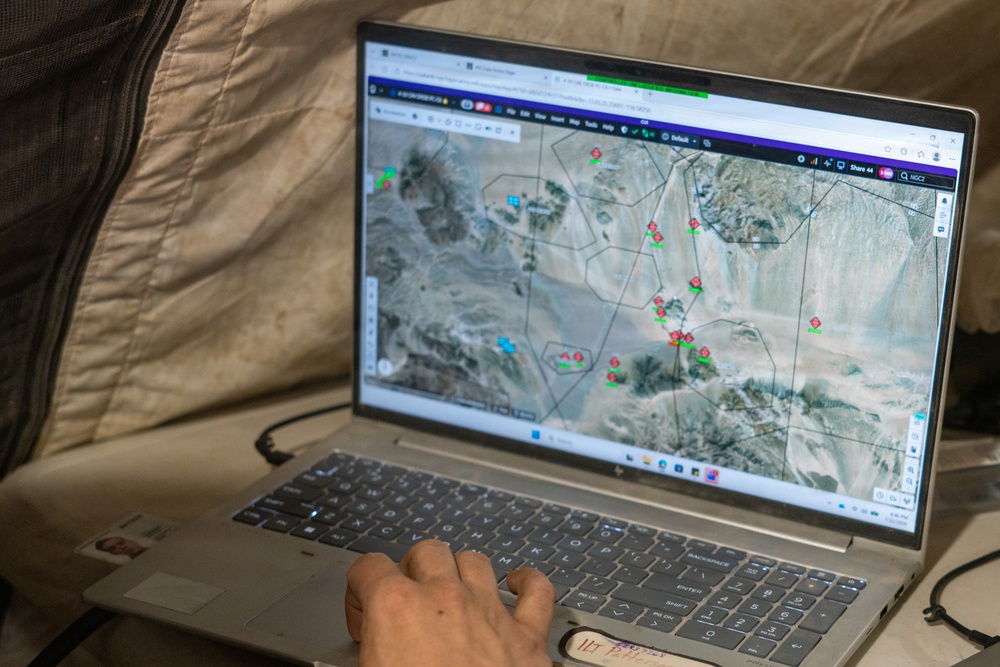
Photo By Staff Sgt. GERVONNI STRAUN | U.S. Army 2nd Lt. Kyle A. Frakes, assigned to 4th Squadron, 10th Cavalry Regiment, 1st...... read more read more
 Subscribe
FORT IRWIN, Calif. – Project Convergence Capstone 6 is defined by its live experimentation venue, providing a chance for the Army and its Joint and multinational allies to assess future warfighting concepts and emerging equipping options in a realistic combat-like environment. While much of the attention is focused on what unfolds in the live field, an equally critical effort takes place behind the scenes.
The Modeling and Simulations team for PC-C6 provided the simulated forces necessary for both friendly and enemy operations to stress-test and assess the effectiveness of emerging technologies and future warfighting capabilities.
The team was comprised of over 100 personnel from locations across the United States, including the Distributed Operations Center at Kirtland Air Force Base at Albuquerque, New Mexico; the Naval Information Warfare Center-Pacific at San Diego, California; the Marine Corps Warfighting Laboratoryat Cherry Point, North Carolina; the Joint Staff J7 at Suffolk, Virginia; the Tactical Software Integration Lab at Fort Bliss, Texas; and multiple Future Capability Directorates across the U.S. Army Futures and Concepts Command.
“The linchpin of all simulation operations we provide, however, are the personnel that comprise the U.S. Army Joint Modernization Command’s Multi-Domain Ops Simulations Center at Fort Bliss, Texas,”shared Lt. Col. Charles Timm, director of MDOSC and lead for PC-C6 simulations. “These people are the cream of the crop in terms of simulations professionals and are the most integral component of what we do and the world-class simulation support MDOSC provides.”
The FCC G-3/5/7 Models and Simulations Division was another supporting effort to the MDOSC simulations team, enabling the team from Fort Bliss through coordination with the Army organizations and the Joint Staff for the integration of the Joint Live Virtual Constructive Simulation Federation and other tools.
“This is one of the largest simulation-supported events the Army and its partners have executed, so I was here to provide another experienced voice or another point of view for simulation enterprise challenges,” said Lt. Col. Robert Prescott, Modeling and Simulations officer for FCC.
At PC-C6, MDOSC employed the Joint Live Virtual Constructive Simulation Federation, a U.S. Department of War architecture managed by the Joint Staff J7 that links live forces, human-operated virtual simulators, and computer-generated constructive models into a single, unified training environment for joint military exercises and experiments.
The PC-C6 Modeling and Simulations team, led by Timm, alongside Mr. Will Kilmer, deputy director of MDOSC, worked closely with the 11th Armored Cavalry Regiment “Blackhorse” on the ground to deliver dynamic, data-driven threat representation that would otherwise be impossible to replicate at scale. They also provided friendly operations, representing 4th Infantry Division's sister divisions as well as III Armored Corps assets.
The close coordination with 11th ACR, the Futures and Concepts Command’s Modeling and Simulations Division, the JMC’s simulation and G-2 teams, and U.S. Army Transformation and Training Command’s G-2 threat team enabled the PC-C6 simulations team to synchronize the strategic OPFOR fight, Timm said.
This collaborative effort ensured the PC-C6 simulations team could accurately represent the threats and complexities of Multi-Domain Operations to provide a realistic, combat-like environment that would effectively stress test the Next Generation Command and Control architecture.
According to Prescott, NGC2 is comprised of three main parts: a transportation layer that moves data securely and reliably; a data layer where information is stored, shared, and managed; and an application layer with the tools and systems that Soldiers use to do their jobs.
"The synthetic environment provided by MDOSC provides external data and stimulation that cannot be represented in the real world whether due to cost, availability, or experiment design,” Prescott explained. “Between 4ID, Blackhorse, and simulations, NGC2 experiences a close resemblance of the real-world data and information environment it must handle."
From there, over 100 operational assessors on the ground captured the results of these experiments, providing quantitative and qualitative data to help inform strategic level decisions.
“The best way simulation can support the stress testing of NGC2 is providing economical scale and scope of traffic on the network,” Timm explained. “The primary output for any simulation at the warfighter level is producing messages to replicate units at echelon and produce the appropriate level of traffic and act as a rheostat to increase as required.”
These messages helped inform the experiment’s data, which was then passed along by the operational assessors to the Table of Knowledge for analysis. The ToK was then able to provide informed feedback on the Acquisition Technical Readiness Level of the technologies being experimented with.
“We also utilize a large number of models to portray multi-domain operations to as high a fidelity as we can, without sacrificing system latency,” Timm said.
These computer-generated force systems helped the PC-C6 Modeling and Simulations team inform the warfighting functions and create a flexible and realistic synthetic environment for experimentation.
According to Timm, the Army is actively advancing its capabilities to simulate highly complex denied, degraded, intermittent, and limited network connectivity to provide even greater realism for combat-like scenarios.
With the MDOSC team already working on this effort alongside Cyber Future Capability Directorate, Timm is optimistic for the future, sharing that the two teams are looking at a number of different models to integrate, but the process takes time to ensure there are no undesired interactions between the models in use.
“There is a plan and we’re hopeful that by the next experiment we’ll be able to have a greater non-kinetic effects model integrated,” Timm said.
While live maneuvers may have captured much of the spotlight at PC-C6, the Modeling and Simulations team remained a vital part of the experiment. This seamless integration of virtual stress-testing and live-field assessment helped ensure the U.S. Army and its Joint and multinational allies and partners are prepared for the full complexities of a modern battlefield.
| Date Taken: | 07.29.2026 |
| Date Posted: | 07.29.2026 11:50 |
| Story ID: | 571002 |
| Location: | FORT IRWIN, US |
| Web Views: | 47 |
| Downloads: | 1 |

This work, Simulated threat environment pushes the Army's NGC2 network to its limits at PC-C6, by Nina Borgeson, identified by DVIDS, must comply with the restrictions shown on https://www.dvidshub.net/about/copyright.


No keywords found.




