ERDC-EL researchers join USACE New Orleans District-led Maurepas Swamp Project
Photo By Justus Reed |
A team of experts from ERDC-EL are supporting the New Orleans District in their River......read moreread more
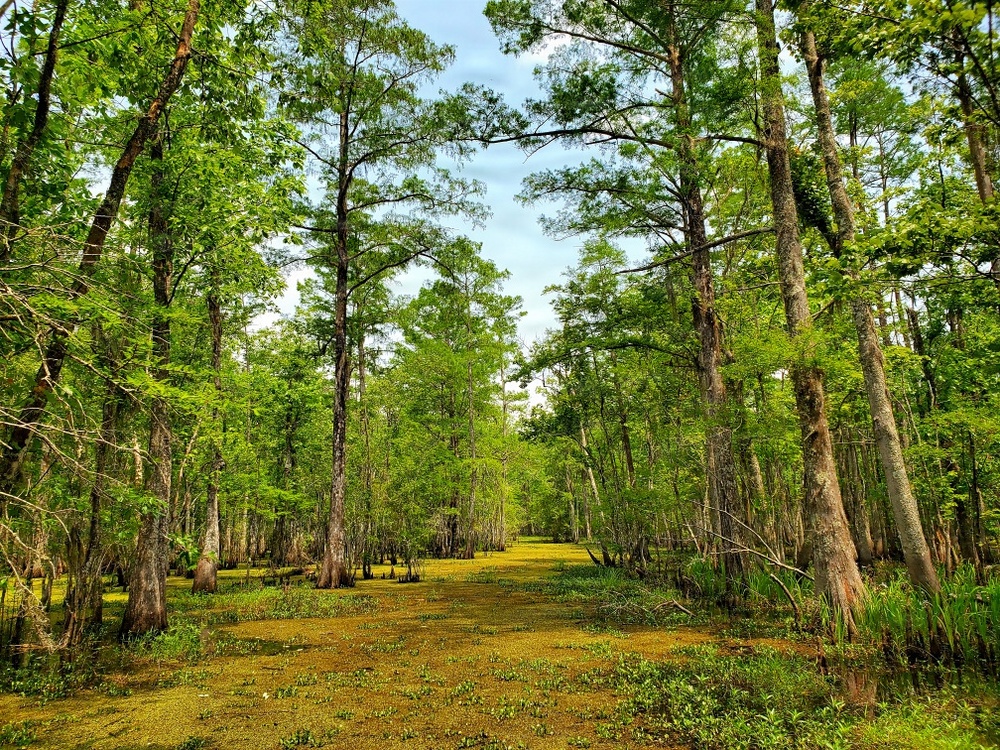
Photo By Justus Reed | A team of experts from ERDC-EL are supporting the New Orleans District in their River Reintroduction into Maurepas Swamp Project, an initiative that will divert freshwater from the Mississippi River back into the swamp through a 5.5-mile controlled-flow diversion and extend the swamp’s lifespan and habitat, providing benefit to approximately 45,000 acres within the swamp. The project aims to improve the cypress-tupelo swamp’s health by adding vital nutrients and flushing stagnant, low-oxygen water. (Photo Credit: Nathan Beane, senior research forester, ERDC EL) see less
| View Image Page
ERDC-EL researchers join USACE New Orleans District-led Maurepas Swamp Project
Laplace, Louisiana— Decades ago, Louisiana’s Maurepas Swamp’s freshwater supply was slowly cut off as levees were constructed along the Mississippi River, causing the Pelican State’s second-largest coastal forested wetland to suffer a significant decline in nutrients, oxygen, and sediment. Today, plans are underway to revitalize the swamp, as the U.S. Army Engineer Research and Development Center’s (ERDC) Environmental Laboratory (EL) is assisting the U.S. Army Corps of Engineers (USACE) New Orleans District and Louisiana Coastal Protection and Restoration Authority (CPRA) to reconnect the swamp with its riverine source.
A team of experts from ERDC-EL are supporting the New Orleans District in their River Reintroduction into Maurepas Swamp Project, an initiative that will divert freshwater from the Mississippi River back into the swamp through a 5.5-mile controlled-flow diversion and extend the swamp’s lifespan and habitat, providing benefit to approximately 45,000 acres within the swamp. The project aims to improve the cypress-tupelo swamp’s health by adding vital nutrients and flushing stagnant, low-oxygen water.
The ERDC team has played an integral role in developing the project's success criteria, and they collectively developed a 50-year monitoring plan to evaluate each phase. Leading the team is Nia Hurst, a research biologist for the lab’s Wetlands and Coastal Ecology Branch.
“The role of the ERDC team now is to help execute the Maurepas Swamp monitoring plan, which is designed to assess the outcomes of this project for the foreseeable future,” said Hurst. “We’ll be evaluating vegetation, water quality, and sedimentation outcomes resulting from this effort to ensure we’re documenting all outcomes and attaining the appropriate benefits.”
The swamp, located west of Lake Pontchartrain, is home to various wildlife species. It also has potential for many eco-tourism and recreational opportunities for locals and tourists – all promising features that inspire Hurst and her team’s mission to restore the swamp.
“Increasing the lifespan and productivity of the Maurepas Swamp allows it to provide critical economic, cultural, and ecological resources,” said Hurst. “The Maurepas Swamp is a wildlife management area that is open to the public. It’s often used for hunting, fishing, boating, hiking and bird watching, serving as a substantial economic and recreational resource for Louisiana. Additionally, the swamp provides an incredible habitat for wildlife while also serving as storm protection for surrounding areas, creating more resilient communities.”
Because the swamp is a staple for locals, the team will analyze data to enhance the swamp’s health, which will, over time, improve swamp-goers’ experience. Dr. Nathan Beane, a senior research forester, who serves as ERDC-EL’s Forest Ecosystem Dynamics (FED) team lead, strives to enhance forest integrity throughout the decades-long monitoring plan.
“We will annually evaluate forest health and condition to ensure enhancement for swamp forest areas that have been disconnected from riverine influence,” said Beane. “During annual evaluations, our team will assess forest conditions, such as diameter growth and tree health at established monitoring locations throughout the mitigation area. Also, non-destructive tree cores will be collected periodically throughout the 50-year monitoring plan to evaluate tree growth dynamics. The goal is to closely monitor forest health and condition across the life of the project.”
Several other environmental conditions will also be monitored and documented to analyze the swamp’s health. Dr. Andrew McQueen, a research biologist, detailed the team’s sampling measures.
“Sampling will be conducted before construction begins to document existing environmental conditions,” said McQueen. “Additional sampling will occur after the diversion begins operating and will continue periodically based on the monitoring results. If monitoring identifies chemical concentrations above expected or protective levels, more studies may be conducted to determine whether fish, wildlife, or other natural resources could be affected. Water, sediment, and selected wildlife samples will be collected to measure environmental conditions, track changes over time, and evaluate whether any observed chemical levels could pose a risk to natural resources.”
The team’s focus also includes creating a safe bypass system into the swamp to avoid pallid sturgeon entrainment, which occurs when fish are involuntarily swept out of their natural river or stream habitats. Dr. Todd Slack, an ERDC fisheries biologist, said that the fish will be monitored pre- and post-construction to ensure their safety.
“Our approach involves deploying an acoustic telemetry array in the river to assess movement of telemetry-tagged fishes, including pallid sturgeon, within the project area,” said Slack. “Following diversion construction, we will deploy a larger acoustic array that includes both main channel and diversion stations to evaluate movement of telemetry-tagged fishes from the Mississippi River proper into the Lake Maurepas System.”
Collaboration has been key to this project’s progression. Amy Dixon, project manager for the USACE New Orleans District, and Matthew Roe, public affairs specialist for the USACE New Orleans District, praised ERDC’s expert knowledge and skills applied to this project.
“ERDC has been an excellent partner,” said Dixon. “The experience and knowledge the ERDC team has for environmental areas is second to none. The team has been responsive and passionate while also being patient with the less technical team members.”
Roe added, “When the New Orleans District undertakes a project, we use all available resources to deliver results based on the best science and engineering practices. The collaboration between the district and ERDC on this project is a perfect example. The expertise ERDC brought to the project has been critical to ensuring this will benefit the people of South Louisiana.”

 Subscribe






