
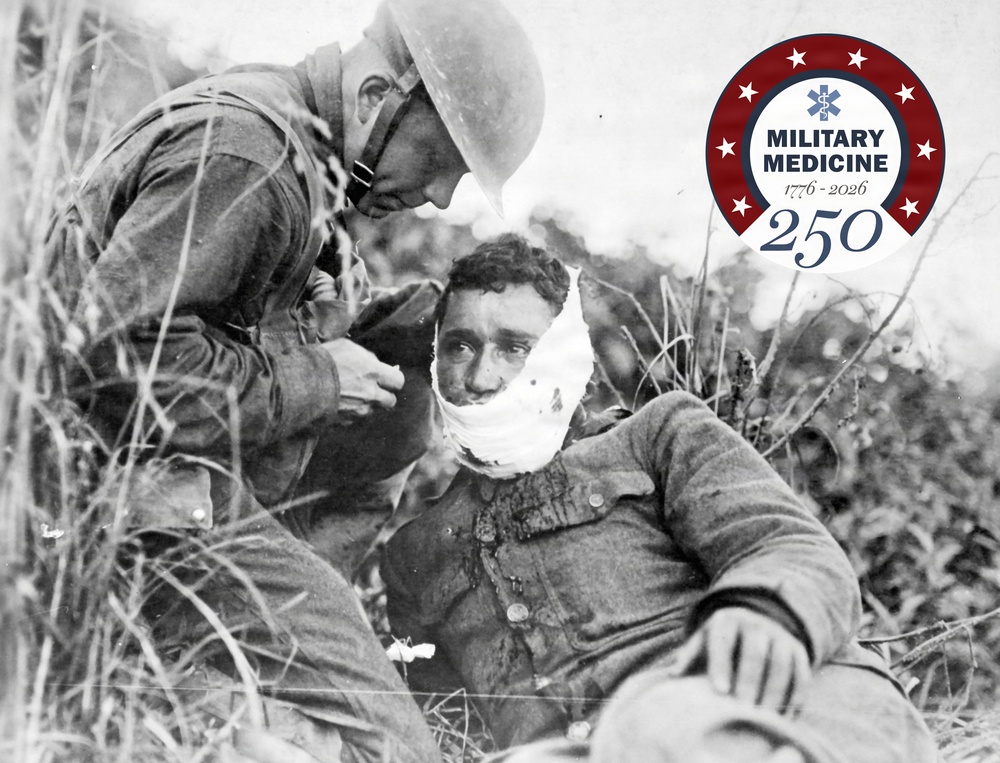
Photo By Robert Hammer | A U.S. Army soldier with Company K, 11Oth Regiment Infantry, receives medical...... read more read more
“This year, the Military Health System is celebrating 250 years of America by recognizing military medicine’s enduring history of innovation and impact to the warfighter. Please join the Military Medicine 250 campaign!”
A month after Archduke Franz Ferdinand was assassinated in Sarajevo, Austria-Hungary, Austria-Hungary declared war on Serbia, July 28, 1914 — beginning World War I. From 1917 to 1920, the United States mobilized over 4.7 million service members. Of those warfighters, 116,516 died from battle, accidents, or disease.
Medical care advancements and fierce battle defined the “war to end all wars,” but the stories of the medical personnel who faced the front lines to save lives paint portraits of perseverance, courage, and strength.
Among them, six courageous U.S. military medical professionals were awarded the Medal of Honor for lifesaving actions during World War I: Navy Cmdr. John Henry Balch, Navy Vice Adm. Joel T. Boone, Navy Pharmacist's Mate 3rd Class David Ephraim Hayden, Navy Vice Adm. Alexander Gordon Lyle, Navy Lt. j.g. Weedon Osborne, and Navy Lt. Orlando Henderson Petty.
Joining the U.S. Navy, May 26, 1917, Navy Pharmacist’s Mate 1st Class Balch was assigned to the 3rd Battalion, 6th Regiment of the U.S. Marine Corps. He saw action during the famed Battle of Belleau Wood and was later wounded in action but able to return to duty.
On July 19, 1918, Balch’s exhausted and battered regiment received orders to push an attack forward through a wheat field towards the Soissons-Chateau-Thierry highway. During a moment of fierce fighting, he left his aid station to treat the wounded and worked for 16 hours during machine-gun and artillery fire. On Oct. 5, 1918, at Somme-Py, he again showed exceptional bravery by setting up an advanced dressing station under heavy shellfire.
Balch received the Medal of Honor at a ceremony at Great Lakes Naval Station, presented by Navy Rear Adm. William A. Moffett. After leaving the service in 1919, Balch worked in retail and sales until obtaining a reserve commission as a Navy Supply Corps officer in 1942. He retired in 1950 as a commander.
Commissioned as a lieutenant junior grade in the U.S. Naval Reserve in April 1914, Boone transferred into the U.S. Navy before the war.
During the war, he was a surgeon with the 6th Regiment, U.S. Marines, near Vierzy, France, when “with absolute disregard for personal safety, ever conscious and mindful of the suffering fallen, Boone, leaving the shelter of a ravine, went forward onto the open field where there was no protection and despite the extreme enemy fire of all calibers, through a heavy mist of gas, applied dressings and first aid to wounded marines,” reads his Medal of Honor citation. When supplies ran out, Boone went back under heavy gunfire to replenish supplies and treat the wounded. He made a second trip on the same day under the same conditions.
Boone went on to become the physician for three presidents, including primary physician to President Herbert Hoover, and was responsible for formalizing the White House Medical Unit in the 1920s. The most highly decorated Navy medical officer in U.S. history, Boone received his Medal of Honor during a ceremony in 1919 by then-assistant secretary of the U.S. Navy, Franklin D. Roosevelt.
Navy Pharmacist's Mate 3rd Class David Ephraim Hayden
Hayden, a native of Florence, Texas, enlisted in the U.S. Navy in 1917.
While attached to the 2nd Battalion, 6th Marines in Thiaucourt, France, Sept. 15, 1918, Hayden was one of four corpsmen ordered to set up an aid station in the village of Xammes, France. Despite machine-gun fire and exploding shells, the men set out for their destination. When a young corporal was hit by enemy fire, Hayden grabbed his aid kit, and dodged bullets and exploding grenades to reach him. Realizing that his comrade’s wounds were very serious, he dressed them on the field during heavy fire, then carried the man back to safety.
Navy Vice Adm. Alexander Gordon Lyle
After graduating from Baltimore College of Dentistry in 1912, Lyle was commissioned in the U.S. Navy as an assistant dental surgeon on April 21, 1915.
Lyle was a dental officer attached to the 5th Regiment, U.S. Marines. During battle in the Verdun sector, a shell explosion seriously wounded a Marine. Lyle rushed through the bombardment and gave surgical aid that saved the Marine’s life. He later became the first dental officer in the armed services to become an admiral. In addition to the Medal of Honor, Lyle received the Silver Star with Oak Leaf Cluster, Commendation Ribbon, Italian War Cross, and other campaign medals. He is one of the first military dentists in history to receive the Medal of Honor.
A Chicago native, Osborne graduated from Northwestern University Dental School in 1915. He was appointed a U.S. Navy dental surgeon May 8, 1917.
Osborne was attached to the 6th Regiment, U.S. Marines. As Marines advanced on the town during the famed Battle of Belleau Wood on June 6, 1918, Osborne “immediately and selflessly began to rescue the wounded,” according to his Medal of Honor citation. In his attempt to carry a wounded officer to safety, an artillery shell killed both men. Osborne was the first commissioned U.S. Naval officer killed on land during the war, and the only dental corps officer to die in battle in that war.
He was posthumously awarded the Medal of Honor and the Distinguished Service Cross for his actions. Osborne was the first U.S. Navy casualty of World War I and is buried at Aisne-Marne American Cemetery in France. Osborne and Lyle hold the distinction as the first military dentists in history to receive the Medal of Honor.
Navy Lt. Orlando Henderson Petty
Petty, a graduate of Jefferson Medical College, was appointed assistant surgeon of the medical corps, U.S. Naval Reserve, and served with the 5th Regiment, U.S. Marines.
On June 11, 1918, Petty was stationed near the front lines in the town of Lucy-le-Bocage, France, when German artillery blasted the town, knocking Petty to the ground, tearing his gas mask, and destroying his dressing station. Despite this, according to this Medal of Honor citation, Petty continued treating the wounded and carried a wounded Marine to safety when the station was demolished. For his bravery that day, Petty was decorated with the Distinguished Service Cross, the French Croix de Guerre, and the Italian Croce di Guerra, in addition to the Medal of Honor. Petty was the first U.S. Navy medical reservist awarded the Medal of Honor.
The dedication of these six men established a legacy of valor, inspiring today's military medical personnel who serve with warfighters on the frontlines and in the trenches focused on saving lives.
Recommended Content:
| Date Taken: | 07.28.2026 |
| Date Posted: | 07.28.2026 16:08 |
| Story ID: | 570917 |
| Location: | US |
| Web Views: | 201 |
| Downloads: | 0 |

This work, Military medical heroes of World War I, by Robert Hammer, identified by DVIDS, must comply with the restrictions shown on https://www.dvidshub.net/about/copyright.


No keywords found.





