
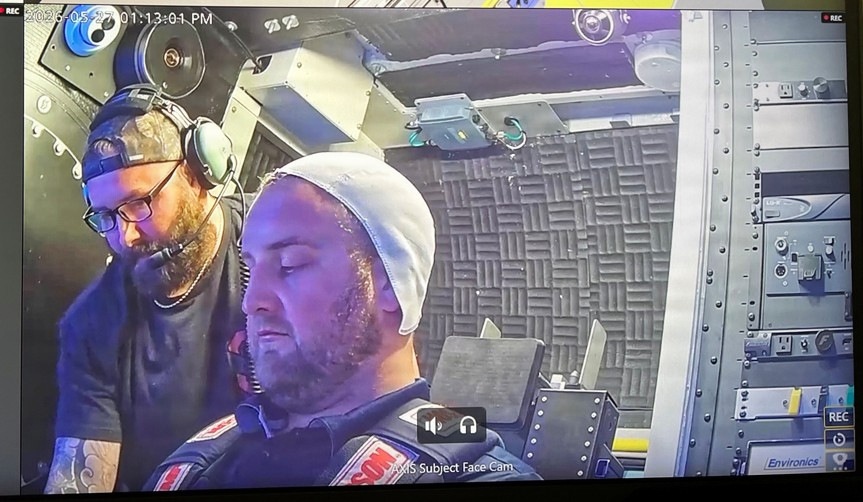
Photo By Zachary Wilson | NASA Human Landing System (HLS) training coordinator Sawyer Mitchell is secured into...... read more read more
Naval Medical Research Unit (NAMRU) Dayton was recently certified by NASA to unleash the Disorientation Research Device (DRD), commonly known as the "Kraken," as a research and training platform for the Artemis Human Landing System (HLS) Lunar Landing Skills curriculum.
“Recent operational testing validated an updated, Artemis-specific Kraken motion control algorithm tuned for multiple potential lander types,” said Rich Folga, the DRD program manager at NAMRU Dayton. “The enhanced simulation now features surface contact and landing gear models, as well as a fuel slosh model, ensuring training fidelity for future Artemis astronauts.”
NASA is working with two American companies to develop the human landing systems that will safely transport astronauts from lunar orbit to the Moon’s surface and back for future Artemis missions. NASA is targeting the first crewed lunar landing of the agency’s Artemis program in early 2028.
The certification marks the culmination of extensive engineering collaboration and rigorous testing, to include successfully integrating the co-located U.S. Air Force centrifuge with the Kraken’s large-field motion cueing. The application has grown out of collaborative research done with NASA to support the ongoing vestibular and sensory studies.
During future missions, astronauts will travel to lunar orbit, where two crew members will board a lander, descend to the Moon’s surface, and spend about a week living, working, and conducting science on the Moon before returning to lunar orbit to board their spacecraft, rejoin their rest of the crew, and return safely to Earth. To replicate the physiologic aspects of spaceflight and lunar descent, the research and training profile first subjects crews to a 60-minute, 3Gx centrifuge exposure, immediately followed by a series of closed-loop manual takeover and redesignation landing scenarios inside the Kraken.
“We are absolutely thrilled to be on board for this next chapter of space exploration,” said Capt. J. Russell Linderman, NAMRU Dayton's commanding officer. “Naval aviation medical research has a proud history of supporting spaceflight dating back to the late 1950’s and through the early days of the Mercury, Gemini and Apollo programs. To continue this legacy here at Wright-Patterson Air Force Base in Dayton, the home of the Wright Brothers and the birthplace of manned flight, adds a profound layer of historical significance as we help prepare the Artemis crews for the moon.”
The DRD is housed in a globally unique, state-of-the-art facility and the Kraken itself is capable of simultaneous motion across six degrees of freedom, combined with planetary (continuous) rotation. Unlike traditional flight simulators, the Kraken boasts a massive motion envelope that can create motion perceptions inherent to spaceflight. This expansive movement capability makes it exceptionally well suited for lunar landing training: this includes aspects of gravitational transitions pilots will face during their final descent and touchdown forces expected on the lunar surface.
NAMRU Dayton is key part of Navy Medicine Research and Development (NMR&D), a global collective of eight commands, conducts research in support of Navy, Marine Corps and joint U.S. warfighter health, readiness and lethality, across a broad spectrum of activity from basic science in the laboratory to field studies in austere and remote areas of the world to investigations in operational environments. NMR&D researches infectious diseases, biological warfare detection and defense, combat casualty care, environmental health concerns, directed energy health effects, aerospace and undersea medicine, medical modeling, simulation, operational mission support, epidemiology and behavioral sciences.
| Date Taken: | 07.28.2026 |
| Date Posted: | 07.28.2026 14:14 |
| Story ID: | 570891 |
| Location: | WRIGHT-PATTERSON AIR FORCE BASE, US |
| Web Views: | 490 |
| Downloads: | 0 |

This work, NAMRU Dayton’s "Kraken" Certified as Training Platform for Artemis Lunar Missions, by Zachary Wilson, identified by DVIDS, must comply with the restrictions shown on https://www.dvidshub.net/about/copyright.

No keywords found.





