
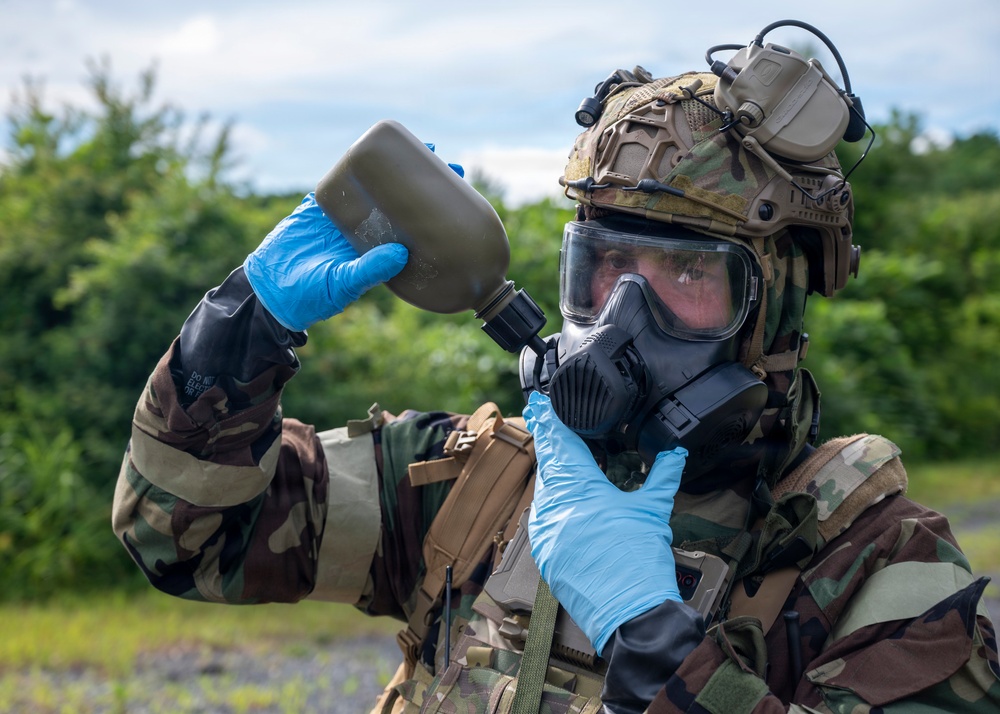
Photo By Senior Airman Kyle Blackham | U.S. Air Force Master Sgt. Timothy Hughes, an emergency management superintendent...... read more read more
 Subscribe
MISAWA AIR BASE, Japan — Emergency management Airmen from five Air National Guard units completed Exercise Serow Samurai, a seven-day deployment for training at Misawa Air Base, Japan, focused on chemical, biological, radiological and nuclear response capabilities, command and control, field reconnaissance, munitions sampling and decontamination operations.
Airmen from the 151st Wing, Utah Air National Guard; 133rd Airlift Wing, Minnesota Air National Guard; 179th Cyberspace Wing, Ohio Air National Guard; 121st Air Refueling Wing, Ohio Air National Guard; and 163rd Civil Engineer Squadron, California Air National Guard, participated in the training. The exercise brought emergency management professionals together to test updated procedures, use emerging response technologies and strengthen relationships with one another and the active-duty force at Misawa.
The training culminated in a 28-hour continuous-operations capstone exercise built around a simulated CBRN incident near a critical flightline facility. In the scenario, base defense forces reported a small drone crash involving an unexploded improvised munition leaking an unknown liquid and emitting a suspicious vapor. The Emergency Operations Center activated the CBRN Control Center to assess the threat, build a common operating picture, run hazard models and deploy a four-person response team to investigate, collect samples and identify the notional hazard.
Exercise Serow Samurai used a hub-and-spoke model to connect the EOC with Airmen operating in the field. The EOC served as the hub, using systems such as C2IMERA and CBRN Information System to track hazards, plot data and direct response actions. The four-person CBRN response team served as the spoke, conducting dismounted reconnaissance and surveillance, reporting through Android Tactical Assault Kit and carrying out munitions sampling and decontamination procedures.
The exercise was designed to move beyond basic familiarization. Airmen were evaluated on their ability to communicate under pressure, verify conflicting information, protect samples from environmental contamination, maintain chain of custody, prevent cross-contamination during decontamination and adapt when equipment, weather or operating conditions changed.
“We want Airmen to become more confident reading operations orders and fragmentary orders so they can conduct CBRN reconnaissance missions if they’re tasked to do so,” said Master Sgt. Kenneth Church, installation emergency manager assigned to the 151st Wing.
For the 151st Wing, the deployment also continued a growing relationship with the 35th Fighter Wing. This marked the second consecutive year Utah Air National Guard emergency management Airmen trained at Misawa, giving the unit another opportunity to operate alongside the host installation while building familiarity with the region, climate and mission environment.
That regional familiarity was one of the major benefits of the exercise. Last year’s training at Misawa took place during snowy March conditions. Serow Samurai placed Airmen in hot, humid weather, forcing them to account for how the environment affects both personnel and equipment.
“Our equipment performs differently depending on the environment, and that’s something Airmen have to experience firsthand,” said Master Sgt. Dan Saldivar, emergency management specialist assigned to the 151st Wing. “Here they’re learning how humidity affects both their equipment and themselves, and they’re developing workarounds so they can still accomplish the mission.”
Training in Japan added realism that cannot be fully replicated at home station. Airmen had to work through the friction of operating in a different country, integrating with another installation and adjusting to conditions common across parts of the Indo-Pacific region.
“Coming to Japan adds additional costs and challenges, but it’s worth it because this is where we expect to operate if called upon,” Saldivar said. “Training in the same climate and terrain we’ll likely face helps us understand our equipment, our limitations and how to prepare ourselves before it truly matters.”
A major focus of the exercise was the four-person response team concept. Instead of relying on larger 12-person teams, Airmen practiced operating in smaller teams with clearer roles and responsibilities. The concept is intended to simplify execution and help teams move, communicate and make decisions more effectively during CBRN response missions.
That structure became especially important during expedient personnel decontamination system training. Airmen practiced establishing a controlled site where potentially contaminated personnel could be processed safely. The process required teams to remove Mission-Oriented Protective Posture gear in a deliberate way, cutting and removing garments while preventing contamination from spreading to clean areas or personnel.
The exercise also tested how teams collected and handled simulated munitions samples. Airmen practiced labeling sample layers, completing DD Form 3108 and maintaining chain-of-custody procedures. Evaluators also introduced complications, including simulated heavy rain and damaged containment materials, to force Airmen to protect evidence, recognize problems and adjust their procedures before the sample was compromised.
Detection training required Airmen to rely on more than one tool or reading. Teams used paper-based detection methods, electronic detectors and handheld analyzers to assess unknown substances. When presented with conflicting results, Airmen had to verify equipment functionality, compare multiple data points and relay a reasoned assessment back to the EOC.
The technology used during the exercise gave Airmen practical experience with systems they may use during future response operations. ATAK allowed team members to view and pin coordinates, track movement and communicate information between the field and command-and-control elements. The Joint Chemical Agent Detector helped identify the possible presence of chemical agents. The ResQ handheld analyzer allowed Airmen to analyze unknown substances using a library of more than 12,000 organic and inorganic materials. Airmen also trained with the Handheld Assay, which analyzes swab samples to detect potential biological agents through a colorimetric result.
Inside the EOC, Airmen worked through the command-and-control side of the response. The CBRN Control Center managed information from the field, built reports for commanders and coordinated with other base response functions. During injects involving simulated unauthorized personnel near the cordon, the EOC had to coordinate with security forces and public affairs while continuing to manage the response team in the field. That coordination reflected one of the broader goals of the deployment: preparing Airmen to integrate quickly and effectively when they arrive at another installation.
“The Air National Guard is a force multiplier for the active-duty Air Force, so we want to be an asset and not a liability when we deploy alongside them,” Master Sgt. Church said. “Training here in Japan also exposes Airmen to an operational environment outside the United States and helps them overcome the challenges that come with integrating into another installation while preparing for missions they may one day perform in the Indo-Pacific.”
The deployment also strengthened relationships across the emergency management career field. With about 1,500 Total Force members, emergency management is a small specialty where professional relationships can directly affect mission execution. Exercises like Serow Samurai give Airmen from different states a chance to train together before they are called to respond together.
For participating Airmen, the value of the exercise came from connecting technical tasks to real response decisions. Reading orders, operating detection equipment, building reports, plotting hazards, collecting samples and processing decontamination lines all contributed to the same mission: giving commanders accurate information while protecting personnel and preserving mission capability.
By training through a realistic CBRN scenario at Misawa, Airmen strengthened the skills needed to operate in complex environments, communicate across response functions and support the active-duty force during potential operations in the Indo-Pacific region.
| Date Taken: | 07.20.2026 |
| Date Posted: | 07.25.2026 02:36 |
| Story ID: | 570719 |
| Location: | JP |
| Web Views: | 400 |
| Downloads: | 0 |

This work, Exercise Serow Samurai strengthens CBRN response readiness at Misawa Air Base, by SrA Kyle Blackham, identified by DVIDS, must comply with the restrictions shown on https://www.dvidshub.net/about/copyright.


No keywords found.




