
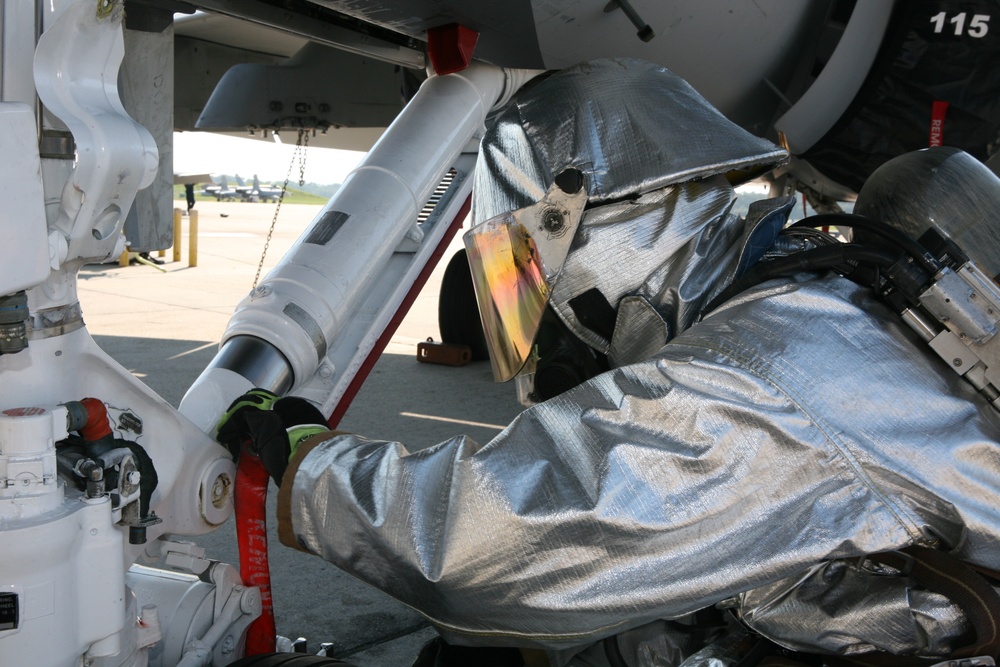
Photo By Cpl. Joshua Pettway | Lance Cpl. Jason McMannis, a turret operator with Headquarters and Headquarters...... read more read more
 Subscribe
MARINE CORPS AIR STATION BEAUFORT , S.C. - The Marines of Aircraft Rescue and Firefighting are vigilant in their duties and have a constant team available to respond to potential aircraft emergencies. Hot Spot, a team comprised of four Marines, is always on call.
“Hot Spot is always on standby and the group of Marines it’s comprised of rotates every two hours,” said Sgt. Ty Crittenden, the ARFF senior rescue man with Headquarters and Headquarters Squadron. “Each of the four Marines has different duties they must fulfill when responding to emergencies. The four roles are comprised of the driver, rescue man, turret and headline.”
When an emergency call comes in, Hot Spot quickly puts on all their gear complete with air tanks, suits and masks before proceeding to the scene.
“Everyone must be able to do a Bunker Gear drill in no more than two minutes, which consists of us putting on all of our equipment and being ready to head out,” said Crittenden. “A response force also has to be on the scene within five minutes of receiving the call, making every second precious.”
Because the Marines must all make sure they are prepared to react suddenly, they time themselves regularly to monitor how quickly they can don their gear.
“All of the training and preparation helps us better ourselves and is something we can take with us outside of the Corps,” said Lance Cpl. Dorian Conrad, a dispatcher with H&HS. “There are a lot of civilian firefighters in the area that were once members of ARFF. A lot of them apply what they’ve learned to what they do now.”
After approaching a burning aircraft, Hot Spot executes a “Bump and Roll” which consists of the P-19 emergency response vehicle moving toward the aircraft while the turret sprays water to reduce the flames. Dousing 90 percent of the flames is the turret’s primary job.
The headline then exits to clear a direct path for the rescueman, who evacuates anyone in the aircraft. If no one is at risk, the rescueman reduces the smaller fires near the incident.
In the case of a fire emergency, the driver keeps communication up between the aircraft crew by using hand and arms signals, according to Conrad. Hot Spot stays on the scene until the emergency subsides making them one of the first and last groups on the scene.
“Every situation we deal with can be dangerous, even during training,” Conrad said. “So during an emergency - when anything could go wrong - we must react quickly.”
| Date Taken: | 09.27.2010 |
| Date Posted: | 09.27.2010 10:18 |
| Story ID: | 57068 |
| Location: | MARINE CORPS AIR STATION BEAUFORT, SOUTH CAROLINA, US |
| Web Views: | 73 |
| Downloads: | 4 |

This work, Hot Spot, by Cpl Joshua Pettway, identified by DVIDS, must comply with the restrictions shown on https://www.dvidshub.net/about/copyright.

No keywords found.




