
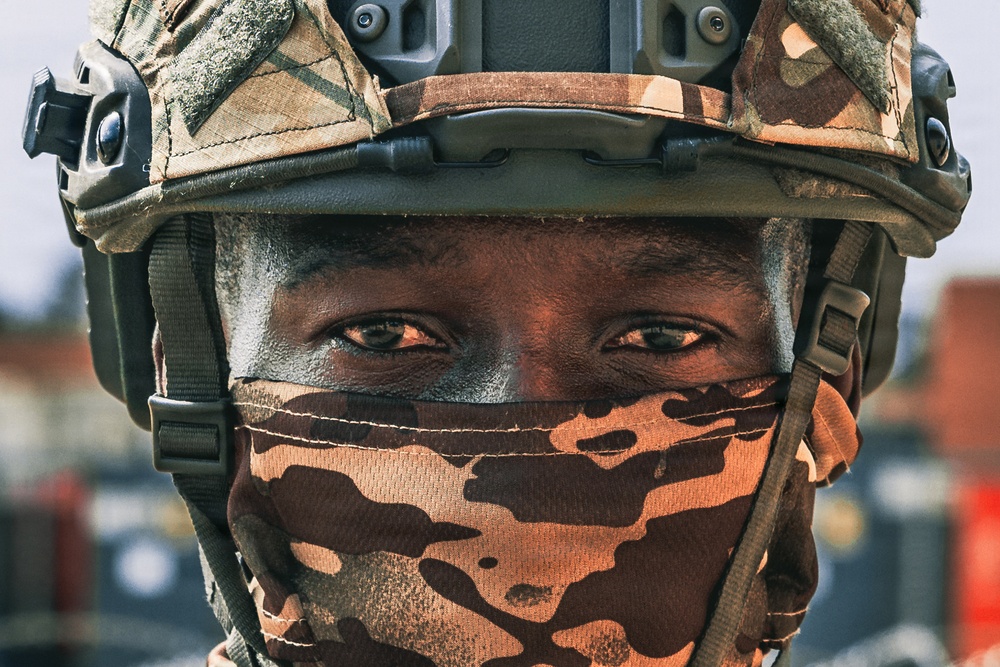
Photo By Staff Sgt. Austin Baker | An Ivorian special operations Soldier poses for a photo during exercise Flintlock 26...... read more read more
 Subscribe
FORT BRAGG, N.C. — If you listen to the briefings, you’d think international partnerships are only built around a formal table and greeting with formal handshakes. On the ground, in the dense heat of Côte d'Ivoire, we built them with a worn-out soccer ball, a makeshift goal made out of two cinderblocks, and a patch of deep red dirt.
That patch of dirt is where I earned the callsign "Mohammed Mustache."
After a long day of training, I found myself playing a pickup game of soccer with a mix of Tunisian and Moroccan special operations soldiers and sailors. I had actually spent some time on vacation in Morocco a few years back, so I already had a feel for the culture and the rhythm of how they live and operate. Curious why three of them shared the same name, I asked them about it after we scored the game-winning goal. They told me that back home, the first-born son is traditionally named Mohammed. Looking at my face, they put two and two together, and the nickname stuck. It was a running joke, but I found it to be an icebreaker. Out in the West African heat, we didn't need a translator. We just laughed, and that was enough.
For over two decades, Exercise Flintlock 26 is U.S. Special Operations Command Africa’s (SOCAFRICA) premier annual training exercise. In a region heavily impacted by violent extremism, Flintlock serves as a key exercise to execute multilateral training on staff planning, military and civilian integration, and tactical skills to counter the violent extremist organizations the relentlessly threaten regional stability. While the exercise focused heavily on multilateral training and tactical skills, behind the scenes, you quickly realize that strategic partnerships do not always take shape on a PowerPoint slide or on the other side of a conference table. Some of the most crucial trust-building happens when you drop the formalities and connect through everyday life.
We saw that everywhere in the hot, dusty environment. Amidst the warm smells of the dining facility and the sight of dozens of soldiers in different uniforms, the traditional velcro shoulder patches were constantly changing hands across the camp. Every time you ripped a patch off your uniform and handed it to a guy from a different country, you were shaking hands on a shared experience. We traded more than just unit logos; sometimes that meant sharing our cultural pastimes.
One afternoon, I grabbed my baseball gloves and invited a few Ivorian special forces soldiers to take up America’s pastime. Watching Côte d'Ivoire’s elite special operations Soldiers from the other side of the world, with whom I didn’t speak the same language, grasp the mechanics of an American backyard game was a unique way to build mutual respect and a was a surreal experience.
That connection wasn't limited to the guys wearing flags on their shoulders. I spent a lot of time getting to know a few of the locally employed Ghanaian staff supporting hundreds of special operators living on the Ivorian camp. I met one of the staff late at night while I was exercising with a makeshift barbell following a long day of training. It was just something to take my mind off work for a brief period of time. It was nothing more than a metal pole with water bottles duct-taped to the ends. I saw him watching me lift this makeshift piece of equipment, so I called him over to jump in. His crew busted out laughing, but he stepped in and started lifting. Finding common ground over a duct-taped barbell was an unorthodox way to build camaraderie, but we talked every day thereafter. He eventually surprised me with a gift of fresh bread and a yogurt-based drink left on my cot. Before we flew out, I dug through my bags and gave him a couple of my extra T-shirts, a small token of thanks.
Around the same time, as I was heading for my evening meal, I connected with another staff member outside the DFAC using a similarly unconventional icebreaker. Shooting a balled-up paper towel at the trash can, I yelled, "Kobe!" Without missing a beat, he yelled back, "Curry!" Arguing over NBA players became part of my nightly routine with "Mr. Curry." It was not a formal exchange. It was just two guys bonding over a shared passion for basketball.
Once the ice was broken, those partnerships I forged were cemented through the universal, unconventional language of food.
As the exercise continued, I was starting to build a relationship with the Tunisians when they pulled me into their circle one afternoon. A small group of us sat together on a few well-organized but dusty cots outside their barracks, taking a break from the relentless heat that beat down. Unbeknownst to me, they offered some food that they had prepared using a few items purchased from a local market. We ate a mix of tuna, bread, and harissa off a shared paper plate. What started as a simple gesture made the meal taste like a five-star dinner.
The Nigerians took that same concept to another level. One evening, near the conclusion of the exercise, a group of Nigerian operators pooled their cash together, bought a goat from a nearby village and butchered it in a small clearing outside of the training area. After hours of preparations and cooking, they invited me to share a meal. As I was sitting there in the smoke, eating freshly cooked goat with our Nigerian counterparts, I realized that this is what "interoperability" really looks like from the ground up. It’s a different kind of partnership that you do not get by reading books and manuals or sitting through a presentation. It wasn't some formal diplomatic exchange; we were just a few guys from opposite sides of the world connecting over everyday life.
During the exercise, we scheduled an engagement with nine student journalists from Côte d’Ivoire’s premier civilian communications school, the Institut des Sciences et Techniques de la Communication (ISTC) Polytechnique. As a military journalist, the objective was to facilitate a media exchange and give these budding Ivorian journalists a firsthand look at how Flintlock 26 was building multinational interoperability. However, the most valuable connection happened when the cameras went down and we sat together for a mentorship exchange. One young woman we spoke to wanted to become a combat correspondent to give a voice to people caught in conflict. Understandably, she was driven by her experiences of having to flee from gunfire alongside her mother and baby brother during the 2011 Ivorian civil war. Connecting with these students over a shared passion for journalism and hearing the raw, uncensored trauma driving their ambition was an incredible way to build empathy and mutual respect. We were not just showing them military training; we were proving that our militaries were there to support a future where they could safely tell those stories.
Some of the most profound test of Flintlock's strategic goals happened away from the military camps entirely. The official exercise mandate specifically calls for "building public trust," which our team put to the test. In a rural village on the outskirts of the nation’s capital, at a small primary school filled with hundreds of school-aged children, we attended an engagement that saw members of the U.S. and Ivorian military show support for the future leaders of Côte d'Ivoire. While we were initially there to capture the event, despite being infatuated with our cameras, I noticed something on the face of the many of the young Ivorian children. It seemed apparent that many of the local children were visibly timid around anyone wearing military uniforms. Then it occurred to me; our presence was likely the only time that these children have ever seen the U.S. military. Simply being present was not enough to break that initial tension.
Then, local music started playing over a speaker. Shortly after, I stepped up and started dancing with one of the students.
The atmosphere instantly shifted. The next thing I knew, a schoolteacher pulled me into the center of the yard to dance to their music in front of hundreds of school students, teachers, and community leaders. We connected with the community that day. We navigated that relationship through the universal joy of a dance.
When we finally packed up our gear and flew out, we left with a deeper understanding of our partners. But the real takeaway from Flintlock 26 was the realization that the strongest partnerships are built in unconventional ways. They are built on cinderblock goals, a duct-taped barbell, the taste of harissa, the smoke from a Nigerian goat roast, a dance in a rural schoolyard, and a nickname I will never forget.
I went to Côte d'Ivoire to document partner forces. I came home having served with brothers.
"Views/recommendations expressed in this paper are those of the author(s) and do not represent an official position of the Department of War, the Army, or the U.S. Government."
| Date Taken: | 07.21.2026 |
| Date Posted: | 07.24.2026 14:39 |
| Story ID: | 570676 |
| Location: | FORT BRAGG, NORTH CAROLINA, US |
| Web Views: | 207 |
| Downloads: | 0 |

This work, The faces of Flintlock 26: Navigating international partnerships through unconventional means, by SSG Austin Baker, identified by DVIDS, must comply with the restrictions shown on https://www.dvidshub.net/about/copyright.


No keywords found.




