
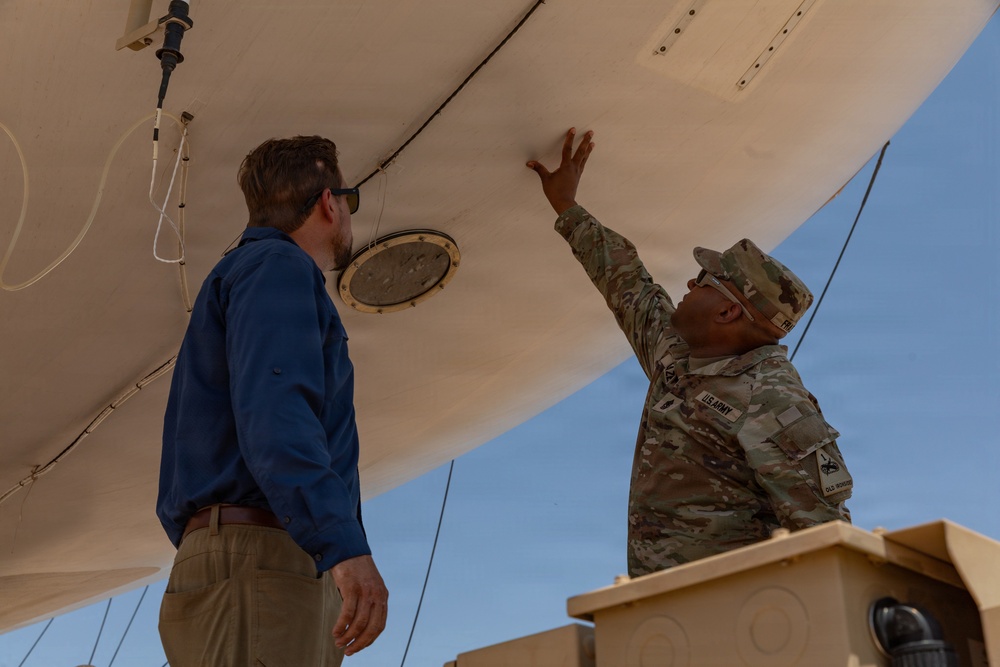
Photo By Kay Edwards | From, left, Joshua Block, tactical operations lead with Product Lead Reconnaissance,...... read more read more
 Subscribe
Through a collaborative effort between government and industry partners, the Product Lead Reconnaissance, Intelligence, Sensors, and Effects (PL RISE) rapidly installed and validated critical observation capabilities to support aerostats at a U.S. Border Patrol (USBP) site, significantly accelerating the operational timeline for enhanced aerial monitoring along the southern border.
Aerostats offer expansive, long‑duration coverage in remote locations. Their onboard sensors provide constant monitoring feeds, and their wide‑area detection capability alerts commanders to movement, supporting faster and more informed decision‑making.
Under standard doctrine, a brigade combat team manages a 3–9 mile battlespace. Along the southern border, that span increases exponentially to over 100 times greater, resulting in a substantial manpower challenge. Utilizing aerostats reduces overall manpower requirements while providing situational awareness and increasing the maneuverability of the 2nd Brigade Combat Team, 1st Armored Division, a unit under Joint Task Force – Southern Border (JTF-SB) supporting the USBP Tucson, El Paso and Big Bend Sectors, without compromising organic coverage elsewhere.
“The aerostats have been force-multipliers for us in the southern border mission, allowing our soldiers to actively monitor illegal aliens who crossed into United States territory until they were apprehended by USBP agents while also serving as an important deterrent against facilitators operating south of the border,” said U.S. Army Capt. Vincent Adelizzio, the collection manager of the 2nd Brigade Combat Team. “For every aerostat employed, we are significantly improving U.S. Border Patrol agents’ and deployed soldiers’ ability to monitor the southern border, minimize dead space, and provide a stronger deterrent against illegal crossings and criminal activity."
To further realize resource efficiencies and address operational requirements, the PL Rise team successfully installed the Persistent Surveillance and Dissemination System of Systems (PSDS2) and integrated the capability into Lattice, a command-and-control network that fuses multiple data streams to foster a common operating picture. PSDS2 oversees sensor operations and integrates seamlessly with Lattice, strengthening both situational understanding and decision‑making processes. The effort enabled full-motion video and data collected from the aerostat system to be disseminated to users supporting the southern border mission.
Integrating aerostat feeds into the Lattice network addressed an operational requirement to make monitoring and observation data available not only at the aerostat site, but also to authorized personnel operating remotely. Through integration, video feeds can now be disseminated across the Department of Homeland Security’s internal network, allowing cleared personnel to access information from multiple locations.
The capability provides operators and decision-makers with faster access to monitoring and observation data, enabling quicker reactions, improved guidance and tasking, and reduced response times for USBP agents operating on the ground.
The sensor feed is continuously displayed in the tactical operations center to provide commanders, staff, and operators awareness of what is happening along the southern border. Access to live streams provides a contingency capability if local aerostat ground station communication fails and USBP is unable to locally connect.
“The addition of aerostat camera feeds directly into the Lattice interface greatly enhances our situational understanding of the area of operations and increases our ability to address detections with USBP,” said U.S. Army Maj. Kevin Stafford, the intelligence chief of the 130th Maneuver Enhancement Brigade, a North Carolina Army National Guard unit assigned to JTF-SB that supports the USBP Del Rio, Laredo and Rio Grande Valley Sectors.
The installation, integration and validation effort was originally projected to take approximately one week per aerostat system, which was reduced to less than three days for the first system. The accelerated timeline was made possible through extensive coordination and preparation among PL RISE and industry partners. Prior to the installation, PL RISE coordinated the shipment of equipment to the site and synchronized the arrival of installation teams to ensure work could proceed without delay.
“Because this was the first installation, we intentionally planned for additional time and resources,” said Joseph Flores, PL RISE logistics manager. “By coordinating equipment deliveries in advance and staggering the arrival of installation teams based on installation dependencies, we were able to significantly reduce the amount of time on site.”
The success of the initial integration effort is expected to accelerate future installations across additional designated sites. The team's approach of shipping equipment in advance, staggering installation schedules and building additional time into the plan for troubleshooting has established a repeatable framework for future integrations.
| Date Taken: | 07.07.2026 |
| Date Posted: | 07.22.2026 10:35 |
| Story ID: | 570485 |
| Location: | US |
| Web Views: | 106 |
| Downloads: | 0 |

This work, Rapid integration effort enhances monitoring capabilities for southern border security in record time, by Kay Edwards, identified by DVIDS, must comply with the restrictions shown on https://www.dvidshub.net/about/copyright.


No keywords found.




