
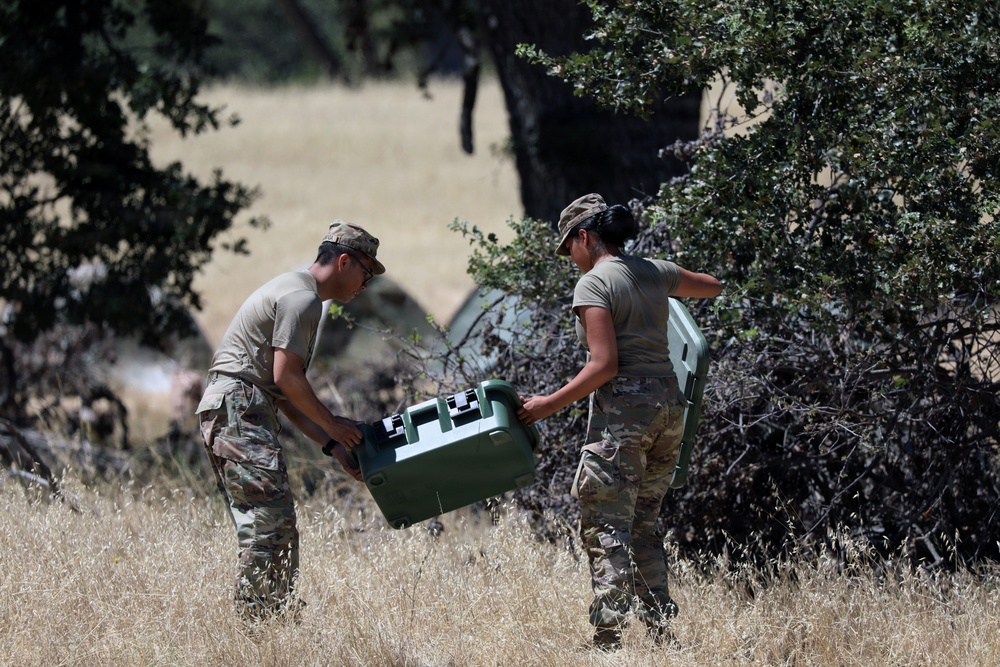
Photo By Sgt. 1st Class Rodney Roldan | U.S. Army Reserve Spc. Arnold Barroga and Pfc. Amy Belman, both culinary specialists...... read more read more
 Subscribe
FORT HUNTER LIGGETT, Calif. — Long before the first formations gather each morning, Soldiers assigned to the U.S. Army Reserve's 880th Quartermaster Company are already hard at work. While Operation Bold Eagle 26 focuses on tactical maneuvers, mission command, and large-scale combat operations, the field feeding company is ensuring one of the most essential elements of mission success never stops: feeding the force.
Bold Eagle is a premier multi-echelon training exercise, providing mission command for 74 units and more than 3,300 Soldiers. It combines a combat support training exercise and Global Medic, an international military medical training exercise, to prepare Army Reserve forces for large scale combat operations in a demanding multi-domain operational environment.
For the 880th Quartermaster Company, headquartered in Los Alamitos, California, the mission extends well beyond preparing meals. As a field feeding company, the unit is simultaneously evaluated on its mission essential task list while providing real-world support to thousands of Soldiers across the training area.
"We are coming down here for a dual purpose," said 1st Sgt. Katelyn Pitts, first sergeant of the 880th Quartermaster Company. "We are being evaluated on our METLs, as well as providing real-world support. We are kind of balancing those requirements while making sure Soldiers receive the meals they need. Food plays a huge role in motivation and morale."
Unlike many units operating from a single location, the 880th Quartermaster Company was dispersed across multiple feeding sites throughout Fort Hunter Liggett. The distributed mission presented unique leadership and logistical challenges, requiring continuous coordination while maintaining consistent food service standards.
"Our unit is divided into multiple sites," Pitts explained. "Most units have everyone together, which makes communication much easier. For us, maintaining communication and coordination across several locations has been one of our biggest challenges. It's been difficult at times, but it's manageable."
The dispersed environment mirrored the realities of modern sustainment operations, where Army Reserve units must remain flexible while supporting widely separated formations operating across an expansive battlefield.
Field feeding operations center around the Army's mobile kitchen trailer, a deployable kitchen system that enables culinary specialists to prepare hot meals in austere environments where fixed dining facilities do not exist. While the MKTs are regularly assembled during monthly battle assemblies to maintain proficiency, Bold Eagle provided Soldiers with the opportunity to employ every component of the system under realistic operational conditions.
"During drill weekends, we're always setting up and taking down the MKTs, so Soldiers stay familiar with them," Pitts said. "Sometimes we even use them to feed Soldiers at reserve centers. But out here, they are using them exactly as they would during a deployment because they wouldn't have a traditional kitchen."
For many of the company's newest culinary specialists, the exercise represented their first opportunity to apply classroom instruction in an operational environment.
"I've had quite a few Soldiers coming out of Advanced Individual Training tell me they're nervous," Pitts said. "I tell them nobody really knows what they're doing until they actually get out here and do it. AIT gives you the foundation, but this builds their confidence because they're gaining real hands-on experience."
That practical experience extended beyond cooking. Throughout the exercise, Soldiers were also responsible for tactical security, requiring them to balance food service operations with traditional Soldier tasks.
"They're pulling security, which is something our Soldiers don't often get to practice," Pitts said. "When we're feeding Soldiers during drill weekends, we don't always have the opportunity to stay proficient in those Soldier skills. Here they're getting to do both."
For Staff Sgt. Lalomoana Vaeao, platoon sergeant for 3rd Platoon and noncommissioned officer in charge of one of the field feeding sites, balancing those competing responsibilities became one of the defining aspects of the mission.
"Our mission is to set up the site and feed Soldiers," Vaeao said. "But because of limited manpower, we're also expected to provide security for our area. Ideally another unit would handle perimeter security while we focused on operations, but we're adapting and making it work."
Operating in the field presented additional challenges unique to culinary specialists. Long workdays often began before sunrise and ended long after serving the final meal, requiring leaders to carefully manage rest cycles while maintaining sanitation standards critical to food safety.
"We're usually the first ones awake and the last ones to go to sleep," Vaeao said. "Even in the field, we still have to maintain a higher level of cleanliness because we're handling food. I also have to make sure Soldiers get showers, clean uniforms, and enough rest while still accomplishing the mission. It's challenging, but it's good training."
Extreme summer temperatures at Fort Hunter Liggett further tested the resilience of the unit as Soldiers prepare hundreds of meals daily while working inside hot kitchen trailers.
"The heat is something we can't control," Vaeao said. "But you work through those challenges, overcome them, and find value in the experience."
Perhaps one of the greatest benefits of training comes from operating the MKT as a complete weapons system rather than simply assembling it during monthly training.
"Back home during battle assembly, we may set the MKT up, but we don't always hook up every piece that makes it operational," Vaeao explained. "Here they get to see the entire process. You need the generator, the power distribution, the truck to pull it, fuel support—every piece matters. Without those components, the MKT doesn't work."
Understanding those interconnected sustainment requirements helps Soldiers appreciate the broader logistics network supporting field feeding operations during large-scale combat scenarios.
"They're seeing the full picture," Vaeao said. "When we go back home and conduct preventive maintenance, they understand why every piece of equipment matters because they've seen how it all comes together during a real mission."
To reduce vulnerability in a tactical environment, the company intentionally dispersed its three MKTs rather than positioning them together, reinforcing survivability considerations while maintaining operational efficiency.
"We could have placed them together, but because this is a tactical environment, I don't want everyone in one location," Vaeao said. "We staggered them, so we're better positioned while still accomplishing the mission."
The extended duration of Bold Eagle also provided Army Reserve Soldiers an opportunity rarely experienced during traditional monthly training.
"We're here for more than two weeks," Vaeao said. "As (troop program unit) Soldiers, we're used to coming in one weekend a month before going back to our civilian jobs. This lets us turn that operational switch back on. There are tough days, but you push through them, refocus, and remember why you joined. It keeps us ready."
Throughout Operation Bold Eagle 26, the 880th Quartermaster Company demonstrated that sustainment remains fundamental to combat readiness. Every meal prepared, every mobile kitchen trailer established, and every Soldier fed directly contributes to the Army Reserve's ability to sustain forces during large-scale combat operations.
By combining technical culinary expertise with tactical Soldier skills, the unit is developing confident, capable field feeding professionals prepared to support the Army wherever the mission demands. Bold Eagle not only validated the company's ability to provide essential sustainment under realistic conditions but also reinforced the Army Reserve's commitment to building resilient Soldiers capable of thriving in the complex operational environments of tomorrow.
| Date Taken: | 07.17.2026 |
| Date Posted: | 07.21.2026 15:38 |
| Story ID: | 570428 |
| Location: | FORT HUNTER LIGGETT, CALIFORNIA, US |
| Web Views: | 174 |
| Downloads: | 0 |

This work, Serving Readiness: 880th Quartermaster sustains with sustenance, by SFC Rodney Roldan, identified by DVIDS, must comply with the restrictions shown on https://www.dvidshub.net/about/copyright.


No keywords found.




