
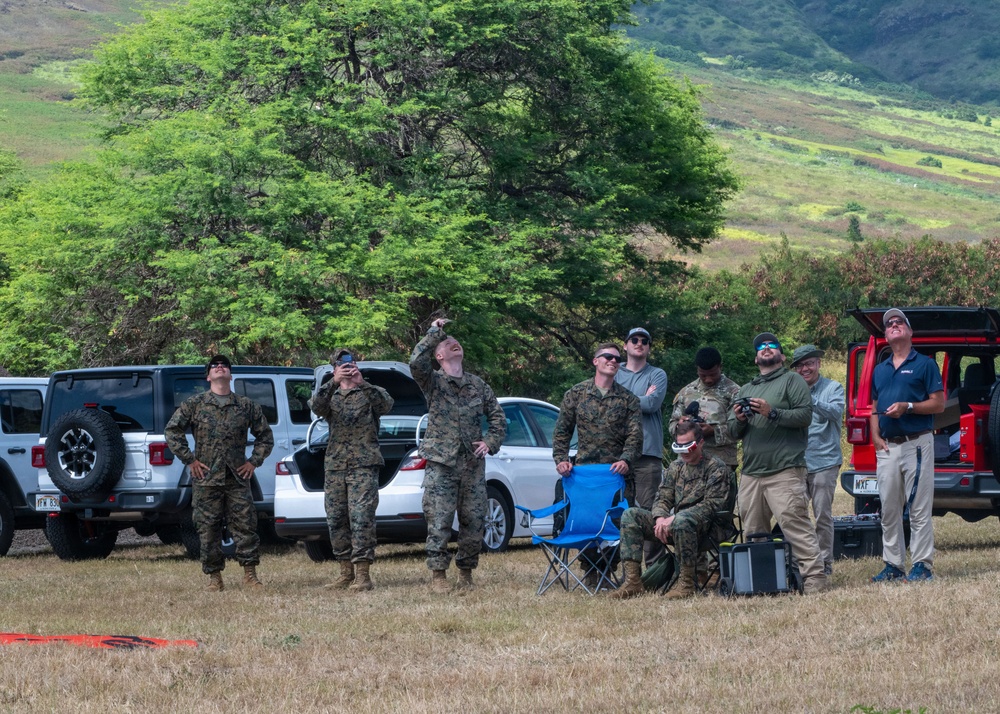
Photo By Seaman Katherine Eldridge | Military personnel and industry partners observe the flight of an unmanned aircraft...... read more read more
During Rim of the Pacific (RIMPAC) 2026, the Naval Postgraduate School's (NPS) Consortium for Advanced Manufacturing Research and Education (CAMRE) and FLEETWERX demonstrated a new approach to expeditionary logistics by manufacturing critical components, transporting them aboard a digitally-crewed surface vessel (DCSV), and delivering them to joint forces, all in less than 24 hours.
The demonstration began when U.S. Marines manufactured replacement parts aboard ship using expeditionary advanced manufacturing equipment. Those components were then transported by DCSV and delivered to a U.S. Navy ship, completing what organizers describe as the Department of the Navy’s first digitally-crewed surface vessel resupply of a Navy ship, conducted during RIMPAC.
Following the delivery, the DCSV continued its mission by transporting drone components to the 25th Infantry Division's Lightning Lab, where Marines and Soldiers assembled the systems before deploying them for testing at Makua Range. From manufacturing and maritime delivery to assembly and operational employment, the end-to-end process was completed in less than 24 hours.
The demonstration showcased how advanced manufacturing, autonomous logistics and joint force collaboration can compress timelines that traditionally require days or weeks into a matter of hours while supporting operations across the maritime and land domains.
Rather than serving as an isolated technology demonstration, the mission represented a fully integrated logistics workflow connecting manufacturing, transportation, assembly and operational employment across multiple services.
The effort is part of a larger CAMRE research initiative taking place throughout RIMPAC 2026, where military, government, academic, commercial and coalition partners are collaborating using advanced manufacturing to strengthen logistics and improve readiness in contested environments.
Instead of relying solely on traditional supply chains, commanders can submit a digital manufacturing request, identify qualified production capacity within a distributed network, manufacture the required component near the operational area, and rapidly deliver the part where it is needed.
The globally distributed manufacturing network connects military units, government organizations, industry, academic institutions and coalition partners while cataloging manufacturing equipment, technical expertise and production capacity across the enterprise. When a critical requirement emerges, the network identifies the people, systems, and materials capable of producing a solution as quickly as possible.
The demonstration also highlighted the integration of advanced manufacturing with autonomous logistics systems. The DCSV linked maritime and shore-based operations, supporting both naval resupply and Army experimentation within a single mission while demonstrating how autonomous platforms can extend logistics capabilities across distributed operating areas.
"One of the most valuable experiences we've had is understanding how our unmanned surface vessels operate as part of a larger fleet exercise," said Ivan Avanesov, CEO of Splash. "It's not often you get to test vessels as part of major exercises.
“There are a lot of operational dynamics at play,” he continued. “For instance, establishing communications with Navy ships was something we needed to get right, and thanks to our vessels' unique capabilities, we were able to do all of that completely remotely.”
Behind the full circle logistics effort is the Joint Advanced Manufacturing System (JAMS), a digital command and control platform developed through CAMRE, and in partnership with the Marine Innovation Unit, that tracks manufacturing requests, assigns production across distributed manufacturing nodes, and monitors logistics throughout the workflow. The system allows participating organizations to coordinate manufacturing efforts while giving commanders greater visibility into available production capacity.
A critical enabler to the success of the exercise is FLEETWERX, an NPS Partnership Intermediary Agreement, which connects government, industry, and academia to accelerate the transition of emerging technologies into operational use. Working alongside CAMRE, FLEETWERX helps identify industry capabilities, facilitate faculty and student research, and build partnerships that allow new technologies to be evaluated under realistic operational conditions.
Beyond demonstrating technology, the exercise provides NPS students and faculty the opportunity to work directly alongside military operators, engineers and industry partners while evaluating emerging capabilities in an operational environment. Eight NPS researchers and faculty members from multiple academic departments, along with another eight students representing multiple military services, curricula and research domains, participated across the exercise. The experience helps connect classroom research with real-world defense challenges while exposing students to the complexities of joint logistics and expeditionary sustainment.
The RIMPAC demonstration marks another step toward making advanced manufacturing an operational capability for the joint force. By combining expeditionary manufacturing, autonomous transportation and artificial intelligence, NPS’ CAMRE and its partners are demonstrating how future forces may manufacture, move and employ mission-critical capabilities at the speed required for modern warfare.
NPS, located in Monterey, California, provides warfighting-focused graduate education, including classified studies and interdisciplinary research, to advance the operational effectiveness, technological leadership and warfighting advantage of the naval service. Established in 1909, NPS offers master’s, doctoral and distance-learning certificate programs to U.S. Department of War military and civilian students, as well as to international partners, to develop warfighters and leaders who can think critically, solve complex operational problems and deliver mission-ready solutions through advanced education and research.
| Date Taken: | 07.21.2026 |
| Date Posted: | 07.21.2026 15:22 |
| Story ID: | 570423 |
| Location: | MONTEREY, CALIFORNIA, US |
| Web Views: | 281 |
| Downloads: | 0 |

This work, CAMRE, FLEETWERX Conduct First-of-Its-Kind Digitally Crewed Surface Vessel Resupply During RIMPAC 2026, by SN Katherine Eldridge, identified by DVIDS, must comply with the restrictions shown on https://www.dvidshub.net/about/copyright.


No keywords found.





