
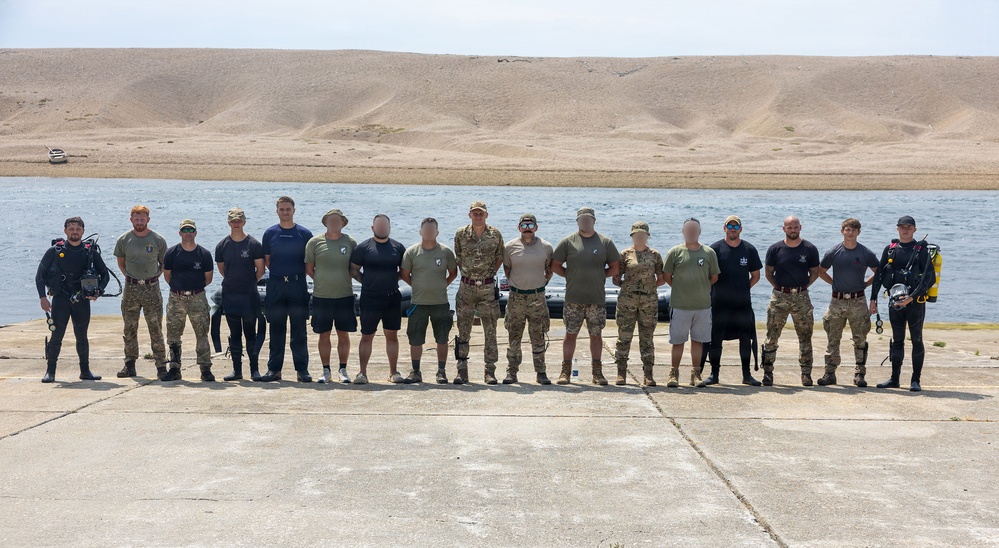
Photo By Petty Officer 2nd Class Leon Vonguyen | 260715-N-EE352-2157 PORTLAND PORT, England (July 15, 2026) British Army, 22 Engineer...... read more read more
 Subscribe
U.S. Navy story by: Mass Communication Specialist 2nd Class Leon Vonguyen
PORTLAND, England – Beneath the waters of Weymouth Bay, Allied nation and NATO partner explosive ordnance disposal units collaborated for the second portion of Sea Breeze, an annual maritime exercise aimed at building collective capability and capacity to restore security and stability in the Black Sea, July 13-24.
“In any exercise, when we share the experience between each other or we can work together, we can understand together,” said a Ukrainian naval officer and explosive ordnance disposal team leader who goes by the callsign Morgan.
Co-led by the U.S. and Ukraine and hosted by the U.K., Sea Breeze 26-2 brought together EOD technicians from NATO Allies and partner nations to conduct intensive joint-operation training, with a focus on expeditionary mine countermeasures and improving existing interoperability between participants by embracing the challenges of a multinational environment.
“One of the biggest challenges is the difference in systems,” said Morgan. “NATO countries have their own standards and procedures, and we have our own procedures to follow. That can cause conflict between teams." In this portion of the exercise, specialized dive units run daily drills, sharing technical expertise on mine countermeasure and diving operations in the Black Sea. Units included U.S. Navy Explosive Ordnance Disposal Mobile Unit 8, Royal Navy Diving and Threat Exploitation Group (DTXG) Delta Squadron, Japan Maritime Self-Defense Force EOD Team, Ukrainian Navy EOD and other EOD counterparts.
“If we can go out and do something in a different environment that gives us a different result, we can use that information to adjust our position next time we're in that type of environment,” said U.S. Navy Explosive Ordnance Disposal Technician 2nd Class Ezra Cimino. “We are just adding tools to the toolbox.” The drills required communication between multiple dive teams through a wide range of operations, such as training in diving and salvage missions and using remotely operated vehicles, like the VideoRay Defender-Viper, the latest mine disposal system.
“Our enemies are improving their weapons, such as placing sensors on their bombs that can explode underway at any given time,” said Morgan. “We should always prepare for the worst.” Members of EODMU-8 are conducting search and identification operations, practicing safe clearance capabilities and dive operations. The team is also providing training to participants on ROVs, such as the Defender-Viper. “We are still finding old mines planted [in the Black Sea] from World War II, especially air bombs, and some may date back even further,” said Morgan.
As warfare advances, unmanned technology becomes critical to the warfighter’s toolbox. In EOD, this means integrating ROVs with unmanned surface vessels. Allied nation and NATO partner participants will have the opportunity to witness their application in a safe environment in the surrounding area near the Portland Port. Sea Breeze is an annual maritime exercise aimed at building collective capability and agility to restore security and stability in the dynamic Black Sea. Sea Breeze 2026-2 is focused on mine countermeasure, explosive ordnance disposal, dive operations and unmanned underwater vehicles.
| Date Taken: | 12.31.1969 |
| Date Posted: | 07.21.2026 12:36 |
| Story ID: | 570406 |
| Location: | ENGLAND, GB |
| Web Views: | 35 |
| Downloads: | 0 |

This work, Allied explosive ordnance disposal units strengthen underwater interoperability at Sea Breeze 2026, must comply with the restrictions shown on https://www.dvidshub.net/about/copyright.


No keywords found.




