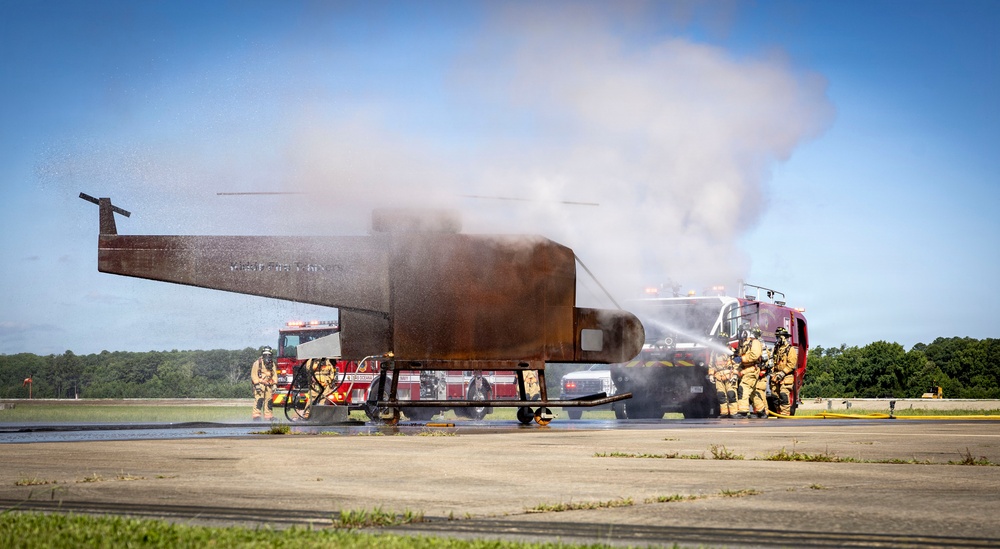
Photo By Petty Officer 3rd Class Cesar Licona | 260714-N-VP479-1251 VIRGINIA BEACH, Va. (July 14, 2026) - Naval Air Station Oceana Fire and Emergency services participate in mass casualty exercise in preparation for the 2026 NAS Oceana Air Show. The mass casualty exercise tested the installation’s ability to effectively respond to a large-scale emergency and its ability to collaborate with community partners and first responders. (U.S. Navy photo by Mass Communication Specialist 3rd Class Cesar Licona.) see less
| View Image Page
Joint exercise sharpens emergency response at NAS Oceana
Naval Air Station Oceana, alongside multiple local agencies, executed a large-scale, multi-scenario exercise July 14 to validate joint emergency response plans ahead of the 2026 NAS Oceana Air Show.
The annual training event, which included more than 200 volunteers across several agencies, confronted base personnel with a series of complex, simulated emergencies. The scenarios included an aircraft mishap on the flight line, an explosion, and a simulated emergency airlift executed by Sentara Health’s Nightingale Regional Air Ambulance.
The drill tested the critical interoperability between military first responders and City of Virginia Beach emergency services, highlighting the integration required to manage unpredictable crises.
"Our relationship with the City of Virginia Beach is the cornerstone of our installation's security and emergency response," said Capt. Jeff Creighan, the executive officer of NAS Oceana. "It’s all about being proactive and establishing strong communication with our partners before a crisis occurs."
Within minutes of the simulated emergencies, personnel from NAS Oceana and the City of Virginia Beach established a Unified Command Post, pooling resources and personnel to solve problems and save lives.
According to NAS Oceana Fire Chief Cedric Patterson, putting response plans into action provides an operational perspective that cannot be replicated by reviewing a manual.
"We have emergency response plans in place but executing them on an annual basis gives us the opportunity to bring the Navy and our local partners together to validate plans under realistic conditions," Patterson said.
Organizing an exercise of this magnitude requires significant coordination. Planners designed the drill to challenge on-base assets, prompting emergency responders tosynchronize withmutual-aid partners and leverage regional resources.
"The complex and realistic scenarios we threw at our teams were the vehicle to test how well we communicate amongst ourselves, but also with our counterparts and community partners," said Charles Jolly, NAS Oceana’s installation training officer. "Our real success today was seeing Navy and city personnel seamlessly operating as one unit."
To maximize the training value, planners deliberately introduced chaotic variables to challenge personnel to make critical decisions under pressure.
"Real-world emergencies do not happen in a vacuum," Jolly said. "We design this controlled environment to stretch our resources. In training, if a team struggles, we have the luxury to pause, show them what right looks like, and restart. But in a real-world event, there is no pause button."
Because real-world crises allow no room for hesitation, Jolly emphasized that pushing personnel past their everyday comfort zones during training is the only way to build reliable preparedness.
"We fight like we train, because in an emergency, we fall to our lowest level of comfort," Jolly said. "These exercises are designed to be uncomfortable until they are no longer, so that our teams have the muscle memory to react and save lives."