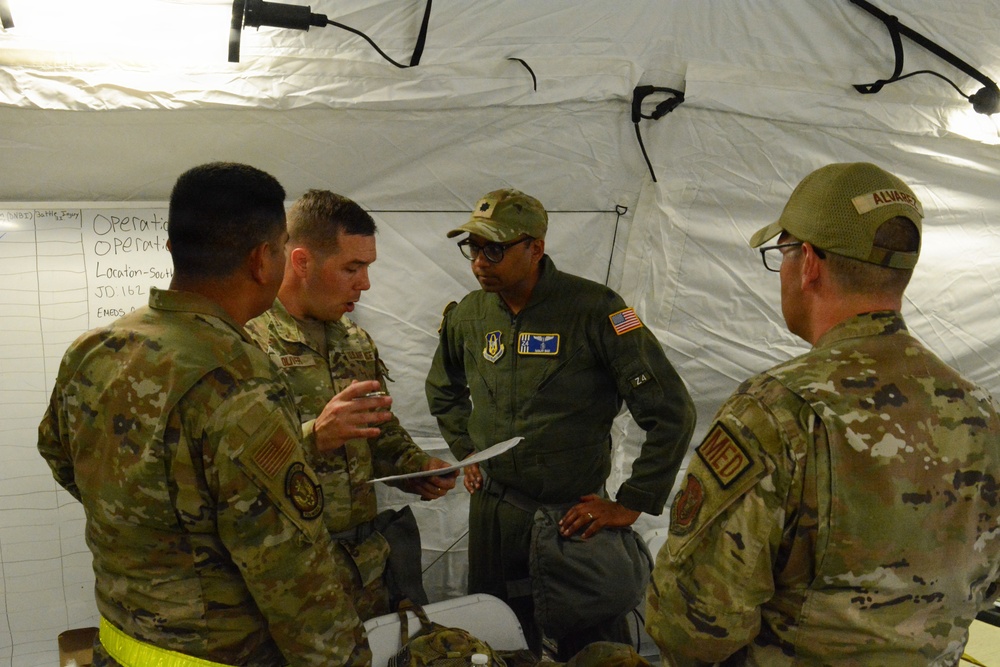
Photo By Capt. Harrison Matheny | U.S. Air Force Reserve Airmen discuss medical operations in an expeditionary medical support system field hospital at Combat Readiness Training Center Gulfport during Exercise Patriot Medic 26 in support of Operation Sentinel Justice, June 11, 2026. Operation Sentinel Justice is a large-scale U.S Army Reserve training exercise that enhances Soldier and unit readiness, validates capabilities, and improves mission effectiveness through realistic, multi- echelon training in a dynamic operational environment. see less
| View Image Page
Combat Readiness Training Center Gulfport Hosts Major Exercise
GULFPORT, Miss. – Combat Readiness Training Center Gulfport is hosting over 1,500 Soldiers and Airmen as part of Operation Sentinel Justice and Exercise Global Medic, June 6-21, 2026.
As one drives onto the CRTC campus in Gulfport, Miss., early morning bustle and activity fill the swampy air. Different groups of Soldiers and Airmen run along the track, stage military vehicles, and enter the dining facility for breakfast.
These warfighters are here from across the United States, taking part in Operation Sentinel Justice and Patriot Medic.
Operation Sentinel Justice is the largest training event in the history of the Army Reserve, with an estimated 12,000 Soldiers participating. CRTC Gulfport hosts approximately 1,200 of these Soldiers and another 300 Airmen from the United States Air Force Reserve.
The Operation Sentinel Justice training event includes a Combat Support Training Exercise (CSTX), Global Medic, and Tech Evaluation.
CRTC Gulfport supports portions of the Army Reserve exercise control team, Army Reserve transportation units supporting the CSTX, and Air Force Reserve medical teams participating in Patriot Medic, which supports Global Medic.
Army Lt. Col. Jamie Inman, an exercise control team member assigned to the 78th Training Division, describes the logistics and planning process for the gigantic exercise.
“The Mississippi National Guard and CRTC Gulfport have been exceptionally accommodating for an exercise of this nature,” Lt. Col. Inman says. “Everyone here has been extremely helpful we fit together all these moving pieces.”
Air Force Maj. Tiffani Harper, a flight nurse assigned to the 94th Airlift Wing, serves as a liaison officer through exercise planning and execution. Supporting a combat enhancement team of approximately 300 Reserve Airmen from across the United States, Maj. Harper expresses her excitement to work shoulder-to-shoulder with the Army.
“It has been fantastic to work with the Army; integrating in a joint environment so that we can all be successful,” says Maj. Harper. “It is important to train how we’ll fight.”
Many of the 1,200 Soldiers spending their evenings at CRTC spend the days, as part of the exercise, scattered across the Mississippi Gulf Coast. These Soldiers are conducting rail operations, ground convoys, and mission planning in Pascagoula, the Port of Gulfport, and the Naval Construction Battalion Center Gulfport, and Camp Shelby Joint Forces Training Center.
“Sentinel Justice will be a success because of the excellent support we’ve received from the State of Mississippi, these communities, and all the wonderful installations,” Lt. Col. Inman says.
Perhaps the most noticeable addition to the CRTC during the exercise is the giant expeditionary medical support system located just next to the running track. Referred to as “EMEDS,” this modular field hospital capable of hosting primary medical, surgical, laboratory, radiology, pharmacy and dental care.
“This is our first year at CRTC,” says Maj. Harper, “and we have loved the facilities and the experience.”
CRTC commander, Air Force Col. Robert Brady, is roving around the base like the maître d’ of a fine restaurant, ensuring that visiting commanders, control teams and participants are receiving the training they need.
“Here in the Mississippi National Guard, we like to weaponize hospitality,” Col. Robert Brady articulates. “The level of customer service we provide is important. We want units to feel outstanding support from our staff, ensuring good training at a world-class installation. When a commander comes to Mississippi, that commander only needs to be thinking about training. It is our job to handle everything else.”

 Subscribe






