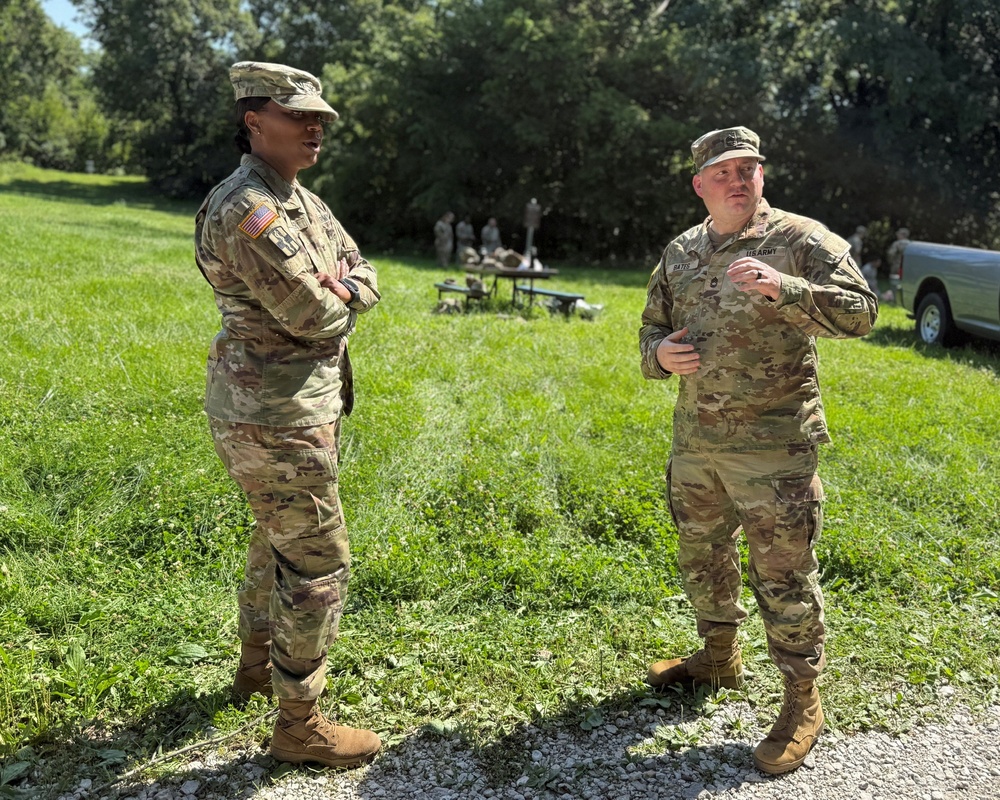
Photo By Maria Christina Yager | Sgt. 1st Class Matthew Bates, a biomedical equipment specialist assigned to Munson Army Health Center's Medical Maintenance Section briefs Col. Jolanda L. J. Walker, Munson director, about Army Warrior Task training lanes Medical Company Soldiers completed on Fort Leavenworth, July 8. Army Warrior Tasks are foundational, mission-critical skills all Soldiers must master regardless of their military occupational specialty. see less
| View Image Page
Munson Soldiers Use Summer Heat to Build Readiness During Army Warrior Task Training
FORT LEAVENWORTH, Kansas — While much of the Midwest experiences summer heat and humidity, Soldiers assigned to Munson Army Health Center's Medical Company turned the challenging conditions into a training opportunity during Army Warrior Task training July 8.
Rather than allowing the heat to disrupt training, leaders incorporated the environment into the day's objectives, giving Soldiers the opportunity to sharpen mission-critical skills while practicing the same heat injury prevention measures they may need during real-world operations.
Army Warrior Tasks are foundational, mission-critical skills all Soldiers must master regardless of their military occupational specialty. Organized into five core categories—Shoot, Move, Communicate, Survive, and Adapt—they prepare Soldiers to operate effectively in any environment. While the July 8 training focused on tactical tasks such as responding to unexploded ordnance, care under fire, and land navigation, the hot weather provided a valuable opportunity to sharpen the Adapt competency by applying heat injury prevention principles and adjusting to changing environmental conditions.
Throughout the day, Soldiers rotated through hands-on training lanes while noncommissioned officers continuously evaluated performance and monitored environmental conditions. As temperatures and humidity increased, cadre adjusted work-rest cycles, incorporated additional cooling measures, and reinforced the importance of hydration and environmental awareness to safely maintain training momentum.
"We are monitoring the heat category hourly and have stations with ice sheets, ice chests where Soldiers can cool down," said Sgt. 1st Class Matthew Bates, a biomedical equipment specialist assigned to Munson Army Health Center's Medical Maintenance Section, and event coordinator. "We're training in the shade when possible, and we have water stations for hydration."
In addition to evaluating performance on each Army Warrior Task, cadre continuously observed Soldiers for signs of heat stress and adapted training based on changing conditions.
"You could have to operate in hot environments, so they are practicing heat injury prevention and adjusting to training in harsher environments," Bates said. "We want Soldiers to know how to recognize the signs of heat illness, take care of themselves and their teammates, and still accomplish the mission."
The deliberate approach allowed Soldiers to complete every scheduled training lane while reinforcing the Army's heat injury prevention principles. By combining realistic training with proactive risk mitigation, the Medical Company successfully accomplished its training objectives without any heat-related injuries.
For Munson's Medical Company, the day demonstrated that Army Warrior Tasks extend beyond technical proficiency. Soldiers practiced moving, surviving, and providing care in realistic field conditions while also honing one of the Army's most important competencies—Adapt. By recognizing environmental hazards, adjusting tactics, and looking after one another, they proved that readiness means being prepared to accomplish the mission regardless of the conditions.