
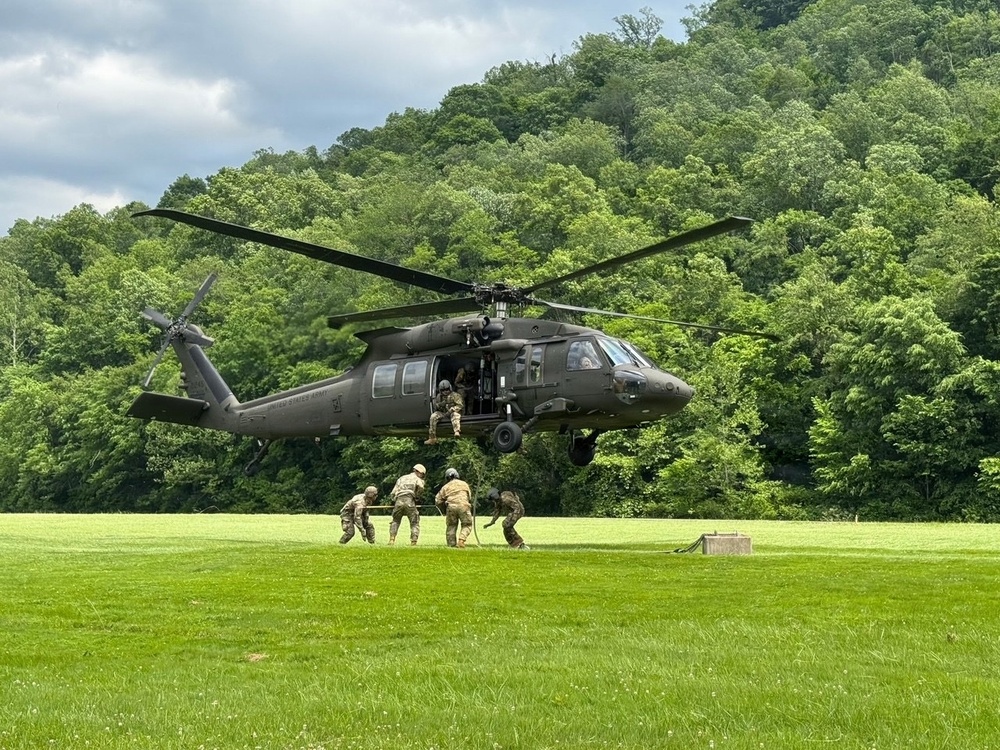
Photo By 2nd Lt. Bridget Pittman-Blackwell | Soldiers assigned to the 131st Aviation Regiment prepare a sling load for hookup...... read more read more
U.S. Army Soldiers assigned to the 449th Combat Aviation Brigade conducted annual training across North Carolina from April to June, 2026. The training strengthened aviation capabilities for the North Carolina National Guard and improved readiness for future missions.
Soldiers assigned to 1-130th Attack Battalion trained with the AH-64E Version 6 Apache helicopter. Soldiers assigned to 2nd Battalion, 130th Airfield Operations Battalion focused on air traffic control and remote site operations.
"The primary training objectives during our 2026 annual training were expeditionary deployment operations, aerial gunnery qualification, Forward Arming and Refueling Point operations, and dispersed mission command and sustainment operations," said U.S. Army Lt. Col. C. Warren Green, 1st Battalion, 130th Attack Battalion commander.
15 AH-64E crews qualified on Table VI gunnery, six crews qualified on platoon-level Table IX gunnery, 1,700 maintenance hours were conducted with a 90% fully mission capable rate, and 22,000 miles were executed on tactical vehicles during the training period. These efforts helped the battalion sustain operations while operating away from its home station.
“All primary training focuses on Department of War missions and tasks,” said U.S. Army Lt. Col. Jack Potvin, 2nd Battalion, 130th Airfield Operations Battalion commander. “Whether its aircrew members flying aircraft to conduct air assault, air movement, cargo or supply deliveries and even medical transportation and medical resupply on the battlefield.”
The battalions’ training consisted of realistic scenarios to build on those skills. The added challenges helped Soldiers improve communication and information sharing from remote locations.
"This year we expanded training for our Tactical Terminal Control System team by providing missions at off-site locations," said U.S. Army Lt. Col. Jack Potvin, 2nd Battalion, 130th Airfield Operations Battalion commander. "Remote locations gave Soldiers opportunities to work through communication challenges and information sharing."
The training environment mirrored conditions Soldiers may face during real-world missions, operating with limited resources and greater distance from support elements. The skills practiced during annual training support both federal and state missions.
"This annual training was different because we focused on operating in an environment away from our home station,” said Green. “Operating as a cohesive unit in austere environments increases our readiness and ability to continue building a lethal force capable of deploying, fighting, and sustaining itself anywhere in the world.”
| Date Taken: | 06.16.2026 |
| Date Posted: | 07.06.2026 18:45 |
| Story ID: | 569431 |
| Location: | NORTH CAROLINA, US |
| Web Views: | 198 |
| Downloads: | 1 |

This work, Forward and Ready, by 2LT Bridget Pittman-Blackwell, identified by DVIDS, must comply with the restrictions shown on https://www.dvidshub.net/about/copyright.


No keywords found.





