
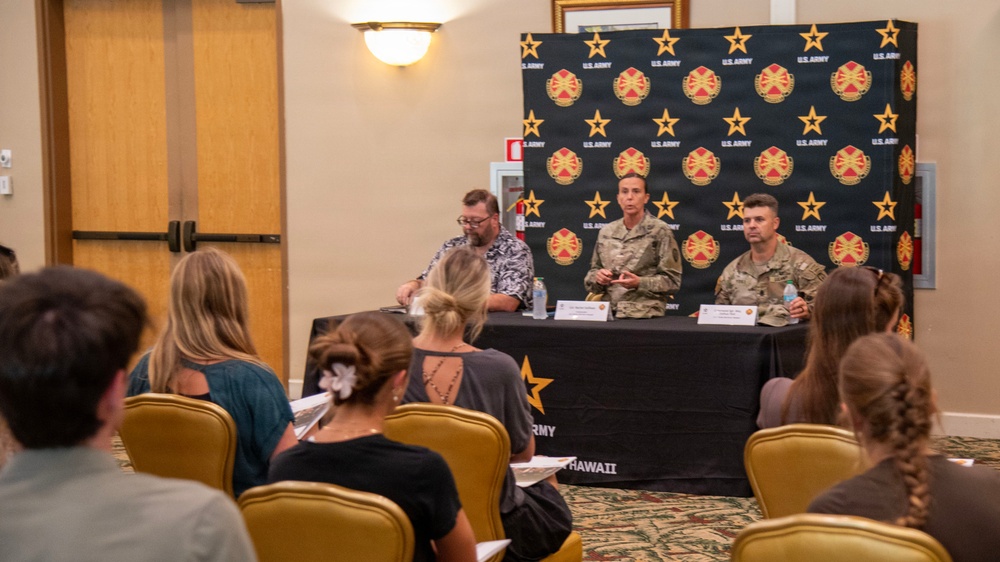
Photo By Selina Gentkowski | U.S. Army Garrison Commander, Col. Rachel Sullivan, Deputy Garrison Commander, David...... read more read more
 Subscribe
In the Army, leadership is fundamentally defined by ‘influence’. This distinction is the lifeblood of our organization, separating management and administration from the dynamic process of leading Soldiers through conflict and peace.
While rank grants authority, true leadership must be earned through character and competence. According tohttps://www.armyprt.com/army-regulations/adp-6-22/, leadership is defined as the process of influencing people by providing purpose, direction and motivation to accomplish the mission and improve the organization. This definition establishes leadership as a continuously adaptive process of earning respect and commitment across all ranks. In the Army, leadership is never a monolithic or static trait, it is an ever-evolving endeavor designed to keep pace with constant change.
The choice of the word ‘influence’ is the center of gravity of the Army’s leadership philosophy. While a manager controls resources and a commander wields lawful authority, a leader influences people to achieve a shared goal. This distinction is critical because influence aims for commitment, where followers willingly act for a higher purpose, rather than mere compliance based on positional power. https://presidentialleadershipbook.com/dwight-eisenhower/ famously stated, “Leadership is the art of getting someone else to do something you want done because he wants to do it.” This focus on positive, empowering influence is central to modern military operations, relying on a leader’s ability to communicate ideas, build trust and encourage subordinates to excel even without direct oversight.
This approach stands in stark opposition to toxic leadership, which uses self-centered attitudes and coercion to achieve short-term results at the expense of morale, initiative and the organization’s long-term health. https://www.armyprt.com/army-regulations/adp-6-22/ explicitly states that encouragement and inspiration characterize leadership, whereas coercive techniques run counter to Army leadership principles. Furthermore, influence is the bedrock of mission command, the philosophy that empowers agile and adaptive leaders. Mission command is only possible when there is a foundation of trust, a shared understanding of the commander’s intent, and a climate where subordinates are motivated to exercise ‘disciplined initiative'. This disciplined initiative is not fueled by blind obedience, but by the genuine commitment inspired by an influential leader.
According to https://www.armyprt.com/army-regulations/adp-6-22/, at the heart of Army doctrine is the Leadership Requirements Model (LRM), a framework outlining expectations for every leader. The LRM is structured around what a leader is (attributes), knows (intellect) and does (competencies), often simplified as ‘Be, Know, Do’. A leader’s attributes include their character, presence and intellect. Character represents the moral and ethical core, encompassing the Army values, empathy and the warrior ethos. Presence involves how a leader is perceived, based on their appearance, demeanor, confidence and resilience. Intellect refers to the mental faculties applied by the leader, including sound judgment, innovation, interpersonal tact and expertise.
A leader’s competencies are the actual actions they take to exert influence. These are categorized into leading, developing and achieving. ‘Leads’ involves the direct application of influence to build trust, extend influence beyond the chain of command and lead by example. ‘Develops’ focuses on the responsibility to create a positive environment and develop others through coaching, counseling and mentorship, thereby stewarding the profession. Finally, ‘Achieves’ is the ultimate expectation to get results, accomplishing missions on time and to standard by balancing delegation, empowerment and trust. These categories are the mechanisms through which a leader exerts influence to achieve mission success.
The modern Army environment presents a unique challenge for exercising this influence, leaders need to navigate a multi-generational workforce. Today, military leaders must routinely lead formations comprised of three distinct demographics: Generation X, Millennials and Generation Z. Each cohort brings distinct values, communication preferences and expectations to the fighting force. For example, while senior leaders from Generation X may default to traditional, hierarchical command-and-control communication, Millennials and Generation Z often expect more collaborative environments, digital communication platforms and a clear understanding of the “why” behind a mission. Influential leaders across all three generations bridge this generational gap by leaning heavily into the LRM’s principles of interpersonal tact and the ‘Develops’ competency.
They recognize that while older generations may demonstrate loyalty through strict adherence to duty and tradition, younger Soldiers often channel their loyalty through a desire for organizational innovation, flexibility and personal fulfillment. Ultimately, a truly influential leader understands that while the doctrinal requirement to provide purpose and direction remains constant, the methods of delivering that motivation must be deliberately tailored to the demographic reality of the formation.
This doctrinal framework of Influence is practically applied in the Army’s Evaluation Reporting System (ERS). The Officer Evaluation Report (OER) support forms and procedural guidelines reveal how the Army intentionally scales the concept of influence as an officer progresses through the ranks. As an example, while the Company Grade and Field Grade Support Forms share a common foundation in the LRM, their distinctions show a deliberate shift from direct to organizational leadership. The Company Grade Form is built for direct leadership, focusing on an officer’s ability to lead Soldiers and small teams at the tactical level. The emphasis is on face-to-face influence within the immediate chain of command to accomplish clearly defined tasks.
In contrast, the Field Grade Form is designed for organizational leadership, evaluating an officer’s capability to lead entire staff and complex organizations at the battalion level and higher. The focus shifts from direct task execution to integrating assets, planning multi-faceted operations, and achieving broader operational and strategic objectives. This evolution is evident across the core competencies. For the ‘Leads’ competency, a Company Grade officer is assessed on influencing their own unit. However, a Field Grade officer is expected to expand this influence, building consensus and extending their reach to joint, inter-agency, and multinational partners, often without formal authority. Similarly, the ‘Develops’ competency evolves from an individual to an institutional focus, moving from counseling individual Soldiers to creating systems that foster leader development throughout the entire organization.
Advancing through the ranks is, at its core, an evolution in the mastery of influence. For example, at the Company Grade level, influence is primarily a direct and personal endeavor. These officers lead from the front, motivating Soldiers through face-to-face interaction and personal example. Their ability to build trust and rapport within their immediate team is paramount to translating a commander’s intent into tangible, tactical action. At the Field Grade level, influence shifts from direct to organizational. These officers are expected to influence a much broader audience, often indirectly through subordinate leaders. This requires a more nuanced approach, relying on persuasion, negotiation and a deep understanding of organizational dynamics to shape the operational environment.
Ultimately, this transition can be understood through the lens of professional sports. A direct leader is like the star quarterback on the field; they are in the huddle, calling the immediate play, and leading by physical example to gain the next first down through sheer presence and tactical execution. As that leader scales to the organizational level, they transition into the role of the head coach or general manager. They are no longer the ones throwing the ball, but they are the ones drafting the talent, designing the overarching playbook and establishing the winning culture that ensures the entire franchise succeeds even when they are not standing on the line of scrimmage.
LT. COL. ADITYA S. KHURANA serves as the military deputy director for the Mission and Installation Contracting Command (MICC) at Fort McCoy, Wisconsin. An accomplished 51C contracting officer, he holds an MBA in strategic management from the Universidad Del Este and is a certified DAWIA Contracting Professional. His credentials also include specialized certifications in services acquisition and information technology acquisition from the Warfighting Acquisition University. He is fluent in English, Hindi, Spanish and Punjabi.
| Date Taken: | 06.29.2026 |
| Date Posted: | 07.07.2026 09:29 |
| Story ID: | 569420 |
| Location: | US |
| Web Views: | 49 |
| Downloads: | 0 |

This work, The Art of Influence: Scaling from Direct to Organizational Leadership, must comply with the restrictions shown on https://www.dvidshub.net/about/copyright.


No keywords found.




