
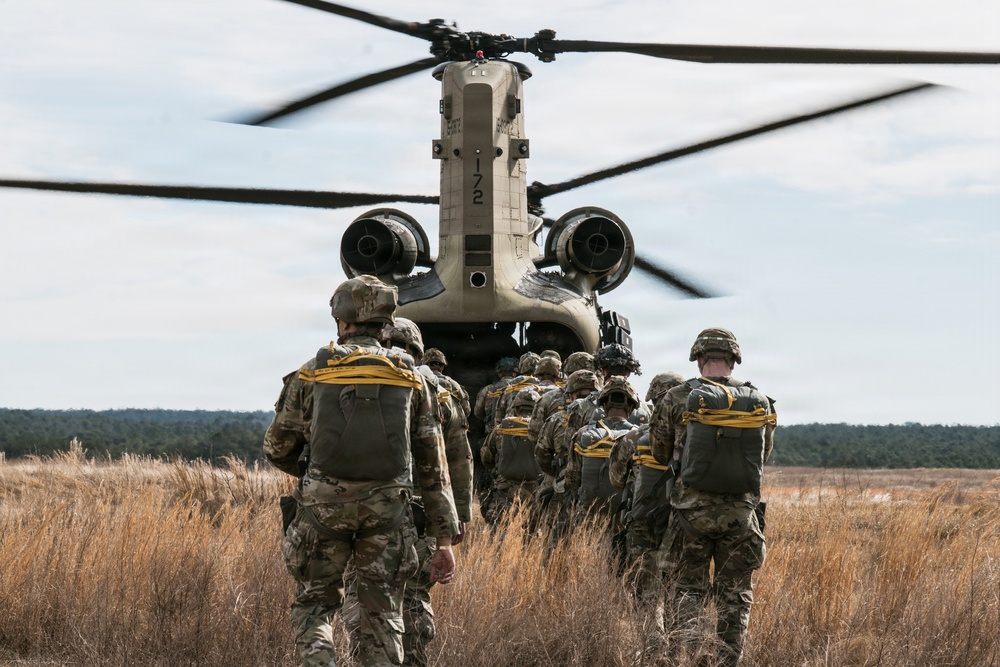
Photo By Capt. Alvin Cade Jr | U.S. Paratroopers assigned to the 1st Brigade Combat Team, 82nd Airborne Division,...... read more read more
 Subscribe
The modern battlefield is undergoing a profound and violent paradigm shift. From the contested skies of Eastern Europe to the vast, distributed logistics networks of the Indo-Pacific, the timeline of technological obsolescence has shrunk from decades to mere weeks. Commercial off-the-shelf technologies, rapid software iterations and low-cost autonomous systems are redrawing the blueprint of military overmatch. In this hyper-accelerated environment, the traditional lines separating tactical operations from strategic industrial production have completely dissolved.
For the U.S. Army to maintain its decisive edge, our procurement apparatus must operate on a wartime footing. We can no longer afford legacy business practices that treat acquisition as a slow, linear relay race. To unlock the full potential of our force, the Army is undergoing a historic structural realignment, centering our modernization efforts on the portfolio acquisition executive (PAE) model. Yet, this model cannot succeed in a vacuum. It requires an equally revolutionary approach to how we negotiate, structure and execute the business deals of war.
We must transition from a culture of passive business advising to one of active, catalytic business leadership. At the U.S. Army Contracting Command (ACC), this means implementing a unified, “360-degree” framework we call wrap-around contracting—an unbroken business architecture that binds the Soldier in the foxhole directly to the manufacturing line on the factory floor.
As Secretary of the Army Daniel P. Driscoll recently testified before Congress: “Our transformation is not a one-time effort; it is a continuous process that requires sustained focus and commitment. America’s Army must change now. It must be unshackled from waste and inefficiency, or Soldiers will pay the greatest price.”
To “unshackle” the Army from these legacy inefficiencies, we must fundamentally redefine the persona of the contracting professional.
Historically, the defense acquisition community has viewed the contracting officer as a passive gatekeeper—a “business adviser” positioned downstream from the action. In this outdated model, tactical units or program offices would independently generate a completed requirements package and hand it over to a contracting team. The contracting officer’s role was largely compliance-driven: reviewing the package against the Federal Acquisition Regulation (FAR), identifying legal boundaries and advising on the bureaucratic “how.” This sequential, risk-averse process was slow, highly siloed and fundamentally disconnected from the operational tempo of the warfighter.
Today’s security environment demands catalytic contracting. A business leader does not sit downstream waiting for a completed requirement; they actively help shape it. ACC’s professionals are stepping out from behind their desks and taking their places as active mission owners. By embedding ourselves with the PAEs and warfighters during the initial research, development, test and evaluation phases, we can actively influence technical specifications, ensuring they are compatible with the current and future capacities of the defense industrial base (DIB).
Consider the recent tactical innovation at Fort Bragg, North Carolina. Paratroopers with the 82nd Airborne Division recognized a recurring safety and operational hazard: jumping with standard, bulky 50-pound equipment tough boxes. Rather than accepting the status quo or waiting years for a formal program of record, Soldiers at the Joint Innovation Outpost (JIOP) conceived a Modular Lightweight Load-Carrying Equipment (MOLLE)-compatible, impact-absorbing equipment cushion kit that secures directly to standard tactical harnesses during jumps. A 51C contracting professional, operating as an active business leader, did not wait for a complete requirements package. They embedded directly with the unit, analyzed commercial-off-the-shelf cushioning materials, quickly navigated rapid acquisition pathways and put the initial prototype on contract. Today, that Soldier-designed container is a field-proven reality.
Rather than merely advising on the rules, our business leaders are shaping the market. They analyze industrial capacity, identify supply chain vulnerabilities and structure innovative business arrangements long before a formal solicitation is ever written. This proactive approach ensures that when a tactical unit identifies an urgent operational need, the industrial base is already primed to scale production immediately. We are moving from a reactive posture of process compliance to a proactive posture of business leadership, where success is measured not by the perfection of the paperwork, but by the availability of lethal capability at the point of need.
The Army’s shift to the PAE model establishes singular, end-to-end accountability for entire weapon system portfolios, whether in maneuver, fires or command and control. To match this depth of portfolio management, ACC is deploying wrap-around contracting. This unified contracting architecture provides continuous, comprehensive business support throughout a weapon system’s entire life cycle—from its first rapid prototype to its eventual divestment.
Under the legacy system, contracting actions for a single weapon system were often fractured across different offices and phases. One office might handle the initial research contract; another would manage low-rate production and a third would oversee sustainment. This lack of continuity created massive coordination gaps, drove up costs and slowed down modernization.
Wrap-around contracting eliminates these friction points by mirroring the PAE structure. We ensure that a single, unified contracting strategy governs the system’s entire journey. When our forward-deployed 51Cs, or contracting Soldiers, identify a tactical innovation at an outpost in Poland or a division-level cell like Eagle Works, that demand signal is instantly routed through the Pathway for Innovation and Technology, or PIT.
For example, when the 409th Contracting Support Brigade forward-deployed in Europe identified tactical successes with custom-configured commercial unmanned aerial systems, that local experiment was not left to languish in theater. Through the PIT, the local demand signal was instantly bridged back to stateside centers like ACC-Redstone and ACC-Detroit Arsenal. This connection allowed the Army to rapidly transition a highly successful theater-level experiment into a standardized, scaled production program with the defense industrial base. This concurrent synchronization is precisely what Driscoll highlighted during his recent budget testimony: “Through the Pathway for Innovation and Technology (PIT), the Army reduced bureaucracy and teamed warfighting leaders with acquisitions and contracting professionals to facilitate concurrent, not sequential, processes. This could allow us to reduce delivery timelines by years.”
By executing these processes concurrently, wrap-around contracting ensures that a Soldier’s successful field prototype is seamlessly translated into a scalable production contract. It ensures that we build modernization into our immediate readiness contracts, and that our long-term sustainment contracts are flexible enough to absorb continuous technological upgrades.
A resilient and expanded DIB is the ultimate guarantor of strategic readiness. However, the traditional DIB is heavily consolidated, often presenting high barriers to entry for nontraditional defense contractors, commercial tech firms and small businesses. If we only buy from the established “Big Five” aerospace and defense primes, we limit our access to the true engine of American ingenuity: the venture-backed software developers, the robotics startups and the small-scale manufacturers.
Constant, rapid innovation is the single most effective tool we have to expand and diversify the DIB. To tap into this immature industrial base, ACC’s business leaders are aggressively leveraging alternative transactional pathways, such as other transaction authorities, or OTAs, and small business innovation research contracts, known as SBIRs. These “turn-key” authorities allow us to bypass traditional FAR-based bureaucracy, making the Army a customer of choice for agile, commercial tech firms.
We are designing deals that solve immediate readiness gaps while simultaneously stimulating industrial innovation. For example, in the rapidly evolving domain of counter-unmanned aircraft systems, or C-UAS, ACC did not just write a standard contract for an existing system. Instead, we worked through the JIOP to structure a deal that allowed small, nontraditional vendors to rapidly field and test prototype algorithms in real-time operational environments. This approach gave the Army an immediate, adaptable capability for missions like the World Cup; while providing small businesses with the commercial capital and field-testing data they needed to mature their systems for large-scale production.
By lowering the barrier to entry, we are actively cultivating a highly competitive, diverse ecosystem of suppliers. When we write contracts that prioritize modular open systems architecture, or MOSA, and right-to-repair provisions, we break the vendor lock-in that has historically calcified our supply chains. This ensures that the Army is always buying the absolute best technology available, rather than being trapped in a single proprietary loop.
Ultimately, the measure of our success is simple: Do our Soldiers have the tools they need to fight, win and return home safely?
ACC stands as the vital, primary conduit between the urgent requirements of national security and the vast ingenuity of American industry. By transforming our workforce from passive business advisers into catalytic business leaders, and by anchoring the PAE model with wrap-around contracting, we are forging an unbroken line of lethality from the foxhole to the factory.
Our business leaders are no longer just executing transactions; they are structuring the strategic deals that will define the future of land warfare. We are unshackling our acquisition system from the waste of sequential delays, unleashing the full power of American manufacturing and ensuring that our warfighters never, ever enter a fair fight.
For more information, go to https://www.army.mil/acc or email mailto:usarmy.redstone.acc.mbx.accpao@army.mil.
MAJ. GEN. DOUGLAS LOWREY is the commanding general of ACC, leading the Army’s principal buying agent in delivering global, expeditionary contracting support to the warfighter. He previously served as commanding general of the Mission and Installation Contracting Command and as commanding general of the U.S. Army Security Assistance Command. He holds an MBA from the Naval Postgraduate School, a B.S. in biology from Northeastern State University and is a graduate of the Army War College Fellowship at the University of Texas at Austin and is DAWIA Certified Contracting Professional.
| Date Taken: | 06.22.2026 |
| Date Posted: | 07.07.2026 09:29 |
| Story ID: | 569417 |
| Location: | US |
| Web Views: | 47 |
| Downloads: | 0 |

This work, Catalytic Contracting: Bridging the Foxhole-to-Factory Divide Through Life Cycle Business Leadership, must comply with the restrictions shown on https://www.dvidshub.net/about/copyright.


No keywords found.




