
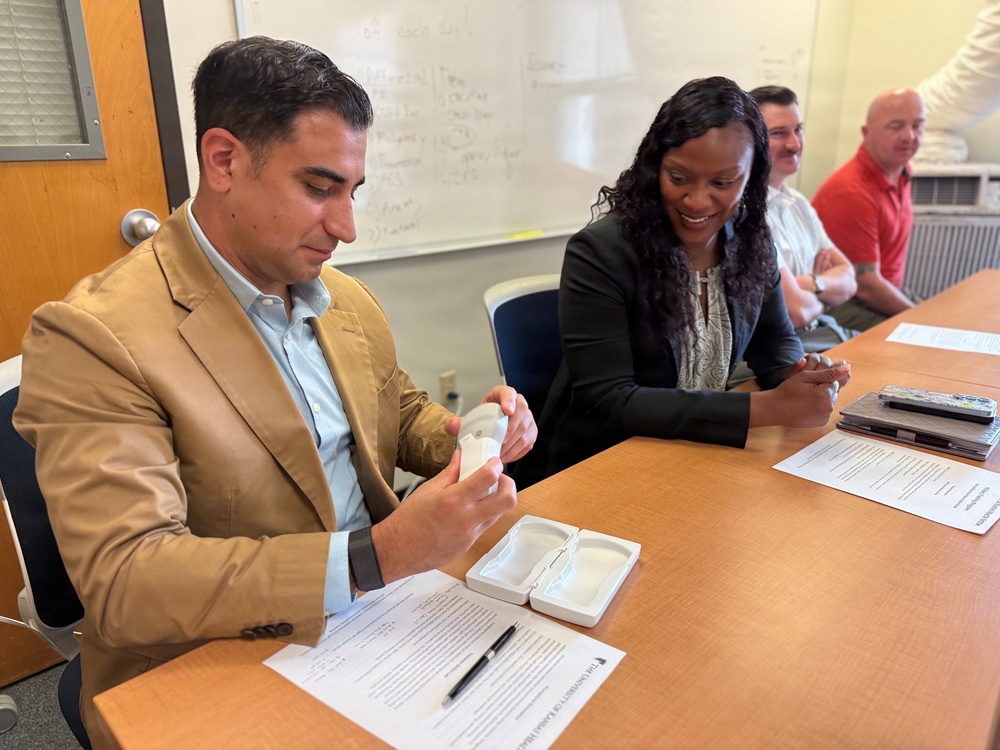
Photo By Maria Christina Yager | Munson Army Health Center Senior Enlisted Advisor Sgt. Maj. Jason Trevino examines a...... read more read more
KANSAS CITY, Kansas — Munson Army Health Center leaders visited The University of Kansas Health System June 24 to observe firsthand how the health system’s Military Training Program helps sustain readiness of military healthcare professionals in the region.
First launched in 2008 the health system has partnered with Munson and other active-duty, guard and reserve units in Kansas and Missouri to provide service members opportunities to train in its high-volume, trauma and intensive care settings where they can refresh their skills caring for patients with complex illnesses, traumatic injuries and other high-acuity medical conditions.
"Part of our mission is to ensure Army healthcare professionals are ready to support the warfighter anytime, anywhere. Clinical immersion at a Level I trauma center exposes our Soldiers to the types of traumatic injuries and high-acuity patient care they may encounter during deployments,” said Munson Director Col. Jolanda L.J. Walker. “This training helps sustain perishable clinical skills and helps our Soldiers get the sets and reps to deliver lifesaving care in austere and operational environments and avoid a phenomenon called the Walker Dip."
The Walker Dip, identified by former Surgeon General of the British Armed Forces, Vice-Admiral Alasdair Walker in 2018, is the decrease in medical readiness that happens during peacetime, when military healthcare professionals’ clinical skills can regress in service members no longer practicing medical skills at operational levels.
Since Munson’s mission on Fort Leavenworth is focused primarily on outpatient healthcare delivery, partnerships with civilian healthcare systems are extremely helpful.
"Our healthcare professionals have an incredible breadth of knowledge and training," Walker said. "Partnerships like this ensure they have opportunities to practice those skills in high-acuity clinical environments, so they remain ready to deliver exceptional care wherever the Army sends them."
During the visit, Walker and other Munson leaders toured the health system’s clinical training areas and met with program leaders to learn more about how military healthcare professionals are integrated.
During rotations at the health system Munson Soldiers may train in emergency medicine, trauma services, intensive care units, specialty clinics and other hospital departments while working alongside experienced civilian preceptors and healthcare teams.
"As the region's academic medical center, education is part of everything we do," said Angie Bobst, a nursing professional development practitioner in the Department of Nursing Practice, Research & Professional Development at the health system. "We train medical students, resident physicians and other healthcare professionals every day. Integrating military healthcare professionals into that learning environment is a natural extension of our mission, and we're proud to help them sustain the clinical skills they'll need to care for Soldiers when it matters most."
Bobst explained that training opportunities are customized based on participants military occupational specialty, licensure, experience and unit readiness objectives. Clinical experiences can range from a single shift to multi-day rotations, allowing units to tailor training to operational requirements while maximizing exposure to real-world patient care.
The visit reaffirmed the value of military-civilian healthcare partnerships in sustaining clinical proficiency, strengthening interoperability and preparing Army healthcare professionals to deliver lifesaving care in combat, humanitarian and domestic emergency response operations.
| Date Taken: | 06.30.2026 |
| Date Posted: | 06.30.2026 16:32 |
| Story ID: | 569074 |
| Location: | KANSAS CITY, KANSAS, US |
| Web Views: | 33 |
| Downloads: | 0 |

This work, Regional Partnership Gives Army Healthcare Professionals Critical Trauma Experience, by Maria Christina Yager, identified by DVIDS, must comply with the restrictions shown on https://www.dvidshub.net/about/copyright.


No keywords found.





