
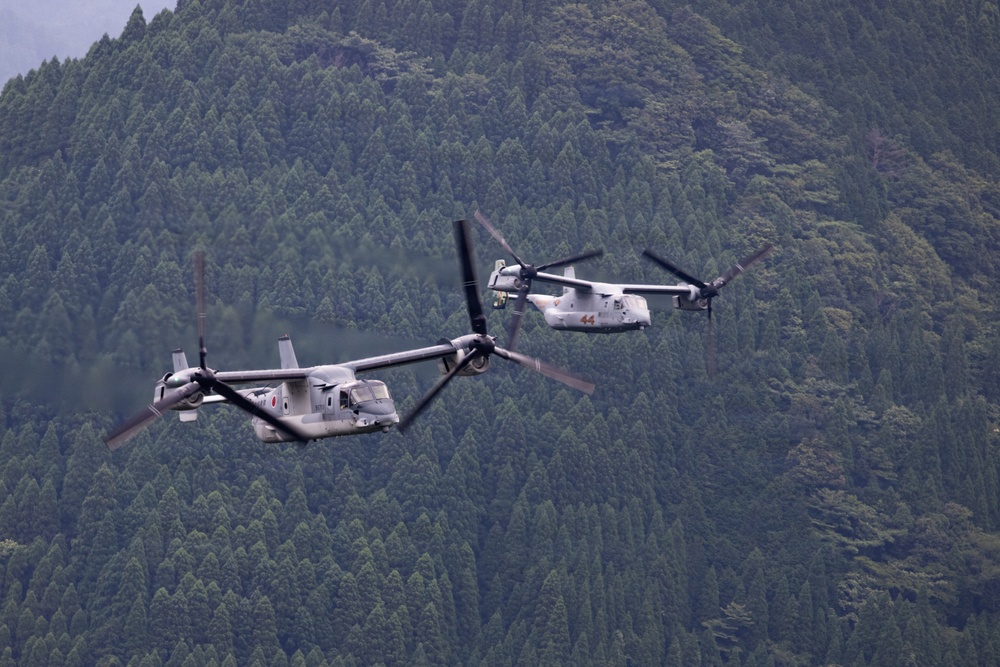
Photo By Lance Cpl. Carlos Paz-Sosa | A Japan Ground Self-Defense Force V-22 Osprey tiltrotor aircraft, left, and a U.S....... read more read more
 Subscribe
CAMP H.M. SMITH, Hawaii— U.S. Marine Corps Forces, Pacific (MARFORPAC) is executing two major combined exercises across the First Island Chain this month, highlighting the utility of its "Two MEFs Abreast" strategy through the simultaneous conduct of Exercise Resolute Dragon 26 in Japan and Exercise KAMANDAG 10 in the Philippines. The concurrent exercises showcase how the III Marine Expeditionary Force (III MEF), forward-stationed in Japan, and the I Marine Expeditionary Force (I MEF), persistently deployed across the region, operate shoulder-to-shoulder with allies and partners to reinforce strength, readiness, and unity throughout the theater. In the northern Indo-Pacific, Exercise Resolute Dragon 26 unites approximately 1,700 Marines from III MEF with 7,300 personnel from the Japan Self-Defense Forces (JSDF) from June 20–30. Now in its sixth iteration and hosted by III MEF and the Japanese Western Army, the exercise spans from Kyushu to the Southwest Islands. Enhanced by the participation of the U.S. Navy and U.S. Army alongside Japan's Maritime and Ground Self-Defense Forces, training includes force-on-force engagements, bilateral logistics movements, combined arms live-fire, medical training, and all-domain sensing operations. The exercise sharpens command, control, and multi-domain maneuver while strengthening air-ground integration and the defense of key maritime terrain. Concurrently, in the areas near the Philippines, Exercise KAMANDAG 10—Kaagapay Ng Mga Mandirigma Mula Sa Dagat, or "Cooperation of Warriors from the Sea" — runs from June 15 to July 1 throughout the Philippine Archipelago. Marine Rotational Force – Southeast Asia, the 3rd Marine Littoral Regiment, and Marine Rotational Force – Darwin integrate alongside the Armed Forces of the Philippines, the Philippine Marine Corps, and regional allies and partners. The multi-domain, multilateral exercise emphasizes maritime security, contested logistics, expeditionary advanced base operations, coastal defense, and combined maneuver in direct support of the 1951 U.S.-Philippines Mutual Defense Treaty. Together, the two exercises demonstrate the ability of I MEF and III MEF to mutually support one another, strengthen interoperability, and rapidly respond together in crisis and conflict. Resolute Dragon and KAMANDAG happening side-by-side is the latest manifestation of Two MEFs Abreast,"said Lieutenant General James F. Glynn, Commander, U.S. Marine Corps Forces, Pacific. "From the Southwest Islands of Japan to the waters of the Philippine Archipelago, Pacific Marines are operating shoulder-to-shoulder with allies across maritime and land regions of the Pacific. This is what forward presence combined with readiness look like — two Marine Expeditionary Forces, mutually supporting and interoperable, training with allies and ready to respond together. It’s quite straightforward: we remain present, ready, and united with our allies to keep this region free, open, and secure." The exercises underscore the enduring commitment of Pacific Marines to deter aggression, uphold regional stability, and operationalize combined maritime and expeditionary capabilities in support of a free and open Indo-Pacific. -30- **Media Contact:**U.S. Marine Corps Forces, Pacific — Public Affairs Office Camp H.M. Smith, Hawaii Email:marforpaccommstrat@usmc.mil.
| Date Taken: | 06.29.2026 |
| Date Posted: | 06.30.2026 16:38 |
| Story ID: | 569073 |
| Location: | US |
| Web Views: | 327 |
| Downloads: | 0 |

This work, PACIFIC MARINES DEMONSTRATE "TWO MEFs ABREAST" STRATEGY THROUGH SIMULTANEOUS EXERCISES RESOLUTE DRAGON 26 AND KAMANDAG 10, must comply with the restrictions shown on https://www.dvidshub.net/about/copyright.


No keywords found.




