LOE in Focus: NUWC Division, Keyport’s Human Performance Systems team
Photo By Peter Clute |
At Joint Base Pearl Harbor-Hickam, Hawaii, instructors at Naval Submarine Training......read moreread more
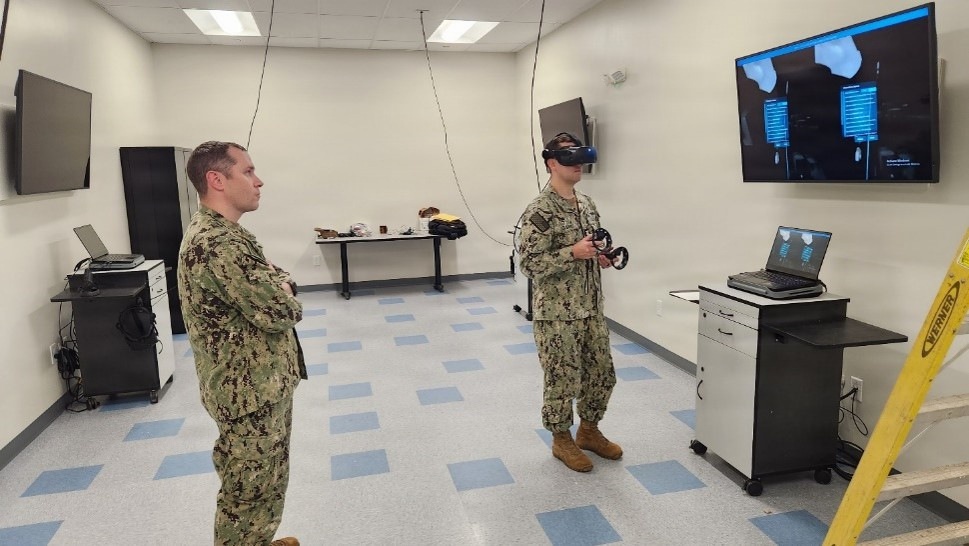
Photo By Peter Clute | At Joint Base Pearl Harbor-Hickam, Hawaii, instructors at Naval Submarine Training Center Pacific test a virtual reality training application from Naval Undersea Warfare Center Division, Keyport. Guided by a “Builders, Not Bureaucrats” philosophy that emphasizes action over red tape, NUWC Division, Keyport is accelerating its innovation pipeline through advancements in manufacturing and digital technologies. (U.S. Navy photo by Aaron Clark/Released) see less
| View Image Page
LOE in Focus: NUWC Division, Keyport’s Human Performance Systems team
The Human Performance Systems team at Naval Undersea Warfare Center Division, Keyport is revolutionizing how Sailors train. Using augmented and virtual reality technologies, this group of developers and 3D artists creates immersive virtual learning environments that provide safe, cost-effective alternatives to traditional training methods.
“Virtual reality allows you to do stuff that previously might have required a giant and expensive physical trainer of some kind,” said Aaron Clark, a project lead and the team’s former acting product owner. “And even with a giant physical trainer, there are limitations, as you can’t expose trainees to a full set of electrical hazards or fully energized hydraulic systems. In the virtual world, however, we can run everyone through that and not have to worry about potential hazards.”
The team, also known as the XR (eXtended Reality) team, is part of the command’s Undersea Systems & Sustainment Engineering Department. Its primary mission is to deliver training that is as engaging and effective as possible. “The broad message in the Navy right now is that our advantage is our people,” said Clark. “Part of the reason for that is that our training is better than anyone else’s.”
The team's developers and 3D artists leverage commercial gaming technology to build what the industry calls "serious games." The process involves working closely with subject matter experts to turn complex procedures and technical data into virtual environments. The team develops prototypes and iterates on them based on feedback from SMEs and users within the Fleet.
The use of commercial gaming technology is advantageous for two main reasons, according to Clark. First, it makes the training more intuitive and engaging for a new generation of Sailors who are already familiar with the aesthetics and user interfaces of video games. Second, it saves costs by eliminating the need to develop the training’s core infrastructure and virtual environments from scratch.
The team’s biggest success story is its Virginia Payload Tube Maintenance Trainer, which has become part of the formal curriculum at Navy schoolhouses. This trainer allows Sailors to practice maintenance procedures on a submarine system that is inaccessible while the submarine is underway or in a shipyard. Since this trainer was implemented, throughput for the training course has tripled, according to Clark.
The team has also built training applications that simulate tasks like assembling a torpedo and verifying electrical equipment is safe to service. It also creates "digital twins" of physical hardware, which allows trainees to become familiar with systems that are obsolete or otherwise difficult to obtain physically. It is also currently exploring the use of artificial intelligence to create a “virtual engineer” that can assist Sailors with troubleshooting and maintenance while underway.
“If you're in a disconnected environment and not able to have a reach-back to a Keyport engineer to assist in a troubleshooting or maintenance evolution while underway, I think the opportunity to have a 'virtual engineer'—meaning an intelligent system that can provide feedback to you similar to how a human would—can ultimately be very valuable for the Fleet,” said Jeremy Landis, technology officer for the Undersea Systems & Sustainment Engineering Department.
According to the team's current product owner, Ken Seacrist, this shift toward extended reality is opening doors for broader collaboration across the Navy.
“With the move into the eXtended Reality space, we are developing organic government partnerships with program offices, shipyards and Warfare Centers,” said Seacrist. “Our mission is to digitally enable the warfighter of today with robust spatial capabilities, allowing them to work more efficiently and train effectively. With our technology, not only can we 'train like we fight,' but we can extend reality to allow us to virtually train where we fight!”
By ensuring Sailors are well trained on real-world maintenance and operational tasks at a minimum of cost and risk to their safety, the Human Performance Systems team directly supports the second and fourth Naval Sea Systems Command Enterprise Lines of Effort, “Generate Readiness” and “Strengthen the Navy Team.”
-KPT-
Naval Undersea Warfare Center Division, Keyport is headquartered in the state of Washington on the Puget Sound, about 10 miles west of Seattle. To provide ready support to Fleet operational forces at all major Navy homeports in the Pacific, NUWC Division, Keyport maintains detachments in San Diego, California and Honolulu, Hawaii, and remote operating sites in Guam; Japan; Hawthorne, Nevada; and Portsmouth, Virginia. At NUWC Division, Keyport, our diverse and highly skilled team of engineers, scientists, technicians, administrative professionals and industrial craftsmen work tirelessly to develop, maintain and sustain undersea warfare superiority for the United States.

 Subscribe






