
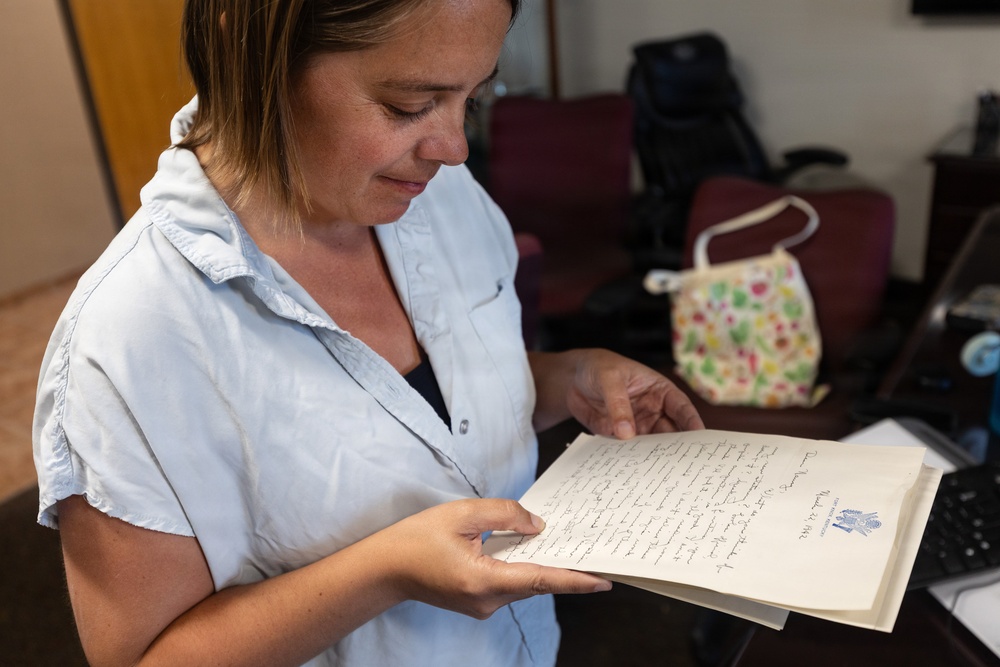
Photo By Eric Pilgrim | Kelli Mitchell, Fort Knox’s historical preservation specialist at the Cultural...... read more read more
FORT KNOX, Ky. — George Edick sat in a dark service club at Fort Knox Aug. 17, 1941, waiting to hear two other Soldiers perform hit songs of the day.
Bad timing: the post was experiencing a power outage, forcing the amateur musicians to postpone their performance until they could power up their borrowed organ and microphone. When the power finally returned, George and other Soldiers sat back and listened.
Later that night, he pulled out some paper and began to write:
“Dear Nancy, here I am again with new and different stationery; I wasn’t able to completely use up all those left-over envelopes,” George wrote to his fiancé Nancy Budd. “Say, does the ruffled edge go at the top or bottom?”
On the second page of the letter, he included some names of hit songs the two Soldiers had eventually performed: songs like “Country Dance,” “Prelude,” “Little Grey Home in the West,” and “I Love Life.” George reflected on some of the songs.
“They did others before they were through. Bill finally got into the groove on some of that popular stuff before he walked away from the organ bench for the last time. I especially liked “Dance Ma Cabre” and “Finlandia;” Bill made the organ talk on those tunes.”
George ended each letter virtually the same: “All my love, George” and mailed them to Nancy almost daily during his year of service at Fort Knox: letters that captured everyday life at the installation during a pivotal time in history – missives about the draft and his concerns about it, about life, death, boredom, prison breaks and more.
Little time capsules written in cursive and drawn from daily experiences prior to World War II made their way to Nancy’s door, and into her heart.
“In these letters I learned about Louisville and Fort Knox and the Brown Hotel,” said Jim Edick, George and Nancy’s youngest of six children. “They describe the daily activities going on at Fort Knox.”
Eighty years later, Jim and his brother Geoff mailed the letters back to Fort Knox and into the hands of Fort Knox Cultural Resources Office personnel.
“We haven’t been able to get into a lot of them yet, but it’s been fun to go through them so far,” said Niki Mills, Cultural Resources manager: “the little details of everyday life that usually don’t get recorded.
“We have these buildings standing today, but we don’t have the stories of the people who lived and worked in them. That’s what these stories are.”
Geoff said the timing of George and Nancy’s whirlwind romance explains a little about why George wrote so many letters to her – a romance that began about six months before he traveled to Fort Knox.
“They went to two different schools in Cleveland [Ohio],” said Geoff. “Mom went to the Flora Stone Mather College for Women. Dad went to Case Institute of Technology.”
Geoff explained that a spring dance at a hotel ballroom in 1940 became the spark that lit their romance. The son of a funeral director, George owned a big car, so he was sometimes sought out for a ride.
When a friend talked him into going to the dance, George brought a date who had broken her leg the day prior. Meanwhile, Nancy went with her own date who was a mutual friend of George’s friend.
Nancy’s date apparently wasn’t much into dancing. George was, so he asked Nancy’s date if he could dance with her. The date said sure.
“It’s almost like they were meant to be,” said Geoff.
George, who was a year ahead of Nancy, started dating her shortly afterward. During that brief time, George graduated and quickly landed a good job with Westinghouse.
Then everything changed. The Army sent George a draft letter.
“In one of his letters, dad wrote, ‘I’m getting shipped out today,’ and explained how his parents were bringing his luggage to the train station in Cleveland,” said Jim. “My mom was a senior in college, so they brought her along.”
While at the station with his mom, dad and sisters standing nearby, George drew Nancy aside.
“Dad had gotten a ring three days prior, so he proposed to her,” said Jim. “Mom accepted, and Dad took his luggage and got on the train. Next thing, he’s in Indiana for like two days, and then on to Fort Knox.”
While on the train to Fort Benjamin Harrison, George penned his first official Army letter to Nancy.
“I think his first paragraph was kind of like, ‘Well, I guess I'm in the Army now so, that’s that,’” said Jim.
Geoff explained how hard it must have been for his parents in the early days of their relationship.
“They were having to learn to live apart when they should’ve been together,” said Geoff. “Everything was hard: trying to do things together – and then the uncertainty of what was going to happen with their relationship.”
An Army conscription lasted a year. After a Soldier had served that year, he was free to go back home. While at Fort Knox in August 1941, George was preparing to get his old job at Westinghouse back and restart his life with Nancy.
Geoff said: “He was thinking, ‘Okay, I just got to get through this year.”
Everything changed again.
“Dear Nancy, some of the men are already leaving for foreign service – for points unknown to them at present,” wrote George on Aug. 18, 1941. “These are regular Army men since the Army cannot as yet send the selectees. These fellows, however, didn’t ask for such service; they’re going as ordered.”
America was rushing toward a war with Germany and Japan. That same month, the Army changed the length of conscription to at least three years.
“Two and a half years is an awful long time especially when I want to get started and accomplish things so that we can get together, but you’re a wonderful goal to work toward,” wrote George. “I miss you terribly, Nancy. All my love, George.”
“You can just see in those letters the sadness and the disappointment in things he was missing,” said Geoff. “Being at Fort Knox was not a bad thing; it was just that he saw friends and other college buddies getting married and going on with their lives.”
The Fort Knox letters became George’s lifeline to Nancy and served to strengthen their relationship, said Jim: “He seemed to like her a lot.”
While at Fort Knox, George worked as a map maker at the installation headquarters. An important map he designed of the post at that time has shed light on how much the post changed and grew at that time and thereafter.
In his spare time, George wrote letters to Nancy about everything he was experiencing - traumatic events like the time a Soldier was killed by a ricocheting bullet during a guardhouse riot, and mundane events like how much time was spent doing various chores.
As inevitability of the war loomed, Jim said, George made plans to marry Nancy before the Army decided to ship him overseas.
“In the letters he talks about trying to get time off,” said Jim.
The letters suggest George planned to use an important date to encourage the Army to grant him leave so he could marry Nancy on Feb. 5, 1942. It worked.
“Dad got to go home from Fort Knox,” said Jim. “February 5 was also his birthday. So, they got married at my mom's parents’ house in Mount Vernon [Ohio]; then they drove to Niagara Falls for three days, then back to Mount Vernon, and then he went back to Fort Knox.”
Shortly afterward, George and Nancy were transferred to a new duty station, George would serve in World War II, and they would have six children. Along the way, George graduated from Officers Candidate School and Nancy taught art at various local schools before eventually settling in as a stay-at-home mother.
“She was just a really neat, smart lady,” said Jim, “but being the mother of six, she stayed home.”
Nancy died in 2011. George followed her in 2013. He had accomplished what he set out to do a lifetime prior, leaving behind six children and a capsule of love and life penned in letters.
| Date Taken: | 06.29.2026 |
| Date Posted: | 06.29.2026 13:49 |
| Story ID: | 568936 |
| Location: | FORT KNOX, KENTUCKY, US |
| Web Views: | 17 |
| Downloads: | 0 |

This work, Fort Knox receives capsule of love and life in letters: The story of George and Nancy Edick, by Eric Pilgrim, identified by DVIDS, must comply with the restrictions shown on https://www.dvidshub.net/about/copyright.


No keywords found.





