How Army Sustainment is shaping the future battlefield
Photo By Alyssa Crockett |
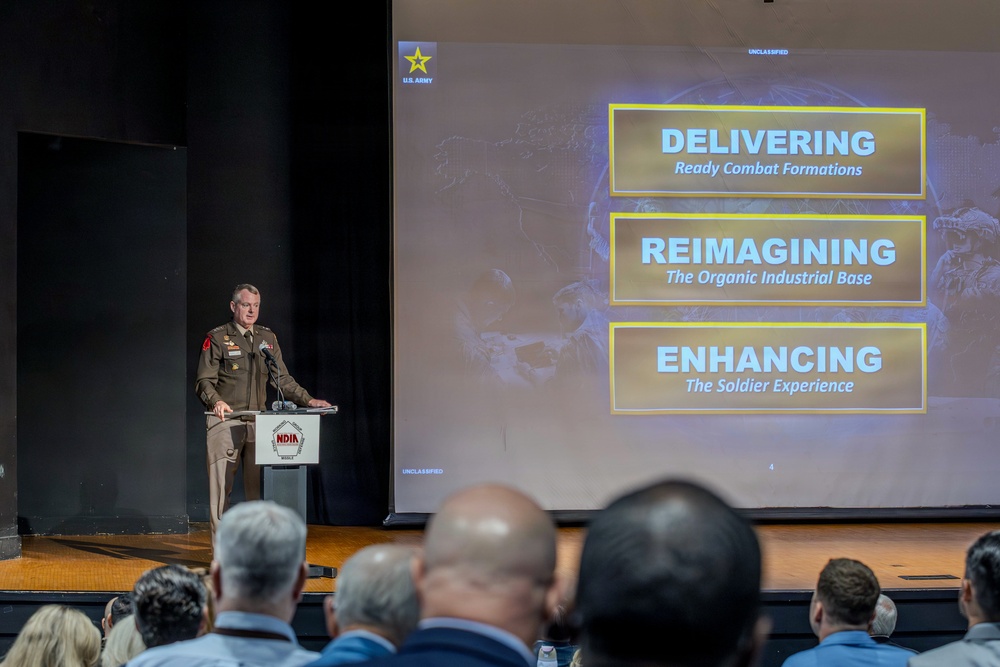
Lt. Gen. Chris Mohan, commanding general of Army Materiel Command, speaks during the......read moreread more
Photo By Alyssa Crockett | Lt. Gen. Chris Mohan, commanding general of Army Materiel Command, speaks during the Space and Missile Defense Working Group June 18, 2026, at the University of Alabama in Huntsville, Alabama. Central to his remarks was how a pivot toward data-centric operations, strategic equipment placement and industrial base transformation is reshaping the modern battlefield. see less
| View Image Page
How Army Sustainment is shaping the future battlefield
HUNTSVILLE, Ala. – It’s no secret that the Pacific region presents some of the most complex logistics and sustainment challenges for both the Army and the joint force.
Lt. Gen. Chris Mohan, commanding general of Army Materiel Command, detailed how AMC is actively working to ease those strains during the Space and Missile Defense Working Group June 18 at the University of Alabama in Huntsville.
Central to his remarks was how a pivot toward data-centric operations, strategic equipment placement and industrial base transformation is reshaping the modern battlefield.
To build supply chain resilience, AMC is leveraging artificial intelligence to make faster, more intelligent sustainment decisions – a move Mohan said is critical. A key element of this effort is Weapon System 360, representing a fundamental shift in how the Army views equipment readiness.
The platform has become the Army's authoritative system, allowing commanders to “look and project forward what the unit readiness is going to look like,” Mohan said. “We have always approached this from a fleet base, and we are going to do it from a unit base.”
The system integrates supply availability, repair parts and industrial capacity with artificial intelligence, allowing AMC to drastically accelerate its analytical capabilities and turn weeks of manual work into minutes.
Retired Gen. Charles Flynn, former U.S. Army Pacific commander, emphasized the region's complexity during the working group, describing the Pacific as “not only an air and maritime theater, but also a joint theater with joint challenges and joint problems, and it requires joint solutions.”
To bridge that geographic gap, the Army is strategically land-basing some of its Army Prepositioned Stocks in the Pacific by establishing footprints in the Philippines and Australia.
However, Mohan stressed that simply placing the equipment isn't enough.
The Army must continually exercise the day-to-day business of sustainment of APS – from customs and maintenance, to exercising, issuing and access and placement – to build the muscle memory that supports Army Service Component Command and Combatant Command requirements.
Sustaining this logistical footprint is what establishes the Army as the “linchpin force” that enables and sustains joint and allied partners across the theater, according to Flynn.
To ensure the Army can continue supplying those partners, the command is rapidly transforming its Organic Industrial Base – the depots, arsenals and ammunition plants that generate readiness. As the Army’s designated lead for advanced manufacturing, the AMC enterprise is making critical investments in robotics and data to scale its capabilities, which includes opening a new brushless motor production line at Tobyhanna Army Depot and manufacturing small-UAS components like carbon fiber bodies, wiring harnesses and batteries.
Ultimately, all these modernization efforts serve a single purpose.
“We cannot forget why we're doing this: it's for our Soldiers, so that our Soldiers can be the most lethal fighting force that the world has seen,” Mohan said, adding that AMC is also driving quality-of-life improvements across the enterprise, from 3D-printed barracks to Campus-Style Dining Venues.

 Subscribe






