
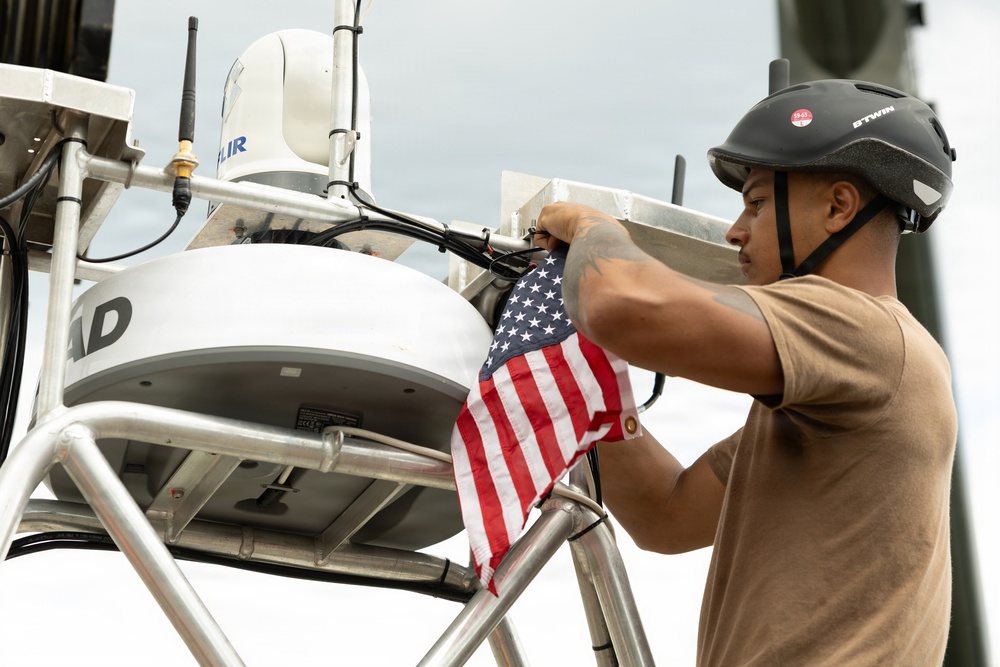
Photo By Petty Officer 3rd Class David Keenan | 260612-N-JH316-1095 GDNYIA, Poland (June 12, 2026) - Engineman Fireman Anthony Lucas,...... read more read more
 Subscribe
June 15, 2026
Story by Mass Communication Specialist 3rd Class David Keenan
GDYNIA, Poland (June 15, 2026) - Sailors from Unmanned Surface Vessel Division 32 (USVDIV-32) are at the forefront of the Navy’s fleet during exercise Baltic Operation 2026 (BALTOPS 2026), delivering realistic counter-unmanned surface vessel (USV) training against unmanned vessels to NATO allies.
Established early this year, USVDIV-32 is one of the newest additions to the Navy’s unmanned operational units. Tasked with maintaining and implementing unmanned vessels, the division’s sailors regularly conduct exercises and training with multiple platforms, with the most common being Global Autonomous Reconnaissance Craft (GARC).
“GARCs are just one of the several USVs,” says Lt. Sarah Weinstein, commanding officer of USVDIV-32. “GARC is just the one that we've had the most experience with in the last couple of years, but they're all very similar.“
A defining feature of USVDIV-32 is the implementation of a new rate, Robotics Warfare Specialist (RW). RWs are trained to operate and maintain vessels such as GARCs.
Robotics Warfare Specialist 3rd Class Joshua VanDeCreek expressed pride in serving in this new field. “I’m proud to be a part of a new unit in the Navy, one that I think is going to be very important,” he said. VanDeCreek added that he is really excited to be on the front lines of a new technology which he believes will keep more people safe by sending USVs as opposed to personnel, calling it “a great step in the future.”
Chief Robotics Warfare Specialist Christian Butler highlights the future importance of RW’s role, saying, “I think most commands, if not all commands, are going to have some component of RWs. Just because there's no going away from unmanned systems at this point, they're only going to grow in scale, and you're going to need RWs to carry that weight.”
During BALTOPS 2026, USVDIV-32 played a crucial role by deploying GARCs as an opposing force to allied forces. This has simultaneously provided allied ships a chance to test their abilities defending against USVs and also provides valuable experience for USDIV-32 seeing their GARCs in action.
“The first difficult part is spotting the USV,” explains Lieutenant Weinstein. “What does it look like? What are the telltale signs that it might be a USV? How to tell if it's coming inbound, and its different behaviors that it's able to display as it gets closer to the ship”
Lt. Weinstein explained the learning opportunity this provided, “It's one of the first times that we've ever had them maneuver against our USV, so seeing the USV response as they go through their PPRs (Pre-Planned Responses) has been a great learning opportunity for us.”
As the Navy moves towards a hybrid fleet, USVDIV-32 is playing the key role in being among the first to implement this technology. The division's work in BALTOPS 2026 has been invaluable not only for the allied forces but for the USVDIV-32 as well.
The sailors of USVDIV-32, with the emerging Robotics Specialist rate, are carving the path for the future of the Navy.
This is only the beginning of this technology, with no end in sight for the importance and potential of its use. Lt. Weinstein remarks, “I think the technology and the autonomy will continue to grow to give them more options to make USVs more lethal or more effective at executing the mission that they've been tasked with.”
| Date Taken: | 06.14.2026 |
| Date Posted: | 06.24.2026 12:10 |
| Story ID: | 568108 |
| Location: | US |
| Web Views: | 199 |
| Downloads: | 0 |

This work, Pioneers in the Fleet: USVDIV-32 Advances Unmanned Operations with NATO During BALTOPS 2026, by PO3 David Keenan, identified by DVIDS, must comply with the restrictions shown on https://www.dvidshub.net/about/copyright.


No keywords found.




