
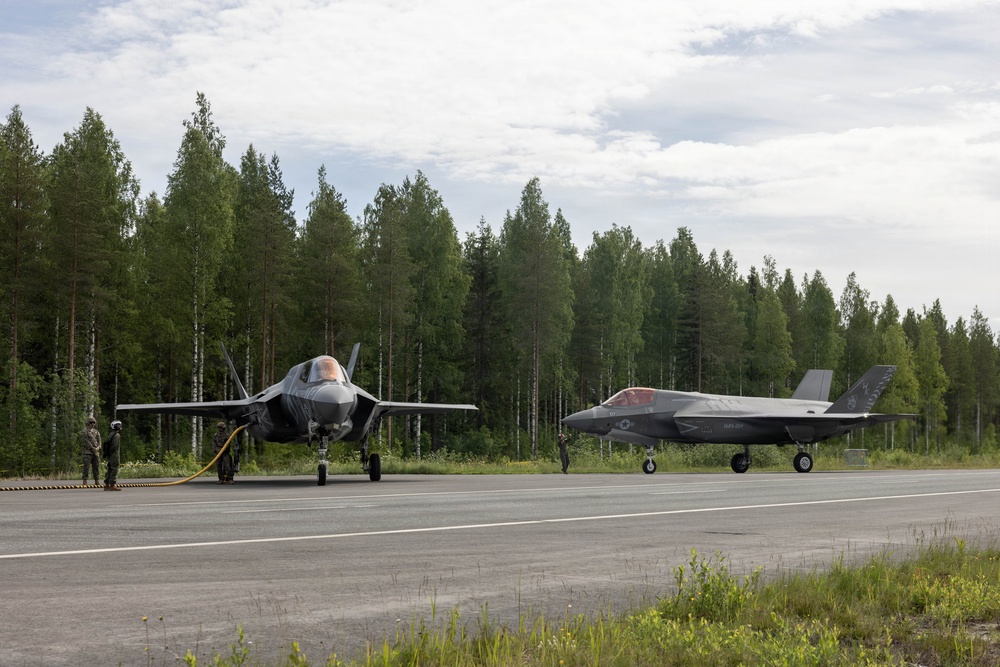
Photo By Cpl. Mya Seymour | Two U.S. Marine Corps F-35B Lightning II aircraft with Marine Fighter Attack Squadron...... read more read more
 Subscribe
In a historic first, U.S. Marine Corps F-35B Lightning II Joint Strike Fighters from Marine Fighter Attack Squadron 224 (VMFA-224), successfully conducted landing and takeoff operations on a highway strip in Tervo, Finland.
The event, which took place from June 8-12, 2026, also marked the first time Polish and Spanish Air Force aircraft operated from a Finnish roadway. The event also comes on the heels of the canceled deployment of U.S. Marine Corps F-35s during Norway’s exercise Cold Response in March and marks the first deployment of U.S. Marine Corps F-35s to Finland.
This milestone occurred during Exercise Ramstein Flag 2026, a large-scale NATO exercise designed to enhance the readiness and interoperability of Allied air forces and demonstrate NATO’s ability to project lethality across large engagement zones.
“This iteration of Ramstein Flag stretches from the northernmost parts of Norway to the southern reaches of Spain, showcasing Allied Airpower's 360-degree approach to defend every inch of NATO territory," said U.S. Air Force Lt. Gen. Jason T. Hinds, commander of Allied Air Command. "The scale of this exercise is a testament to NATO's determination to counter modern and emerging threats through distributed operations across NATO's Joint Operations Areas."
The highway operations involved U.S. Marine Corps F-35Bs, Spanish F-18s, and Polish F-16s, with forward arming and refueling support coming from U.S. Marines with Marine Wing Support Squadron 272.
The operation provided NATO Allies with a unique opportunity to practice agile combat employment concepts, a strategic capability that enables NATO to project combat power from dispersed and non-traditional locations. During conflict, this concept would allow allied air forces to extend the reach of aircraft fare beyond traditional airfields and infrastructure.
The commander of U.S. Marine Corps Forces, Europe and Africa, U.S. Marine Corps Maj. Gen. Daniel Shipley emphasized that successful execution highlights the Alliance's ability to adapt and operate in complex environments, ensuring that Allied forces can project expeditionary lethality from anywhere at any time.
"Our mission is to ensure the joint force can fight and win," Shipley said. "Our participation in Ramstein Flag enhances the lethality of the Marine Corps, enables NATO success and guarantees our ability to deter and defeat sophisticated aerial threats."
The operation also incorporated major elements from across the Nordics. The recently established Combined Air Operations Center in Bodo, Norway orchestrated air command and control over the highway operations as well as other air-to-air and deep strike scenarios during the exercise. Liaison officers from 2nd Marine Aircraft Wing provided enabling support to the CAOC and worked directly with more than 19 nations to coordinate multi-national air power.
The event underscores increased European leadership within NATO and its capacity to project capabilities and to directly engage any threat.
| Date Taken: | 06.16.2026 |
| Date Posted: | 06.17.2026 07:31 |
| Story ID: | 567979 |
| Location: | FI |
| Web Views: | 759 |
| Downloads: | 0 |

This work, U.S. Marine F-35s land on Finnish highway for the first time, showcasing NATO agility, by MGySgt Scott Schmidt, identified by DVIDS, must comply with the restrictions shown on https://www.dvidshub.net/about/copyright.


No keywords found.




