
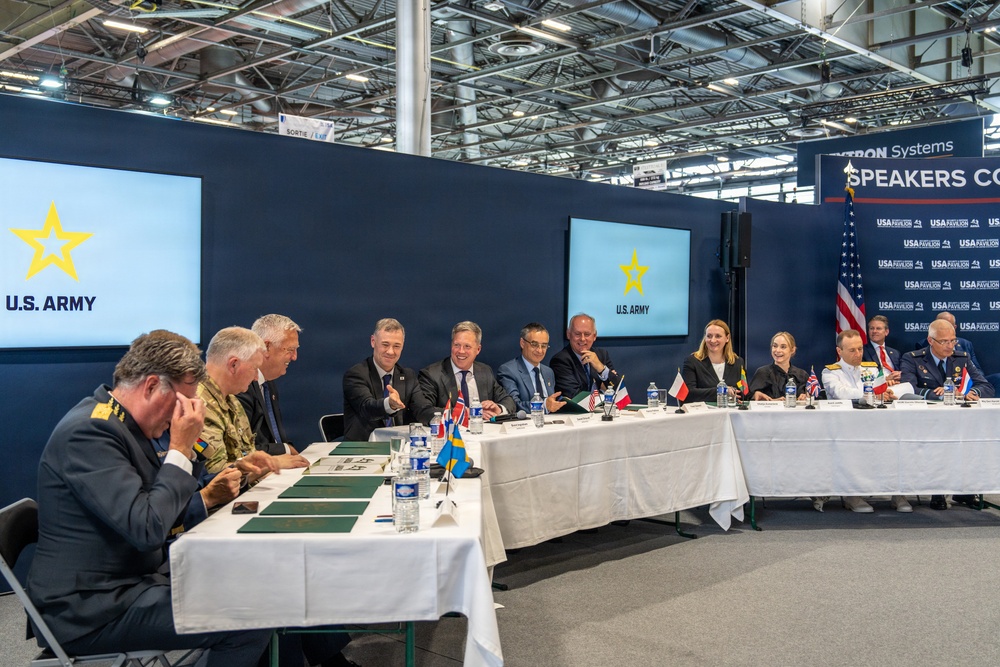
Photo By Maj. Alexander Watkins | Secretary of the Army Dan Driscoll leads a signing ceremony with NATO allies and...... read more read more
 Subscribe
PARIS — Secretary of the Army Dan Driscoll called for faster acquisition, stronger interoperability, and closer cooperation with allies and partners during a letter of intent signing ceremony held during the second day of Eurosatory 2026. The agreement is intended to expand the Counter-Unmanned Aircraft Marketplace granting allies and partners access to counter-drone capabilities that have been proven on today’s battlefields.
The ceremony brought together U.S. Army leaders and representatives from NATO Allies including Sweden, Denmark, Norway, France, Poland, the United Kingdom, the Netherlands, Italy, and Lithuania to address one of the most urgent challenges facing modern militaries: how to move faster against the unmanned aircraft systems threat.
The letter of intent affirms Allied commitment to streamline counter-UAS acquisition and training while helping participating nations identify, evaluate, and field capabilities at the pace required on today’s battlefield.
For Driscoll, the agreement is part of a larger effort to change how the Army connects battlefield needs with industry solutions.
“What we’re fundamentally trying to do here is bring in the same market portals that have made so many companies successful in our country and yours, and just get our government and other governments’ regulation out of the way,” Driscoll said.
Driscoll described the counter-UAS marketplace as a practical way to make acquisition more transparent, responsive, and informed by the Soldiers and operators who use the equipment. He said the model is designed to give allies and partners access to user feedback, allow vendors from participating nations to compete in the same environment, and help governments scale systems that prove effective.
“What we think will work is to allow transparent access to user feedback,” Driscoll said. “What we think will work is to allow everyone here to offer their products to Soldiers around the world and us to just listen to Soldiers, get their feedback, and then scale the things that work.”
Unmanned aircraft systems continue to reshape the battlefield, creating new requirements for force protection, air defense, and rapid adaptation. Small drones, one-way attack systems, and other unmanned platforms have increased the demand for layered detection, tracking, and defeat capabilities that can be fielded quickly and integrated across allied formations.
Driscoll said the challenge is not only acquiring better equipment, but also making sure those systems can work together across nations and services.
“What we know is this inflection point of war is going to require us to create compatible systems,” Driscoll said. “To do things like air defense, we need all of our equipment to be interoperable at a minimum.”
Interoperability was a central theme of the event. Leaders described the effort as more than a procurement initiative, framing it as a way to help allied and partner forces share information, compare capabilities, align requirements, and reduce barriers that can slow the delivery of emerging technologies to the force.
Driscoll pointed to Project Jailbreak, a U.S. Army effort aimed at improving how Army systems share data, as one example of the service’s work to remove technical barriers. He said the Army reviewed about 100 systems in 30 days and identified a larger requirement to ensure Army equipment can transmit and receive data through common digital interfaces.
The Army is also preparing to apply similar lessons in Europe through the Eastern Flank Deterrence Initiative, known as EFDI. Driscoll said the goal is to help vendors build to allied requirements from the beginning, making systems more useful, more compatible, and easier to field.
The marketplace initiative begins with counter-drone systems, but Driscoll described a broader vision that could eventually include drones, radars, sensors, tanks, helicopters, and other major capabilities. The long-term goal is to create a trusted environment where allied nations can identify, evaluate, and procure equipment more efficiently while giving industry clearer insight into operational demand.
Additionally, the ceremony highlighted the role of industry in helping the Army and its partners keep pace with emerging threats. Driscoll said acquisition reform depends not only on government action, but also on sustained collaboration with companies that can deliver tested, practical capabilities.
Testing was another focus of Driscoll’s remarks. He said the Army is working to expand access to ranges and reduce delays that prevent vendors from rapidly proving their systems. Faster testing is essential to helping governments determine what works and move effective capabilities into the hands of Soldiers and allied forces.
Following the signing, Driscoll linked the agreement to the trust and speed required in modern conflict. He said interoperability will shape how allies work together in the future and described the agreement as a first step toward systems that support decision-making at the speed of war.
Eurosatory, a major international defense and security exhibition, provided a setting for the signing by bringing together military leaders, government officials, and industry representatives from around the world.
Driscoll’s remarks placed the signing within a larger Army modernization effort focused on speed and Soldier-informed innovation. As unmanned systems continue to evolve, Army leaders said the ability to move quickly with allies and partners will remain central to deterrence, readiness, and operational advantage.
The counter-UAS letter of intent represents an early step in that effort, one focused on reducing friction, expanding cooperation, and helping allied forces move from shared requirements to fielded capability faster.
| Date Taken: | 06.15.2026 |
| Date Posted: | 06.16.2026 10:37 |
| Story ID: | 567892 |
| Location: | FR |
| Web Views: | 444 |
| Downloads: | 0 |

This work, Army secretary highlights counter-UAS cooperation, acquisition reform at Eurosatory 2026, by MAJ Alexander Watkins, identified by DVIDS, must comply with the restrictions shown on https://www.dvidshub.net/about/copyright.


No keywords found.




