
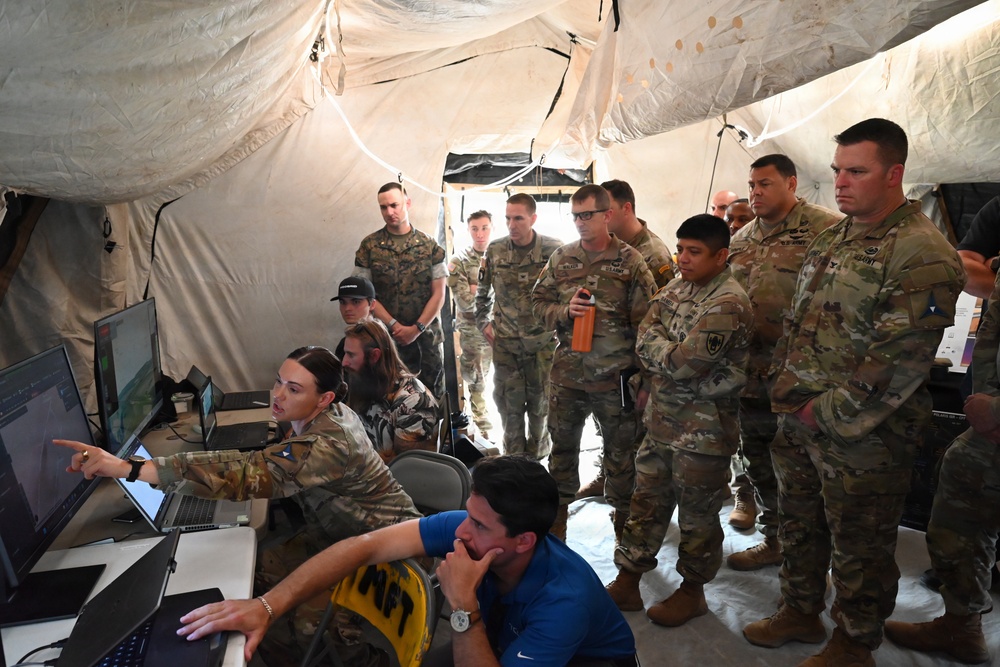
Photo By Derika Upshaw | Capt. Jena Tyson, III Armored Corps intelligence data team lead, explains what is...... read more read more
 Subscribe
FORT HOOD, TEXAS —The III Armored Corps Intelligence and Data Fusion Lab and vendors demonstrated new UAS sensor integration capabilities that can help leaders make decisions faster June 5 at the Pilot Knob Range during their sensor integration demonstration.
The new integration system takes about two to five minutes to process information versus the current system which takes approximately 27 minutes, providing leaders an extra 20 minutes adversaries do not have, to make decisions.
According to Maj. Eric J. Slater, officer in charge of the III Armored Corps Sensor Integration office, this is an example of decision dominance.
“My commander has the capacity to make decisions that affect the battle, the operational environment and the enemy commander doesn’t have a vote because we have more information. We’re processing the information faster, and our commanders are capable of making decisions that the other commanders have had taken away from them.”
Slater said the purpose of the Intelligence and Data Fusion Lab was to fix the historical problem of delays in receiving information from sensors. Previously, sensor data was routed to a dedicated computer. Systems were not interoperable, preventing effective communication.
In contrast, the new system can read over 100 different systems and can be programmed to meet the needs of any command team’s current information system.
“You have to communicate with each other in order to get the complete picture of everything that’s going on around you, and what that introduces is latency,” Slater explained, providing an example.
“It’s slower for you to have to communicate what you’re seeing to him, and him to have to communicate what he’s seeing to you, for both of you to have a complete understanding,” he said, using the interviewer and a Soldier as an example.
Slater said their solution was to pull all the sensors into one system.
“We’re using a middleware solution to pull in all of the sensor data, and then we’re sending it to an intelligence system,” he said. “We’ve created a connection to an intelligence platform that’s capable of characterizing the threat … based upon known enemy platforms.”
Slater explained from there, the data is immediately routed to the mission command information system commanders are using.
“How powerful that would be to see every single piece of information coming off your sensors coming to your screen in a refined manner that enables you to make tactical decisions at the correct place with the correct information,” Slater said.
The demonstration displayed four types of sensors from short and long-distance systems — Acoustic, Discovair G2+, Falcon Medium and EchoShield Radar. The demonstration simulated a real-world event using Soldiers from 2nd Battalion 5th Cavalry Regiment, 1st Armored Brigade Combat Team, 1st Cavalry Division using sensor integration and unmanned aircraft systems to detect and respond to enemy drones and tanks.
The event was geared toward general officers, brigade command teams, Transformation in Contact commanders and staff, intelligence personnel, transformation leads and operation personnel. Chief Warrant Officer 2 Trenton Huntsinger, 1st Cav. Div., Artillery, explained the scenario, which featured a field-ready system already in use within 1st Cav. Div.
“The enemy fly drones in, we detect it, we say with high confidence this is a legit target,” Huntsinger explained. “It goes to our targeting software, and we confirm that target. It will then launch aircraft, so we’re going to launch two bumblebees, which are quadcopter UAS (unmanned aircraft system), to go interdict.”
Col. Alvin Word, director for the Intelligence Transformation Integration Directorate, Intelligence Center of Excellence, Fort Huachuca, Arizona, said he was impressed with the team’s demonstration.
“They are absolutely advancing the concepts of what we think we need on the modern battlefield,” Word said. “But they are doing it in such a way that this isn’t just an experiment, this is a demonstration of capability right now that with a little bit more refinement that we’ll be able to deliver meaningful, impactful capabilities to the tactical layer, so that we can find, fix and finish the adversary before he even understands what is coming.”
Slater said the main thing he wants commanders to take away from the demonstration is the importance of helping them become more lethal.
“I want commanders to understand that the corps is throwing its weight behind designing these solutions in order to make them effective in the operation environment and provide their intelligence professionals with the tools necessary in order to be successful at enabling their targeting as well as their situational understanding and their protection of their own forces,” he said. “I want them to really come back to us with feedback of ‘Here’s what I needed from you,’ … to push us further along with helping them be successful.”
| Date Taken: | 06.11.2026 |
| Date Posted: | 06.16.2026 10:35 |
| Story ID: | 567585 |
| Location: | FORT HOOD, TEXAS, US |
| Web Views: | 71 |
| Downloads: | 0 |

This work, Intelligence unit leverages technology to protect Soldiers, by Derika Upshaw, identified by DVIDS, must comply with the restrictions shown on https://www.dvidshub.net/about/copyright.


No keywords found.




