
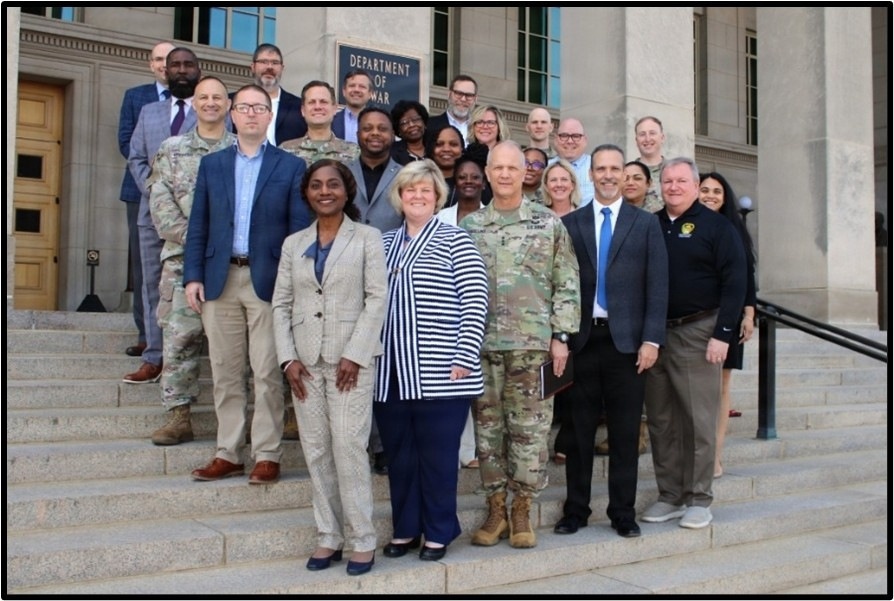
Photo By Aliyah Harrison | Members of the DASA(P) Advisory Board gather on the steps of the Department of War,...... read more read more
 Subscribe
by Maj. Morgan McCreary and Michael Stock
The Deputy Assistant Secretary of the Army for Procurement (DASA(P)) convened its DASA(P) Advisory Board on April 22-23, 2026, for a pivotal two-day summit at the Pentagon. The summit focused on accelerating artificial intelligence (AI) integration and workforce transformation across Army contracting.
Chaired by DASA(P) Kimberly Buehler, the event brought together senior Army acquisition leaders and Head of Contracting Activity (HCA) representatives. The agenda centered on “The AI Revolution in Army Contracting” and “The Evolving Role of the Contracting Professional,” reflecting the Army’s commitment to modernizing its procurement enterprise.
A major highlight was the launch of the Procurement Capability Advisory Board (PCAB), a new governance body designed to streamline the delivery of essential acquisition tools and foster cross-Department of War collaboration. The PCAB replaces the former Army Contract Writing System Leadership Advisory Board and will oversee the entire procurement life cycle, ensuring rapid, user-focused capability development.
Looking ahead, the Army discussed the status of multiple AI-driven pilots and unveiled a plan for the development of the Acquisition Total Life cycle Automation System (ATLAS) concept that would serve as an agility layer to transform the current Army Contract Writing System into a fully AI-enabled platform. ATLAS aims to deliver at least 40%-time savings per contract, enabling quicker delivery of capability to the Soldier.
Workforce transformation was a key theme, with leaders emphasizing that AI amplifies the need for subject matter expertise rather than replacing it. The Army’s Intelligent Automation (AIT) team, credited with over $30 million in annual cost avoidance, demonstrated tools like AI-Powered Public Square, also known as AI-PUPS, and PAMela, but cautioned that AI’s value depends on skilled human oversight.
As Craig Stiller, DASA(P) AIT Team Lead, stated, “AI offers government a powerful opportunity to improve decision-making, accelerate delivery and create greater value. But its promise depends on how it is used: as a tool to support human judgment, not replace it. Guided by critical thinking and subject matter expertise, AI shifts from being just an answer engine to becoming a true thinking partner, working alongside our contracting experts to shape the future of acquisition.”
The summit also addressed workforce challenges, including the impact of the Deferred Resignation Program on the Army’s 8,000-plus contracting professionals and the need to strengthen certification and talent management. The evolving “Army Business Advisor” role was highlighted as a model for proactive, strategic engagement in acquisition.
DASA(P) reaffirmed its commitment to three lines of effort: improve, integrate and innovate—eliminating barriers, building trust and harnessing technology to deliver smarter, faster acquisition outcomes.
With the PCAB established, smart contracting pilots underway and ATLAS on the horizon, Army contracting is poised for its most significant transformation in decades, defining the future of defense acquisition.
For more information, go to https://armyeitaas.sharepoint-mil.us/sites/ASA-ALT-PAM (CAC-enabled).
Maj. Morgan McCreary is the executive officer to the DASA(P). He holds an M.S. in park and recreation management from the University of Mississippi, a B.S. in health and physical education from Appalachian State University and is a DAWIA Certified contracting professional.
Michael Stock is the special assistant to the DASA(P). He holds an MBA from Saint Martin’s University, a B.S. in criminology from Niagara University and is a DAWIA Certified contracting professional.
| Date Taken: | 06.08.2026 |
| Date Posted: | 06.12.2026 17:31 |
| Story ID: | 567584 |
| Location: | US |
| Web Views: | 112 |
| Downloads: | 0 |

This work, Army Contracting Enterprise Leaders Chart the Way Forward, by Aliyah Harrison, identified by DVIDS, must comply with the restrictions shown on https://www.dvidshub.net/about/copyright.


No keywords found.




