
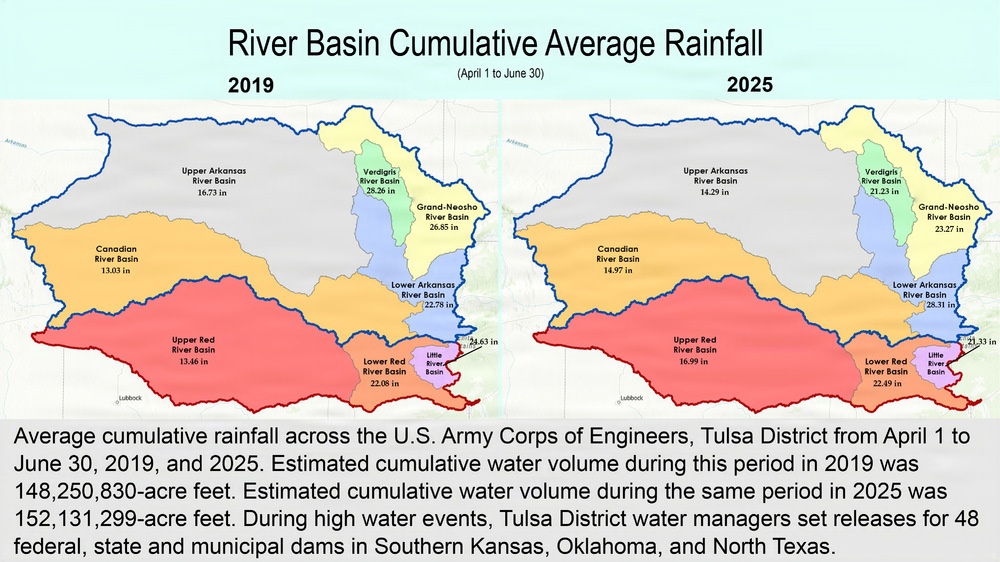
Photo By Brannen Parrish | Average cumulative rainfall across the U.S.Army Corps of Engineers, Tulsa District...... read more read more
TULSA, Okla. —In 2025, U.S. Army Corps of Engineers, Tulsa District flood control infrastructure and water management execution prevented more than $2.6 billion in flood damages despite record-breaking rainfall in Oklahoma, parts of Texas and Kansas.
Well-maintained flood control infrastructure, quality data, information analysis and even some cooperation from the weather helped ensure a high-water event in 2025 didn’t become a flood event.
More than 152.1 million acre-feet of water fell on Tulsa District’s watersheds between April and June 2025, compared to 148.88 million acre-feet over the same period in 2019.
The difference in water volume over the same three months in 2025 versus 2019 is staggering. An estimated 1.26 trillion more gallons of water fell in 2025 during that period. For perspective, the difference in volume is enough to fill Lake Eufaula to elevation 597, the top of its flood pool, and leave enough surplus water to meet Oklahoma City’s needs for 34 months.
Adjusted for inflation, Tulsa District prevented $8.6 billion in flood damages during the 2019 flood fight.
In both years, the Tulsa District operated its dams according to the same water management manuals and principles.
So, why didn’t 2025 result in large-scale flooding?
“The rain that fell in 2025 was more spaced out over the entire wet period compared to 2019, which had a few events in April to prime the river basins before the enduring heavy rains in May,” said David Druzynski, a Tulsa District water manager who oversees releases at five dams in the Upper Arkansas River Basin in Kansas and Oklahoma, as well as two Red River Basin dams.
The differentiation in weather patterns allowed Tulsa District water managers to remove water from the system, recover flood storage, and prevent large-scale flooding by storing runoff while downstream runoff subsided. As a result, 2019 is remembered for large flood releases in the Arkansas River Basin during a single, monstrous May, while 2025 is easily forgotten despite a relentless, three-month soaking that saturated the basins and ultimately produced a higher cumulative rainfall across the district.
“It all boils down to time and concentration,” said Joe Large, Tulsa District chief of water management, USACE. “Rainfall was more dispersed across the district in 2025, and moved into different watersheds, which gave us more time to evacuate water between each round of precipitation.”
In 2019, the Arkansas River and its tributaries, which include the Verdigris River, Grand-Neosho and Canadian river basins, received more than 106.63 million acre-feet of water between April and June, compared to 103.20 million acre-feet in 2025.
Meanwhile, the Red River Basin drove the record 2025 totals. Cumulative precipitation there from April to June 2025 exceeded 2019 totals by 7.3 million acre-feet, roughly 142% of Lake Texoma’s cumulative storage. One of the constraints water managers contend with when making release decisions is unregulated flow. These flows are caused by rainfall and runoff in drainage areas downstream of USACE-operated reservoirs and reduce channel capacity.
Water managers must consider these downstream conditions when determining when, where, and how much water they can release during widespread high-water events because they consume channel capacity.
Unregulated flows affected Waurika Lake water releases in 2025. Located in Jefferson County, Oklahoma, Waurika Lake covers approximately 10,000 surface acres at elevation 951.4, the top of its conservation or normal pool. By the end of the day on April 20, Waurika Lake was at elevation 949.51, nearly 1.9 feet below normal pool elevation.
Eight days later, Waurika Lake reached elevation 952.55, but downstream runoff into Beaver Creek, which flows along the southwestern edge of the city of Waurika, reduced channel capacity. With Beaver Creek full, Waurika was unable to release water until May 3.
Additional rainfall in the basin forced a temporary halt to water releases, and Waurika Lake reached elevation 962.95 and exceeded 100% of its flood storage pool by May 8.
“For me, the atmosphere during the 2025 event had a looming sense of anticipation,” said Josh Phillips, Waurika Lake and Upper Red River Basin water manager, Tulsa District, USACE. “I was asking myself, ‘Where is the next rain going to fall? When will the downstream channel clear out so I can safely make releases?’ Beyond that, I knew that once we had the smaller projects under control Lake Texoma and the Lower Red River Basin would have to deal with all that water.”
Water releases resumed May 9, but repeated rain events and limited downstream channel capacity kept the lake above 50% of its flood storage capacity until June 1. Waurika Lake's elevation remained above elevation 951.4 until December.
“Conditions can change much faster for smaller projects, so you have to be ready to make adjustments to release plans in a shorter period of time,” said Phillips. “It’s much easier for a bike or car to speed up or slow down than a semi-truck or a freight train.”
The situation around the Arkansas River was different. Despite significant rainfall in the Arkansas River Basin and its tributary basins, none of the 29 flood control reservoirs in the system exceeded 100% of their flood storage capacity in 2025.
The Grand-Neosho, Verdigris and Canadian River Basins flow into the Arkansas River. Combined, they cover about 112,000 square miles. During basin-wide high-water events, water managers coordinate water releases between as many as 29 reservoirs in Kansas and Oklahoma.
Tulsa District water managers are guided by the available capacity in immediate and downstream channels when making releases. In the Arkansas River Basin, the Van Buren gage just across the Arkansas border is the regulating point. The water level there must not exceed the 22-foot river stage.
“The gage at Van Buren is a constraint we operate under. We’re watching it to keep the Arkansas River in the banks, but because of the timing, locations and depth of rainfall, we were able to release enough to recover storage between rain events,” said Adrian Saenz, Canadian River Basin water manager, Tulsa District, USACE. “At Lake Eufaula we reached about 93% of flood storage but we were able to consistently release near 40,000 cfs because there was room in the channel at Van Buren.”
Understanding downstream water conditions helps water managers make decisions about releases. Data from stream gages informs them about rainfall amounts and the volume of water flowing into rivers and creeks.
“In a flood fight environment, water managers are requesting data and updates from other hydraulics and hydrology sections hourly,” said Druzynski. “To make the most informed decisions, we are looking at each hour’s data drop with more scrutiny and trying to determine what the last hours’ worth of data implies for the overall lake conditions and future trends. It can sometimes feel like reading tea leaves if it’s been very windy for hours on end because it causes wave action at the gage and results in data reads on peaks and troughs.”
The Van Buren gage is one of many that capture information about river flows. Combined, the Tulsa District and the U.S. Geological Survey own and manage more than 500 stream gages across watersheds within Tulsa District’s boundaries. These gages send the data to the district, so forecasters and water managers know how much water has entered channels and reservoirs.
“Informed decisions are based upon the quality of the data, so we gather a lot of data about rainfall, river stages and flows to make sure a rain event doesn’t become a flood to the best of our ability,” said Rachel Felice, Tulsa District chief of hydrology and hydraulics, USACE.
Tulsa District stream gage technicians maintain and monitor these devices to ensure data is accurate and available to water managers, forecasters and the public.
The Water Control Data System website, www.swt-wc.usace.army.mil, reflects data from USACE and USGS stream gages. The site also provides historical data to users.
“When users visit the Tulsa District’s Water Control Data System website, what they’re seeing is the data captured by the stream gages in our district,” said Felice. “Farmers, anglers, boaters and commercial enterprises use our sites to plan and get information about what’s going on in the lakes and rivers.”
Forecasters review and compare weather data to provide models that help water managers prepare for different scenarios. These models assist water managers by helping them prepare contingency plans.
“Overall, water management is tied to the hip with our respective forecasters the most because we want to know what the latest model iteration is predicting, how we can potentially adjust the release plan accordingly, and what other contingencies may arise,” said Druzynski.
Managing releases between 48 federal, state and municipal dams across nearly 163,000 square miles—an area nearly the size of California—requires communication and a coordinated team effort.
"Through teamwork, specialized expertise, and strategic tool utilization, we executed our water control plan," remarked Col. Jessica Goffena, USACE Tulsa District commander. "Our staff's joint efforts and reliable infrastructure kept the system operating as designed. This is the core of our daily mission."
| Date Taken: | 06.11.2026 |
| Date Posted: | 06.11.2026 16:41 |
| Story ID: | 567494 |
| Location: | TULSA, OKLAHOMA, US |
| Web Views: | 225 |
| Downloads: | 0 |

This work, The Flood That Wasn’t: The Quiet Flood of 2025, by Brannen Parrish, identified by DVIDS, must comply with the restrictions shown on https://www.dvidshub.net/about/copyright.


No keywords found.





