
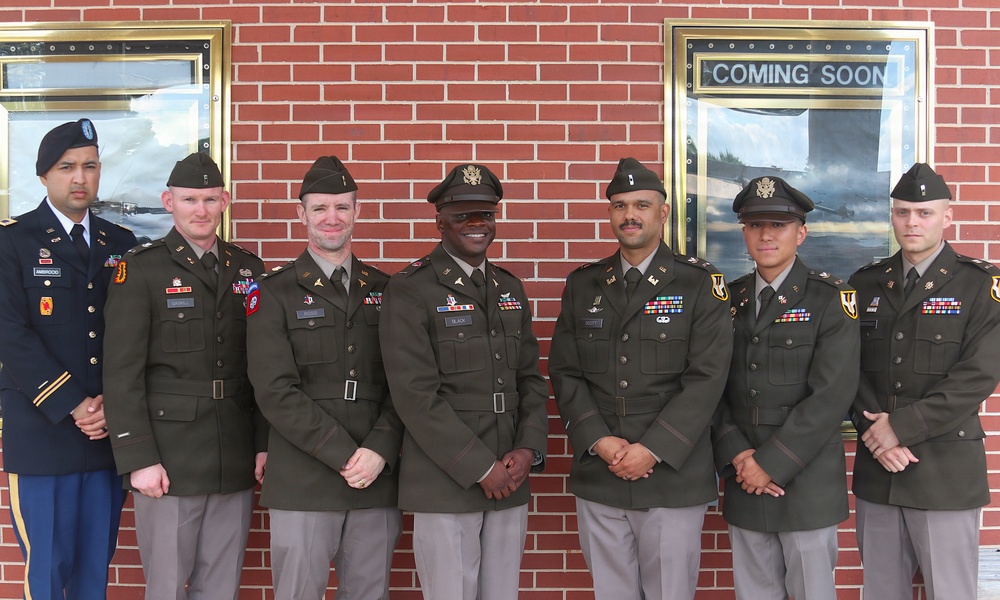
Courtesy Photo | Newly minted Software Operations Technicians gather for a photo following a Warrant...... read more read more
 Subscribe
FORT RUCKER, Ala.--Army Software Factory noncommissioned officers marked a milestone in their careers as they became Software Operations warrant officers, graduating from Warrant Officer Candidate School at Fort Rucker, Ala., June 10.
The 280A Software Operations Technician is the Army’s newest functional area.
“We realized the operational power of having Soldiers who have software operations skills paired with Soldiers with artificial intelligence skills to solve problems for commanders,” said Howard K. “Howie” Brewington, deputy director of the Mission Command Center of Excellence based at Fort Leavenworth, Kansas.
The Army Software Factory is an Army Transformation and Training Command unit that enables Soldiers to reach global mission outcomes through software operations. They find hidden tech talent in the Army to build proficiency and mastery in commercial technologies and processes. This results in an upskilled technical force that enables the Army to be better prepared for software-centric and dynamic contested environments.
The traditional path for transitioning an NCO to Warrant Officer was too slow to support the rapid transformation needed, so the MCCoE encouraged exceptional NCOs that were Army Software Factory ASI complete to submit their packets for the FA28 Software Operations Functional Area Selection Panel in the fourth quarter of Fiscal Year 2025.
The NCOs were selected through a rigorous multi-stage interview process, which examines military performance records and experience, civilian experience and technical aptitude. The NCOs then received 12 months of training and real-world operational experience on a Software Development Team.
Brewington said Soldiers with a passion for software operations now have a path to continue serving their nation, whereas a year ago, the Army was losing NCOs with these skill sets to industry.
“…Same thing with warrant officers, same thing with officers. We said this is important enough that we need to have a specialty called Software Operations, a functional area. Functional Area 28 includes Area of Concentration 28A Software Operations Officer, and MOS 280A Software Operations Technician,” he said.
Standing up a functional area that includes officers, warrant officers and noncommissioned officers who want to become warrant officers, benefits the operational force, the Soldier and Army recruiting and retention goals.
“If you think about a Venn Diagram with three circles: the needs of the Army; the knowledge, skills, attributes, and other characteristics of the Soldier/Leader; and the desires or preferences of the Soldier, you find the place where those three circles overlap, you color that in, put a Soldier there, and they will stay in our Army forever,” he said.
Warrant Officer DJ Barroga, a product designer who previously served as a 25B IT specialist, was serving as an NCO in an Army operations and training office in Hawaii when he saw the military personnel (MILPER) message that went out, and he applied.
“I am the empathizer-in-chief: I go around talking to different users and stakeholders and discovering…is it a software solution for them, or an issue with their process? I relay that information to their battalion commander or their company commander, and then synthesize all that information to bring it back to our team, the project manager, software engineers, so we can discuss what is the best course of action to solve their problem,” Barroga said.
He explained that the Army Software Factory has four tracks--product managers, product designers, software engineers and platform engineers.
“We all work in agile teams,” Barroga said. “We’ll get tasked from our product office with some issues that go to our Army Software Factory site. Those issues come from the force. The product office will review all these problem sets and figure out if it’s something we can work on that’s not enterprise, because the Army pays for applications and we don’t want to do double dipping. They’ll give us a problem set, and the team will go out and start doing the discovery and framing application process.”
Barroga said he likes the uniqueness of the job. In communicating with leaders and Soldiers he gets a better look at the actual issue the user is having, which enables him to translate that to leaders and develop a path forward.
“You’re able to build that connection and say, ‘Hey, sir or ma’am, what you’re saying is valid, but your Soldiers down the line are having a totally different issue, so I think we should go this way’,” he said.
He anticipates that becoming a warrant officer likely will not change his duties, but rather impact how he is able to do the job.
“I think I’m going to have more of that presence, and be able to talk to these leaders and they will take what I say into consideration more because of what a warrant officer is and that status a warrant officer holds,” the former staff sergeant said.
The next step for the group of warrant officers is Warrant Officer Basic Course.
| Date Taken: | 06.11.2026 |
| Date Posted: | 06.11.2026 14:23 |
| Story ID: | 567474 |
| Location: | ALABAMA, US |
| Web Views: | 154 |
| Downloads: | 0 |

This work, Army Software Factory NCOs Become Warrant Officers, by Kelly Morris, identified by DVIDS, must comply with the restrictions shown on https://www.dvidshub.net/about/copyright.


No keywords found.




