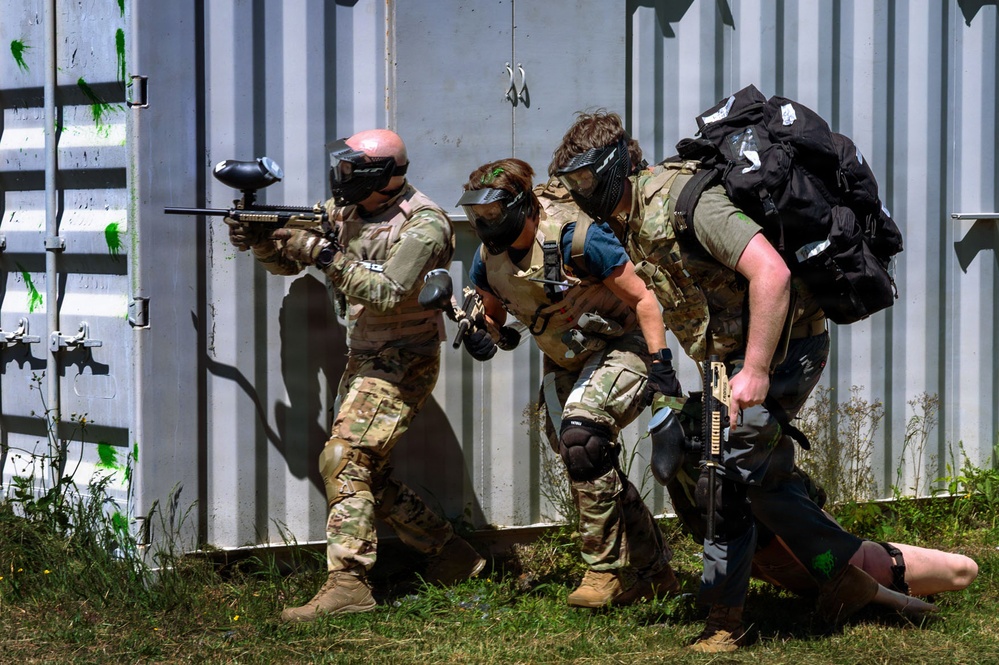
JOINT BASE LANGLEY-EUSTIS, Va.– With sweat beading down their faces, the medical Tier-3 training team quickly removes their paintball gear and springs into action, providing lifesaving care as fast as possible before their practice patients are pronounced dead.
To increase readiness, the 633d Medical Group, Education and Training Flight at Joint Base Langley-Eustis, Virginia, hosts tactical combat casualty care trainings in simulated combat zones.
The TCCC courses are split between four tiers, bridging the gap between basic self-aid and advanced critical care. The courses require military medics to stay disciplined, challenging them to manage stressful situations while also delivering precise TCCC skills.
“We would simulate being in a combat zone with gunfire and screaming. Each team member had a role,” said U.S. Air Force Staff Sgt. Jailene Baldivia, 633d Health Care Operations respiratory therapist. “Someone did communication while another managed airway. It forced us to work together quickly.”
Baldivia works within the Langley Air Force Base hospital and has graduated from the Tier-3 training course.
She explained that these real-world scenarios boost unity as a team and help medics gain confidence and understanding on how fast they need to react during stressful situations.
“I feel as though these exercises have made me faster in a sense. I’m not thinking hard about my decisions. Instead, I just know how to operate under gunfire,” said Baldivia.
TCCC training not only demands their medics to show improvement but also adaptability.
“Whether it be assessing burns or doing battle buddy carries, the medic trainees are being put into scenarios that induce stress so we can learn how to react faster in a combat zone.”
With the courses being held in a class-like setting, the medical students can ask questions if needed and receive feedback on how to improve.
“The emphasis is not only the knowledge from the course but the proficiency in the skill, without reading it off a presentation slide” said U.S. Air Force Tech. Sgt. Deevon Carpenter, 633d Medical Group, Education and Training flight chief.
Carpenter is a TCCC program coordinator and works alongside the medic trainees, helping them learn. He emphasized that every day during the course, trainees are given skills with the main goal of proficiency.
"Passing the trainees isn't just about checking them off a list; it's about them demonstrating real competence," said Carpenter
The instructor team intentionally sets the standards high so that they are prepared to execute TCCC correctly when it counts.
“We induce stress to help them filter out distractions and perform under pressure,” said Carpenter. “We want them to get used to the stress, so they can focus on what’s important.”
Carpenter emphasizes that the TCCC Education and Training flight does their best to go beyond the standard of the TCCC training guidelines.
“We don't lower our standards or grade based on a curve,” said Carpenter. “Our Curriculum is the baseline for us, because at the end of the day, their competence could save somebody's life.”
Not only do the students strive to perfect these skills, but the instructor team aims to prepare them so that when the time comes, they can react quickly in real emergencies.
Medics within the military can be the only difference ensuring whether their fellow members live or die. By being able to provide care to their patients in uncontrollable and unpredictable circumstances, medics can be considered an essential part to any team.
| Date Taken: |
06.02.2026 |
| Date Posted: |
06.10.2026 09:21 |
| Story ID: |
567314 |
| Location: |
JOINT BASE LANGLEY-EUSTIS, VIRGINIA, US |
| Web Views: |
62 |
| Downloads: |
0 |
PUBLIC DOMAIN

This work, Enhancing readiness through combat TCCC, by A1C Chloe Goodman, identified by DVIDS, must comply with the restrictions shown on https://www.dvidshub.net/about/copyright.

 Subscribe






