
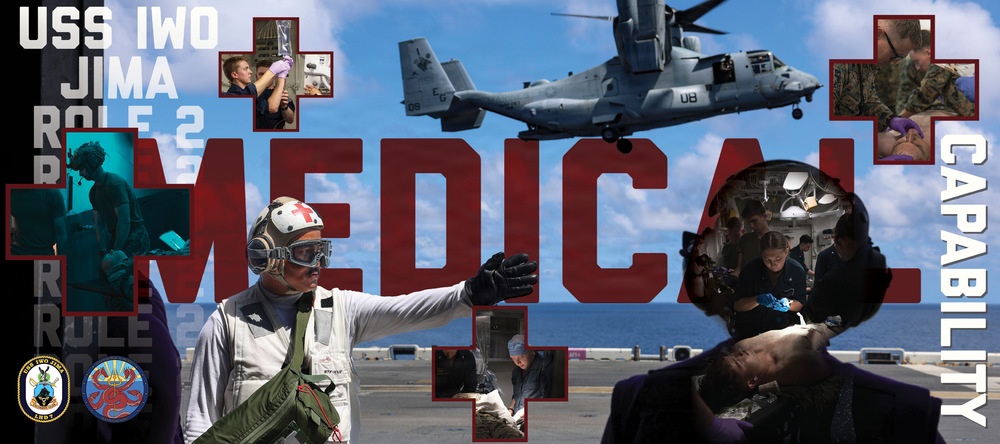
Photo By Petty Officer 3rd Class Andrew Eggert | A photo illustration showcases Wasp-class amphibious assault ship USS Iwo Jima's (LHD...... read more read more
 Subscribe
Outside the skin of the ship, Wasp-class amphibious assault ship USS Iwo Jima (LHD 7) is a floating airfield. On the busy flight deck, the pilots of MH-60S Sea Hawk helicopters and MV-22B Osprey tiltrotor aircraft await Sailors from the ship’s Air department to direct them into the skies as part of a clear mission—project power.
Just below the flight deck, another less-seen but equally as critical operation is at play— a medical synergy that marks the Navy’s amphibious assault ships as one of the most capable floating medical platforms in the world. With four operating rooms, a 15-bed Intensive Care Unit, and a hospital ward that can expand to hundreds of beds during a crisis, Iwo Jima and its integrated medical team is a bedrock of the Navy’s ability to stay in the fight, saving and protecting lives at sea 24 hours a day, 7 days a week.
“If you talk about the [22nd Marine Expeditionary Unit (Special Operations Capable)] you also have to talk about the Amphibious Ready Group that they ride on because that team is in an incredible, synchronized joint force that is still on task today,” said U.S. Marine Corps Gen. Francis Donovan, commander of U.S. Southern Command during his mid-March testimony to the Senate Armed Services Committee.
The Navy’s amphibious assault ships come with a standard “Role I” primary care and sick call sea-based hospital. When a Fleet Surgical Team (FST) embarks, the ship becomes a “Role II” surgical and resuscitative powerhouse and the FST transforms the warship into a casualty receiving and treatment ship.
Embarked aboard Iwo Jima, FST 2 brings this advanced level of medical readiness to a combatant commander’s area of responsibility.. Iwo Jima—the flagship of the Iwo Jima Amphibious Ready Group (IWO ARG)—has previously been deployed with U.S. military forces to the U.S. Southern Command area of responsibility in support of Operation SOUTHERN SPEAR, Department of War-directed operations, and the president's priorities to disrupt illicit drug trafficking, deter malign actors, and protect the homeland through continuous presence.
“I traveled to Caracas to meet with that government and our incredible Charge d’ Affaires there,” continued Donovan in his testimony. “Their safety and security is based on that amphibious platform—those Marines and Sailors—with that quick reaction force but also with a Role II plus surgical suite… four ORs, operating tables, ready to respond,” said Donovan.
Between Iwo’s medical team, FST 2, and 22nd MEU (SOC) medical staff, the military providers, nurses, and Hospital Corpsman aboard provided a full spectrum of medical care from illness and minor injuries to emergency surgeries and combat casualty care. This medical “team of teams” is also able to stabilize post-surgical cases for evacuation to shore-based facilities, if needed.
“Overall, we're trying to bring a surgical and hospital expanded capability, which doesn't exist down here to be perfectly honest, especially on ships,” said Cmdr. Derek Austin, FST 2 fleet surgeon. “It's really about that targeted window that you're getting them to a role 3 [shore-based hospital].”
Aboard Iwo Jima, freezers hold blood ready to administer to patients in the event of major blood loss due to injury or surgery. In addition to this, Iwo’s “walking blood bank”, a group of volunteers who are pre-screened to donate blood rapidly for the duration of a deployment, became force-multipliers who increase the medical team’s capacity to save lives.
“Having that capability is what allows us to do the surgeries and be as capable as we are,” said Cmdr. Rachel Neubert, Senior Medical Officer aboard Iwo Jima.
One of the most critical roles for the amphibious assault ships’ medical ward is to receive casualties. Integration and teamwork between ship’s company, FST 2 and 22nd MEU (SOC) medical teams during deployment enabled Iwo Jima the ability to handle mass casualties effectively when seconds matter.
“We come together as a team in practice for mass casualty situations. As a ship FST-MEU medical unit we have integrated very well, it has been very evident whenever we have had to come together either for an exercise or real [scenarios],”said Neubert.
During a mass casualty, Iwo Jima transforms different areas of the ship into triage spaces giving ample space to treat patients quickly. Injured service members can arrive from either aircraft or ship-to-shore connectors, so the ship’s hangar bay and lower vehicle storage areas are turned into spaces where patients can be provided initial primary care and treated by the ship’s triage teams.
“From there, we're able to get them brought up to medical in the most urgent priority line so we can get the [most critically injured] patients treated first,” said Hospital Corpsman 3rd Class Matthew Kadrie, assigned to FST 2.
The Medical team aboard Iwo Jima also has the capability to provide care to civilians during a non-combatant evacuation and humanitarian response operations, contingencies the ship has trained for since before its deployment to the U.S. Southern Command area of responsibility. Should the Navy-Marine Corps medical team be tasked to succeed at any medical mission, Neubert is confident the team will rise to the occasion.
“As a combined FST-MEU medical unit, we have integrated very well,” said Neubert who explained that this blue-green team partnership is evident in both training and real-world scenarios.
“That makes our team super strong and I love working here because of it.”
Iwo Jima is now operating in the Atlantic Ocean following its deployment to the U.S. Southern Command area of responsibility.
U.S. military forces remain deployed to the U.S. Southern Command area of responsibility in support of Operation SOUTHERN SPEAR, Department of War-directed operations, and the president’s priorities to disrupt illicit drug trafficking, deter malign actors and protect the homeland through continuous presence.
| Date Taken: | 06.02.2026 |
| Date Posted: | 06.02.2026 12:57 |
| Story ID: | 566689 |
| Location: | ATLANTIC OCEAN |
| Web Views: | 274 |
| Downloads: | 0 |

This work, Casualty Care: Iwo Jima’s Role II Mission, by PO3 Andrew Eggert, identified by DVIDS, must comply with the restrictions shown on https://www.dvidshub.net/about/copyright.


No keywords found.




