
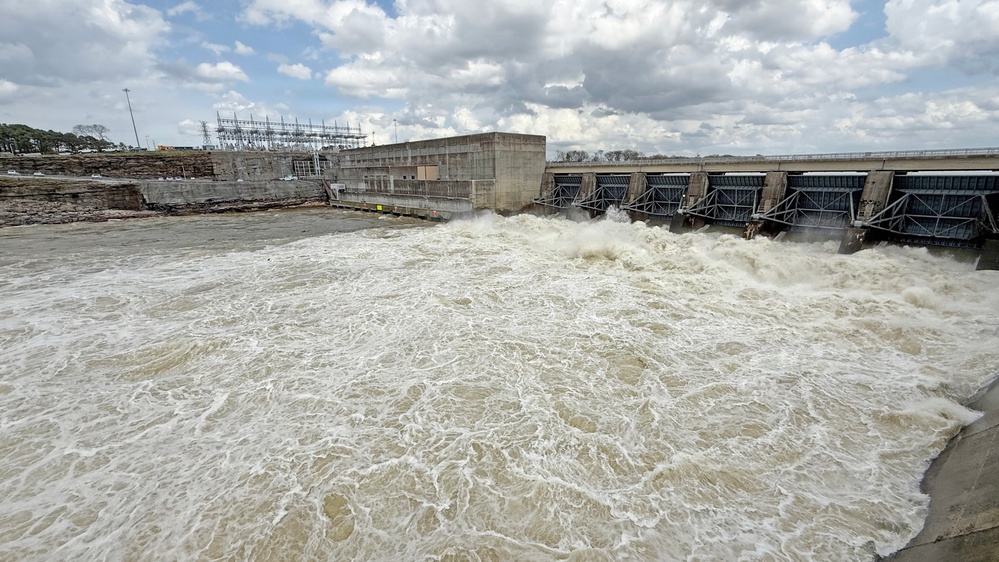
Photo By Leon Roberts | Old Hickory Dam spills April 4, 2024, on the Cumberland River in Hendersonville,...... read more read more
NASHVILLE, Tenn. (May 29, 2026) – This Sunday marks National Dam Safety Awareness Day, an annual observance dedicated to educating the public about the 10 dams in the Cumberland River Basin, local flood risks, and the vital importance of preparedness for potential dam emergencies.
The U.S. Army Corps of Engineers Nashville District operates and maintains an extensive network of water infrastructure across two states. This includes Cheatham, J. Percy Priest, Old Hickory, Cordell Hull, Center Hill, and Dale Hollow dams in Tennessee, as well as Barkley, Wolf Creek, Laurel River, and Martins Fork dams in Kentucky.
Brad Long, Dam Safety Program manager for the Nashville District, emphasized that community awareness is the first line of defense when managing major infrastructure. According to Long, it is critical for nearby residents to understand the inherent risks associated with operating a dam, how water releases are managed, and how the Corps continuously monitors these structures to mitigate safety hazards.
“National Dam Safety Day is a great opportunity for us to communicate openly about risk at our dams and levees,” Long said. “Our goal is to ensure the public has a baseline understanding of how these systems work and is fully informed on how to prepare for the unexpected.”
Proactive Dam Safety Practices
Modern dam safety relies on a continuous, multi-layered strategy known as a "portfolio risk management" approach. Because infrastructure ages and environmental conditions shift over time, reducing risk requires a precise blend of physical engineering, advanced monitoring technology, and structured operational policies.
While dams may appear completely static from the outside, they are actually dynamic structures that subtly shift, compress, and experience internal water pressure. To manage this, the Nashville District relies on embedded digital sensors that act as an early warning system. Physical inspection cycles complement these high-tech instruments by catching surface-level wear, mechanical issues, and environmental vulnerabilities before they escalate. However, advanced hardware and monitoring networks are only as effective as the human framework supporting them. Structured operational practices ensure that engineering and maintenance teams are always trained and prepared for emergency scenarios.
“In modern engineering, no dam is considered ‘100% safe,’” Long explained. “Instead, our dam safety programs focus on continuous risk reduction — identifying the most likely failure pathways and systematically investing resources to interrupt them.”
Long stressed that his primary duty is keeping project delivery teams intensely focused on structural integrity and operational readiness, always prioritizing public safety above all else.
The Balancing Act: Benefits of the Dams
The 10 dam projects in the Cumberland River Basin are dynamically balanced every day to fulfill several Congressionally authorized missions that protect public safety, power the local economy, and supply critical regional resources.
Before these modern structures were built, the Cumberland River was highly unpredictable, and the city of Nashville averaged a major flood roughly every two years. Today, massive upstream storage reservoirs — including Wolf Creek (Lake Cumberland), Dale Hollow, Center Hill, and J. Percy Priest — act as giant catch basins during severe weather.
During high-water events, this system prevents billions of dollars in urban destruction. For example, during a historic high-water event in March 2021, the Nashville District’s flood risk management operations prevented an estimated $980 million in regional damages, which equates to $1.2 billion in today’s dollars.
While upstream storage dams regulate overall flow volumes, downstream "run-of-river" locks and dams — such as Cordell Hull, Old Hickory, Cheatham, and Barkley — maintain a dependable nine-foot navigable channel along the Cumberland River. By utilizing the river's four commercial locks, a single commercial barge tow can transport cargo equivalent to hundreds of semi-trucks, keeping shipping costs low and significantly reducing wear-and-tear on regional highways.
Additionally, nine of the ten dams in the basin house clean, renewable hydroelectric power plants. These facilities generate low-cost electricity that feeds directly into the regional power grid via preference customers and marketing partners like the Tennessee Valley Authority.
The reservoirs also secure municipal water supply and quality, providing a highly reliable source of drinking water for over 70 municipal and industrial water treatment systems that support millions of residents. Furthermore, these bodies of water have become world-class destinations for outdoor enthusiasts, drawing more than 22 million visitors annually to the region's public lands and fueling local tourism economies.
Strengthening Community Preparedness
Dam safety incidents — ranging from controlled, high-volume spillway releases during historic storms to potential structural breaches — require a swift, proactive approach. Because a worst-case failure can leave communities with only minutes to react, preparedness must be a shared responsibility between local emergency agencies and individual property owners.
Long noted that while the Nashville District maintains an intensive internal safety program to keep dams, hydropower plants, and navigation locks well-maintained, external collaboration is just as vital. The Corps partners closely with federal agencies, local governments, emergency managers, and community leaders to identify vulnerable infrastructure — such as schools, hospitals, and water treatment plants — inside mapped inundation zones. Teams regularly conduct joint tabletop exercises to simulate emergency responses for various failure scenarios.
“Communities and property owners should be familiar with the flood mapping in their immediate areas, understand how it impacts their neighbors and local roadways, and maintain an active action plan,” Long said.
For property owners, an effective action plan means preparing for rapid evacuation and maintaining a portable disaster supply "go-bag" with enough food, water, and essential items to sustain every member of the household, including pets, for at least three days.
Emergency management officials recommend the following four steps for residents living near water infrastructure:
“If a dam warning is issued for your area, do not wait to see the water,” Long warned. “Evacuate to high ground immediately. Structures can fail in minutes, and floodwaters move much faster than standard rainfall flooding.”
A Shared Mission for the Future
National Dam Safety Day serves as a vital reminder that infrastructure is not a "set-and-forget" resource. The 10 multi-purpose dams across the Cumberland River Basin do far more than hold back water; they anchor the regional economy, generate clean energy, secure drinking water, and actively shield communities from catastrophe.
But true flood resiliency is a shared mission. While federal engineers and water managers work around the clock to monitor, inspect, and modernize these structures, local residents must remain active partners in preparedness. Reducing risk means understanding your local landscape, establishing family evacuation plans, and staying tuned to local emergency alert systems.
As the region faces growing populations and shifting weather patterns, the safety of the basin depends on a continuous cycle of investment, vigilance, and proactive readiness. This National Dam Safety Day, residents are encouraged to take the time to know their risk, build their plan, and help ensure that the infrastructure built to protect the region can continue to do its job safely for generations to come.
National Dam Safety Day is observed annually on May 31 in memory of the 1889 Johnstown, Pennsylvania, dam failure — a stark historical reminder of the critical importance of dam safety engineering, rigorous maintenance, and public awareness.
The public can get more information about National Dam Safety Awareness Day the Association of State Dam Safety Officials (ASDSO) Awareness Center at https://damsafety.org/awareness-center and the Federal Emergency Management Agency (FEMA) at https://www.fema.gov/grants/mitigation/learn/dam-safety/awareness-day. In addition, the USACE National Inventory of Dams at https://nid.sec.usace.army.mil/ lists more than 90,000 dams and 10,000 low-head dams in the United States.
The public can obtain news, updates and information from the U.S. Army Corps of Engineers Nashville District on the district’s website athttps://www.lrd.usace.army.mil/About/Districts/Nashville-District/, on Facebook athttp://www.facebook.com/nashvillecorpsand on X (formerly Twitter) athttp://www.x.com/nashvillecorps. Follow us on LinkedIn for the latest Nashville District employment and contracting opportunities athttps://www.linkedin.com/company/u-s-army-corps-of-engineers-nashville-district.
| Date Taken: | 05.29.2026 |
| Date Posted: | 05.29.2026 10:22 |
| Story ID: | 566409 |
| Location: | NASHVILLE, TENNESSEE, US |
| Web Views: | 181 |
| Downloads: | 0 |

This work, What National Dam Safety Day means for the Cumberland Basin, by Leon Roberts, identified by DVIDS, must comply with the restrictions shown on https://www.dvidshub.net/about/copyright.

No keywords found.





