
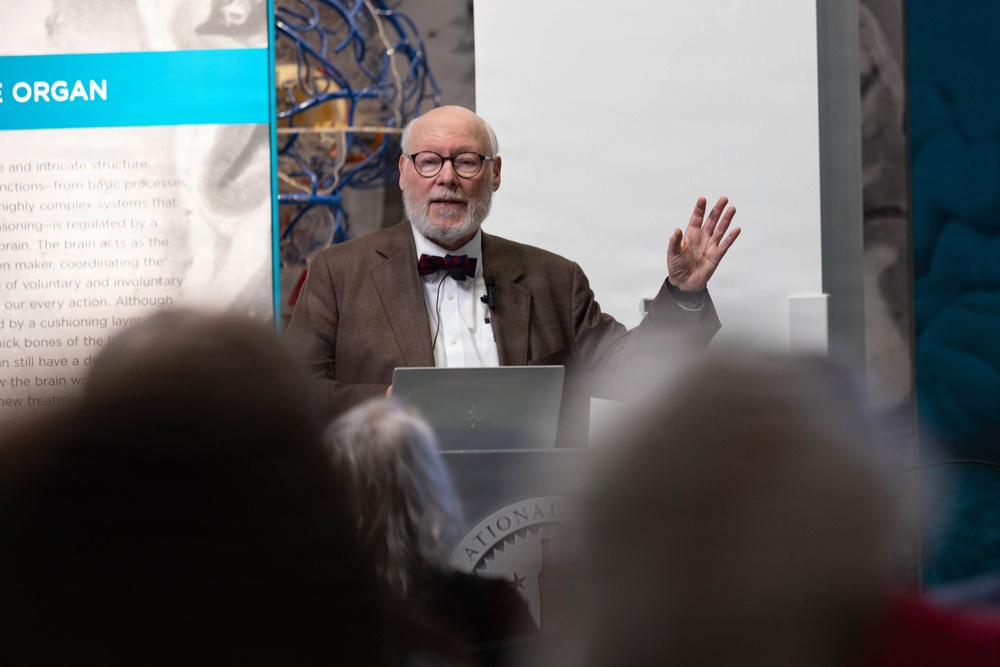
Photo By Chuck Kennedy | Paul Kimmel, MD, clinical professor of medicine emeritus at George Washington...... read more read more
Large drums, long tubes, and hours of treatment marked the early days of dialysis care. These first machines looked very different from the equipment used today, but they helped save lives and changed the future of kidney treatment.
In early May, the National Museum of Health and Medicine hosted a lecture featuring nephrologist Dr. Paul Kimmel, clinical professor of medicine emeritus at George Washington University in Washington, D.C. He spoke about the history of kidney failure treatment and how dialysis care improved over time.
“Undoubtedly, the greatest advance in therapy for kidney failure was the conjoint development of dialysis and kidney transplantation,” Kimmel said. He explained how early dialysis machines from the 1940s and 1950s paved the way for safer and more effective care for patients with kidney disease.
Kimmel’s lecture connected closely with objects preserved in the museum’s collections.
Alan Hawk, historical collections manager at NMHM, presented photos of early dialysis machines and filters used to clean waste from the blood when the kidneys no longer work properly.
Visitors learned how Dr. Willem Kolff built one of the first successful dialysis machines during World War II while living under Nazi occupation in the Netherlands. His machine used long cellophane tubes wrapped around a rotating drum to clean the blood.
After the war, doctors in the United States improved Kolff’s machine. Over the last 70 years, the units have become smaller, faster, and easier to use. New filters also helped doctors clean the blood more safely.
Hawk also explained how these filters led to new ideas in blood-cleaning technology. Researchers later tested systems like the “biospleen,” to remove viruses and other harmful particles from the blood.
“The technology continues to evolve, and researchers are still exploring new uses for these systems,” Hawk said. He also described the “biospleen” developed by the Wyss Institute for Biologically Inspired Engineering at Harvard University under a grant from the Defense Advanced Research Projects Agency. The device takes blood from the body and passes it through a special filtration system. Magnetic nanoparticles enter the bloodstream and bind to pathogens and toxins. As blood flows through a manifold, magnets pull out the magnetized impurities out of the blood, which is then returned to the subject.
The lecture also showed how dialysis supports military medicine. For more than 75 years, military doctors and nurses have used dialysis machines near the battlefield to help treat service members with kidney problems caused by illness, acute kidney injury, and shock.
“These artifacts help people see how dialysis changed over time,” Hawk said. “Each new design helped doctors care for patients in better ways and save more lives.”
Today, the museum continues to preserve these machines and medical tools so visitors can learn how dialysis changed patient care over time.
To attend future lectures and events, visit medicalmuseum.com
| Date Taken: | 05.28.2026 |
| Date Posted: | 05.28.2026 14:21 |
| Story ID: | 566336 |
| Location: | SILVER SPRING, MARYLAND, US |
| Web Views: | 250 |
| Downloads: | 1 |

This work, From Early Dialysis Machines to Lifelong Care: NMHM Lecture Explores the History of Kidney Treatments, by Kenya Baylor, identified by DVIDS, must comply with the restrictions shown on https://www.dvidshub.net/about/copyright.


No keywords found.





