
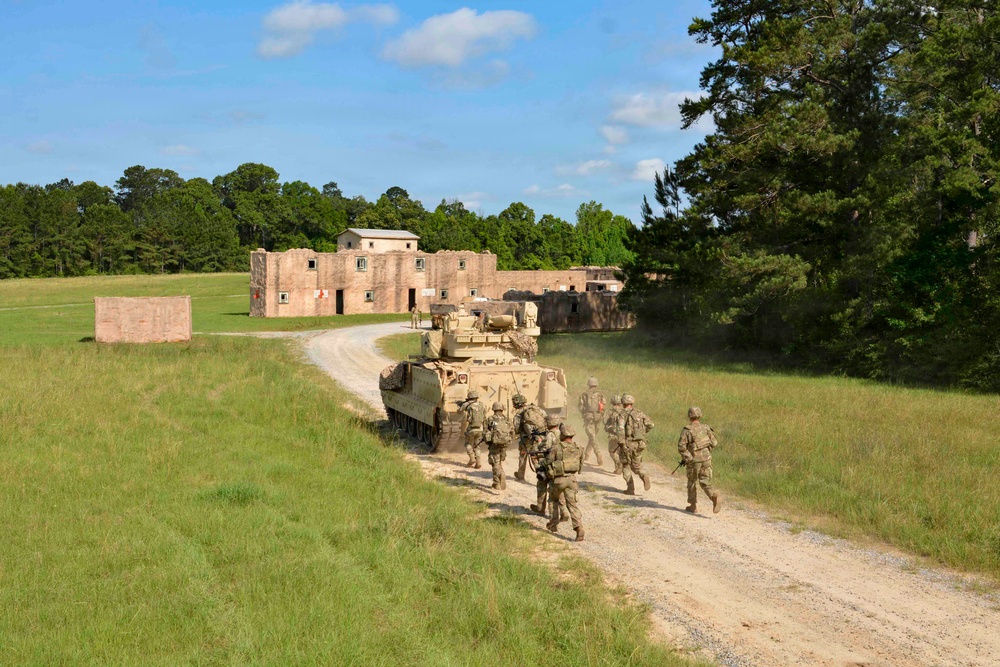
Photo By Capt. Harrison Matheny | A section of dismounted infantry Soldiers assigned to A Company, 1st Battalion, 155th...... read more read more
 Subscribe
CAMP SHELBY JOINT FORCES TRAINING CENTER, Miss. – With lineage dating to 1798, the 1st Battalion, 155th Infantry Regiment, 155th Armored Brigade Combat Team (ABCT), known as the Mississippi Rifles, is the oldest National Guard unit in Mississippi and the seventh-oldest infantry regiment in the United States Army.
One can imagine what life would be like for citizen soldiers training on the 18th century Mississippi frontier as they slept outside, survived multiple days without bathing, ate wild game, practiced squad and platoon sized maneuvers, drank coffee boiled over open flames, and consumed copious amounts of nicotine.
While the weapons systems improved, and meals ready to eat (MREs) replaced wild game, many characteristics of the field training lifestyle remain unchanged over the past 228 years.
With more than 138,000 acres of maneuver area across Forrest and Perry Counties in south Mississippi, Camp Shelby Joint Forces Training Center hosted the 1-155th Infantry Regiment for six days of intense maneuver training May 14-19, 2026.
“In maneuver training, we try to sneak in until we are seen. Then once we are seen, we overwhelm them with a whole lot of bullets to keep their head down so that our head can stay up until we get close enough to kill them, drop dismounts, and seize the objective,” explains Master Sgt. Tommy Guess, the 1-155th Master Gunner. “Maneuver training is like little kids playing with G.I. Joes, but bigger and louder.”
The Bradley Fighting Vehicle crews of A Company and B Company, the tank crews of C Company, and the mortar and sniper platoons of Headquarters and Headquarters Company, use the eight steps of troop leading procedures (TLPs) to execute training missions against a simulated opposition force comprised of other soldiers from the 155th ABCT.
TLPs are the backbone of small maneuver tactics in the United States Army. The eight steps are - receive the mission, issue a warning order, make a tentative plan, initiate movement, conduct reconnaissance, complete the plan, issue the order, and supervise and refine.
The maneuver areas used by the Mississippi Rifles during this training included large rolling fields, dense wooded areas, marshy wetlands, and buildings and compounds made of repurposed shipping containers.
At 6 p.m., Monday, May 18, B Company receives its training mission for the evening: send a section of two Bradley Fighting Vehicles and 8 dismounted infantry Soldiers 1.5 miles across the training area, engage enemy soldiers and armored vehicles, and take control of a compound.
As the early evening changes to dusk then total darkness, Guess oversees the platoon sergeants as they work through the TLPs with their section, developing a plan of attack. Soldiers load blank ammunition rounds into their rifles. While the blanks look like real bullets, these training rounds do not include a projectile.
At 7:50 p.m., Bradley crews and soldiers load into their 33-ton armored vehicle. The Bradley driver, gunner, and track commander confirm internal and external communications while Infantry soldiers in the back of the vehicle adjust their helmet-mounted Night Optical Devices (NODs), which allow them to see in low-light and no-light conditions.
Just a few heartbeats later, the unmistakable clack of Bradley tracks and engine roars reverberate through the crisp nighttime air. Within minutes, the Bradley gunners engage and destroy the enemy’s armored vehicle hiding in the wood-line. Upon reaching a pre-determined location next to the compound, the Bradleys lower their rear ramps and the soldiers run out with their issued M4 / M4A1 carbine rifles in hand.
As the assault begins, Capt. Caleb Lafferty, B Company commander, receives reports from his soldiers over the radio and issues commands when necessary. He oversees the operation from a vehicle staged 50 yards away.
Squads break into the compound and begin room clearing; the staccato cracks of automatic rifle fire fill the air as B Company soldiers hunt and neutralize the enemy.
After the exercise ends, Lafferty and B Company soldiers conduct an after-action review, asking and discussing, “What was supposed to happen?” “What actually happened?” “Why was there a difference?” And “What should we sustain or improve?”
Another section of B Company runs the scenario less than an hour later; all this after each of the two sections completed similar efforts earlier in the day.
B Company returns to its camp in the woodline around 11 p.m., having completed the fifth of six days of maneuver training. Each day builds upon the last as the training scenarios become more complex.
None of these B Company soldiers, nor any others from the Mississippi Rifles, have been in a warm bed, taken a shower, or used indoor plumbing in nearly a week. Unquantifiable amounts of caffeine and nicotine have been consumed.
“AT is the culmination of everything we have done all year, “ says Guess. “This is where we get to tie in all those other drills into one event so that we can see if the things we have been practicing all year will work in a combat simulated environment. And then what does not work, we get to refine so that it will work. We train to get better so that we can defend the United States of America and kill the enemy.”
| Date Taken: | 05.27.2026 |
| Date Posted: | 06.01.2026 15:05 |
| Story ID: | 566231 |
| Location: | MISSISSIPPI, US |
| Web Views: | 168 |
| Downloads: | 0 |

This work, Mississippi Rifles Conduct Maneuver Training, by Capt. Harrison Matheny, identified by DVIDS, must comply with the restrictions shown on https://www.dvidshub.net/about/copyright.


No keywords found.




