
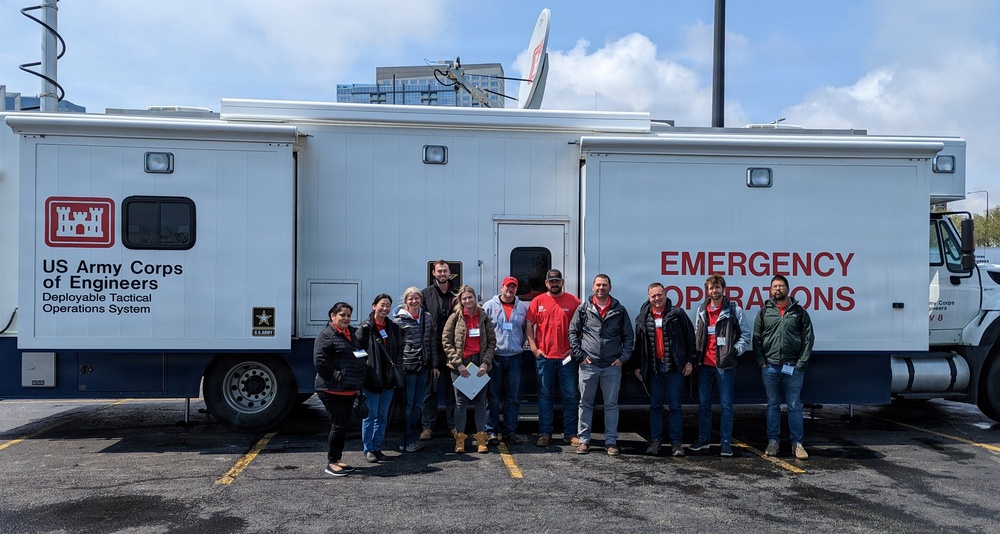
Photo By Emily Helton | USACE participated in the multi-day, utility-led emergency drill which featured over...... read more read more
A crucial part of the U.S. Army Corps of Engineers’ (USACE) mission involves responding to emergencies. USACE Emergency Management teams respond during times of need not only within their immediate areas, but also by supporting other districts—sometimes on a global scale. They provide engineering, construction, and water resources expertise to mitigate property damage and loss of life during disasters. Authorized to fulfill direct requests for assistance from states, USACE provides technical support for public facilities, infrastructure, and residential and commercial developments when disaster needs exceed local and state capabilities.
Facilitating Preparedness through Teamwork
The most important aspect of any response takes place long before an emergency occurs. USACE prioritizes preparedness to ensure our teams maintain a proactive posture. The Emergency Management section coordinates across numerous internal and external groups, forging strong partnerships that are ready to deploy at any moment. By developing comprehensive plans for various scenarios, the team can identify potential impacts and pre-position necessary resources. When disaster strikes, this rigorous preparation ensures smooth communication and rapid action.
“A lot of our work is knowing what resources and tools will be available during a response,” says USACE, Chicago District Chief of Emergency Management, Bob Paluch.
Holding both a bachelor’s and master’s degree in civil engineering with a focus on hydrology from the University of Illinois Chicago, Paluch joined USACE in 2009 as a Civil Engineer. In 2013, he stepped into Emergency Management on a temporary detail.
“I was asked to rebuild the Chicago District Emergency Management program and improve coordination with federal, state, local, and nonprofit partners. I knew this would be a great opportunity to learn another aspect of the organization and to use my engineering background to strengthen our program. I was able to accomplish this task and make the Chicago District a well-respected partner across the region and the enterprise.What was planned to be a year or two detail has become a significant portion of my career,” says Paluch.
While prepared for many types of emergencies, the Chicago District responds to flooding most frequently. Often, the emergency management office supports neighboring districts and partner agencies as part of its response actions.
“We find that we are in support of others more than we have emergencies within our district. Because of where we are geographically, our district is not susceptible to hurricanes, wildfires, or some of the other extreme events that occur in other parts of the country,” Paluch says. “One thing that we are mindful of is, because a large portion of our district is in a densely populated major metropolitan area, a disaster could be smaller in size, but more impactful because of the area that it impacts.”
The USACE Emergency Management team is composed of many professionals of varying disciplines who are regularly trained and capable of providing a wide array of assistance and expertise. Flood teams comprise approximately four to six planners, engineers, construction specialists, and operations specialists. They provide technical assistance as subject matter experts familiar with their assigned watershed. Emergency Management also conducts sandbag and flood response training internally and upon request to partner agencies.
Coordination and Communication: Responding to Recent Floods
Recently, USACE Emergency Management teams responded to elevated water flows throughout the Fox-Wolf-Winnebago watershed following a significant regional flood event driven by heavy snowpack, rapid warming, and substantial rainfall across northeast Wisconsin. USACE monitored and inspected the gates and dams along the Fox River while providing sandbags and technical support following direct requests for assistance from the State of Wisconsin.
“The emergency response to flooding typically starts with someone from Water Management alerting Emergency Operations that there are increasing risks within one or more areas in our district. This is immediately followed up by a discussion among key personnel to define the situation and determine potential impacts,” says Paluch.
Water Management staff also provide daily reports on current conditions across the district. When river levels rise or significant precipitation is in the forecast, key personnel immediately coordinate. If they determine that external support may be required, a Declaration of Emergency—signed by the commander—activates official action and funding.
“The storms that are most difficult to deal with are the summertime storms in urban areas. A large amount of rainfall can quickly develop and fall in a very localized area. Those are the storms that pop up and punch you in the gut. They are virtually impossible to get in front of,” Paluch explains.
The true cornerstone for all district Emergency Management offices within USACE is the relationship maintained at the state level, which allows USACE to leverage its authorities to support a state’s specific requests. The Federal Emergency Management Agency (FEMA) can also request USACE support through the Stafford Act.
Within the Chicago District’s Area of Responsibility (AOR), designated USACE districts take the lead as primary emergency touchpoints: the Rock Island District leads for Illinois, the St. Paul District leads for Wisconsin, and the Louisville District leads for Indiana. However, state emergency management agencies can contact any USACE Emergency Management office directly for assistance. Guided by the "One door to the Corps" philosophy, offices seamlessly coordinate internally to route support from the appropriate district.
USACE Emergency Management teams maintain a highly collaborative environment, convening several times a week to address emerging national events and ensure operational continuity across the organization.
“We all work very closely together and support each other in all of our initiatives,” said Paluch. “Even in this past response, our EOC was activated for less than one day and I was already receiving texts from other USACE Emergency Management offices asking if we needed anything. Being able to very easily leverage resources from across the enterprise allows us the ability to scale our response as necessary.”
Equally important is the routine collaboration with stakeholders and partners across Northeast Illinois and Northwest Indiana to pre-position vital emergency assets.
“USACE maintains agreements with a number of our partners to store sandbags and equipment at their facilities,” explains Paluch “Those supplies are staged and available for immediate use during a response. With only a few phone calls, we are able to leverage the transportation assets of our partners to very quickly move materials to areas of need and substantially reduce the time of delivery. Given the speed that urbanized areas of our watershed react, response activities must occur very rapidly.”
This strategic network was perfectly demonstrated during a recent flooding event when McHenry County, Illinois, ran critically low on sandbags. Because a standard delivery truck from the USACE Flood Fight Material Center could not arrive in time to prevent a shortage, the Little Calumet River Basin Development Commission partnered with the Town of Munster to rapidly transfer 100,000 pre-positioned USACE sandbags to McHenry County that same day, staying well ahead of the rising waters.
A Point of Pride: The COVID-19 Pandemic and Alternate Care Facilities
Reflecting on his career, Paluch finds his proudest professional accomplishments during the regional response to the COVID-19 pandemic. USACE was tasked with constructing Alternate Care Facilities to provide critical overflow capacity for hospitals reaching their operational limits. Chicago District leadership initially met with various teams of medical and logistics experts to determine immediate requirements, a process where everyone shared the same goal but initially underestimated the sheer scale of the looming project.
“There just weren't enough facilities to handle what their projected need was,” said Paluch “The State was looking at shifting people from one hospital to another and utilizing what was available within the healthcare network across the state. Through the intensive discussions and response, the State had not yet realized that the projected need was going to be far greater than the number of available spaces, and the available capacity wasn’t even close to what was needed.”
Facing an unprecedented public health crisis and a strict 30-day timeline, it required total interagency collaboration to design a viable solution.
“More and more people got brought into the room to discuss the situation,” said Paluch “Once everyone realized the magnitude of the issue, we began to discuss how we were going to meet the need. That meeting kicked off the entire response.”
“We haven’t had an emergency of that scale probably since the tunnel flood in ’92,” Paluch says. “You had the best of the best involved from both the Corps of Engineers and the private sector able to work together and make decisions as a team. We were able to very quickly begin construction and meet the needs.”
Completing the Cycle: From Close-Out to Preparation for the Next Emergency
After an emergency operations period concludes, the team conducts a thorough after-action review to isolate lessons learned. This review is a vital phase of the response lifecycle, ensuring USACE continuously refines its emergency processes and procedures. Although an immediate response may draw to a close, the Emergency Management team immediately shifts its focus back to the readiness stage—always standing by to mobilize again at a moment’s notice.
Synchronizing immediate operational needs across a large, multi-disciplinary team during an unexpected crisis can be one of the position's greatest challenges.
“Asking people to stop what they are working on and quickly pivot to responding to an emergency can be difficult and disruptive,” says Paluch. “Luckily, we have a talented staff that understands our mission and is very willing to help.”
While it can be stressful managing the unknowns of the next impending disaster, the dedication of the team ensures that USACE Emergency Management is always prepared to get the job done.
“I think the thing that I like the best is the Emergency Management team, especially within LRD. They are top notch. They're honest, they're straightforward, and everybody is always willing to fully support each other.”
| Date Taken: | 05.26.2026 |
| Date Posted: | 05.26.2026 13:26 |
| Story ID: | 566114 |
| Location: | US |
| Web Views: | 232 |
| Downloads: | 0 |

This work, Behind the Response: Inside USACE Chicago District Emergency Management, by Kyler Davis and Emily Helton, identified by DVIDS, must comply with the restrictions shown on https://www.dvidshub.net/about/copyright.


No keywords found.





