
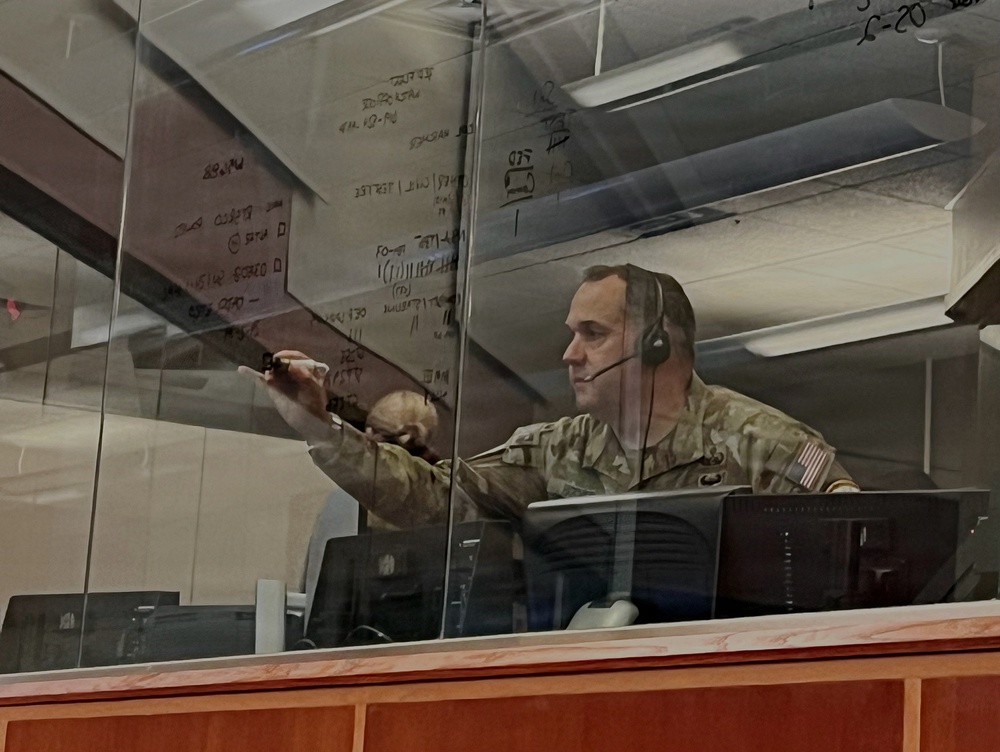
Photo By Jennifer Green-Lanchoney | U.S. Space Force Col. Dorian Hatcher, Space Launch Delta 30 deputy commander for...... read more read more
 Subscribe
VANDENBERG SPACE FORCE BASE, Calif. — As the sun set over the central coast of California May 19, a Falcon 9 rocket soared into the sky at 7:42 p.m., carrying 24 satellites into low-Earth orbit. Just over four hours later, at 12:01 a.m., May 20, an unarmed Minuteman III intercontinental ballistic missile pierced the darkness over the Pacific Ocean.
The increasing frequency of launches might suggest that space and test launch from the Vandenberg Spaceport and test range has become routine. But inside the Western Range Operations Control Center, where personnel manage complex airspace and launch corridors, the atmosphere is anything but common.
Executing a dual-launch night demands relentless precision. While strategic nuclear deterrence missions like the unarmed Minuteman III test are scheduled years in advance, spaceport launches are dictated by the requirements of orbital mechanics. When those timelines intersect, the rapid pivot from deploying orbital assets to testing the nation’s nuclear deterrent leaves no room for error.
"Assured access to space is no longer just a capability; it is an absolute requirement of our national security," said Col. Dorian Hatcher, Space Launch Delta 30 deputy commander for operations. "As the cadence of these launches accelerates, so does the weight on our Guardians' shoulders. You might think the sheer volume would desensitize us, but it’s the exact opposite. Delivering this level of excellence day in and day out requires dedication, because we know the nation is relying on us."
The midnight unarmed ICBM test capped a demanding evening for the installation and marked a personal milestone for Hatcher. It was his final operation as the launch decision authority. Concluding a two-year tour defined by an unprecedented operational pace, he will now depart Vandenberg to take command of U.S. Space Forces-Korea.
During his tenure, Hatcher oversaw more than 130 space launch and test range operations — the busiest period at Vandenberg since the Cold War. He supported an enterprise of more than 11,000 military, civilian and contractor personnel and managed integrated operations spanning 118,000 acres.
"Supporting Air Force Global Strike Command’s deterrence mission is a no-fail endeavor," said Lt. Col. Ralph Salazar, 2nd Range Operations Squadron commander. "Executing a night like this requires proficiency and exceptional leadership. Col. Hatcher has provided that vision over the last two years, navigating this unprecedented launch pace. We owe him a tremendous debt of gratitude as he takes his expertise to the Indo-Pacific."
The Minuteman III launch, known as GT-256, served as a critical demonstration of military readiness, rounding out the night's operations.
"These operational tests are the most visible and vital way we verify the readiness of our Minuteman III ICBM systems," said Col. Dustin Harmon, 377th Test and Evaluation Group commander, which is headquartered here at Vandenberg SFB. "More importantly, they are a direct reflection of the unmatched skill and dedication of the Airmen in our missile community and the Guardians who support us at Vandenberg.”
For Hatcher, the back-to-back launches provided a fitting conclusion to a transformative tour.
“These past two years have redefined what operational excellence looks like on the Western Range,” Hatcher said. “I leave here knowing this team isn't just reacting to the future of space — they are actively shaping it to ensure our nation’s strategic edge remains unmatched.”
| Date Taken: | 05.20.2026 |
| Date Posted: | 05.21.2026 17:01 |
| Story ID: | 565958 |
| Location: | CALIFORNIA, US |
| Web Views: | 308 |
| Downloads: | 0 |

This work, Vandenberg executes back-to-back space, ICBM launches as operations deputy marks final mission, by Jennifer Green-Lanchoney, identified by DVIDS, must comply with the restrictions shown on https://www.dvidshub.net/about/copyright.


No keywords found.




