
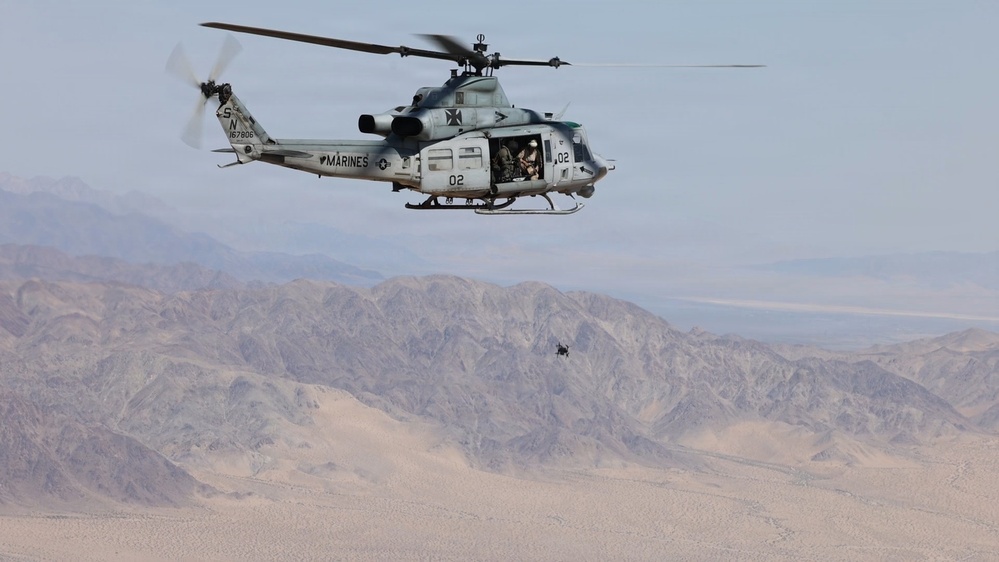
Photo By Sgt. Symira Bostic | Marines aboard a UH-1Y Venom assigned to Marine Light Attack Helicopter Squadron...... read more read more
 Subscribe
MARINE CORPS AIR STATION MIRAMAR, Calif. — In a significant leap forward for aerial warfare, the U.S. Marine Corps has successfully integrated its iconic H-1 helicopter fleet with advanced, low-cost drone technology, demonstrating a new and lethal capability for the modern battlefield. During a recent exercise, Marines with Marine Light Attack Helicopter Squadron (HMLA) 169, Marine Air Group 39, 3rd Marine Aircraft Wing, and 3rd Light Armored Reconnaissance Battalion, 1st Marine Division, showcased the ability of the UH-1Y Venom and AH-1Z Viper helicopters to act as airborne motherships, extending the reach and lethality of first-person view drones to strike targets from unprecedented distances.
“The primary objective was to test the feasibility of a non-kinetic drop and deployment of a first-person view drone from a moving helicopter, which we were able to do today,” said Capt. Quinton Thornbury, a UH-1Y Venom pilot with Marine Light Attack Helicopter Squadron (HMLA) 169, Marine Air Group 39, 3rd Marine Aircraft Wing. “From there, validate that we can control the maneuver of that drone from the back of the aircraft.”
The exercise tested a critical battlefield scenario where ground forces from 3rd LAR launched a Neros Archer FPV drone. Once airborne, control of the drone was seamlessly handed off to a specialized operator team inside a UH-1Y Venom helicopter orbiting safely miles away. The Venom, leveraging its superior altitude and mobility, became a flying command post, directing the drone to its target and validating the aircraft’s role as an aerial control station.
This utilization of drones alongside manned aircraft is designed to counter the growing danger of more sophisticated air defense systems that force helicopters to operate from farther away, limiting their effectiveness. By pairing the H-1’s endurance and perspective with the drone's speed and expendability, the Marine Corps is taking the next step the integration of drones on the battlefield.
This tactic allows us to keep our air crews safe and sound while pushing the lethal edge of the battlefield out to where the enemy is. “We are still providing our ground support, and close air support, but in a way that lets the drones close with and destroy the enemy, rather than putting our Marines in harm’s way,” said Sgt. Matthew Pocklington, a UH-1Y crew chief, with HMLA-169, MAG-39, 3rd MAW. Blending the strengths of a proven aviation platform with an agile, attritable weapon. It gives commanders a scalable, cost-effective option to service a wide range of threats without risking the aircraft or expending expensive munitions on every target.
The Neros Archer, already the most common FPV system in the Marine Corps infantry, was selected for its proven performance and existing logistical support, which accelerates integration.
The successful demonstration proved the viability of using FPV drones as a remote extension of the helicopter’s own sensors and weapons. The small, precise nature of the drones also minimizes collateral damage, a critical risk factor in complex environments. By enabling helicopter formations to detect, target, and engage everything from enemy armor to maritime craft from a safe distance, this innovation ensures the H-1 platform will remain a dominant and relevant force on the battlefields of tomorrow.
| Date Taken: | 05.14.2026 |
| Date Posted: | 05.20.2026 17:42 |
| Story ID: | 565824 |
| Location: | US |
| Web Views: | 419 |
| Downloads: | 2 |

This work, H-1s Become Drone Control Platforms, by 1LT Connor Jenig, identified by DVIDS, must comply with the restrictions shown on https://www.dvidshub.net/about/copyright.

No keywords found.




