
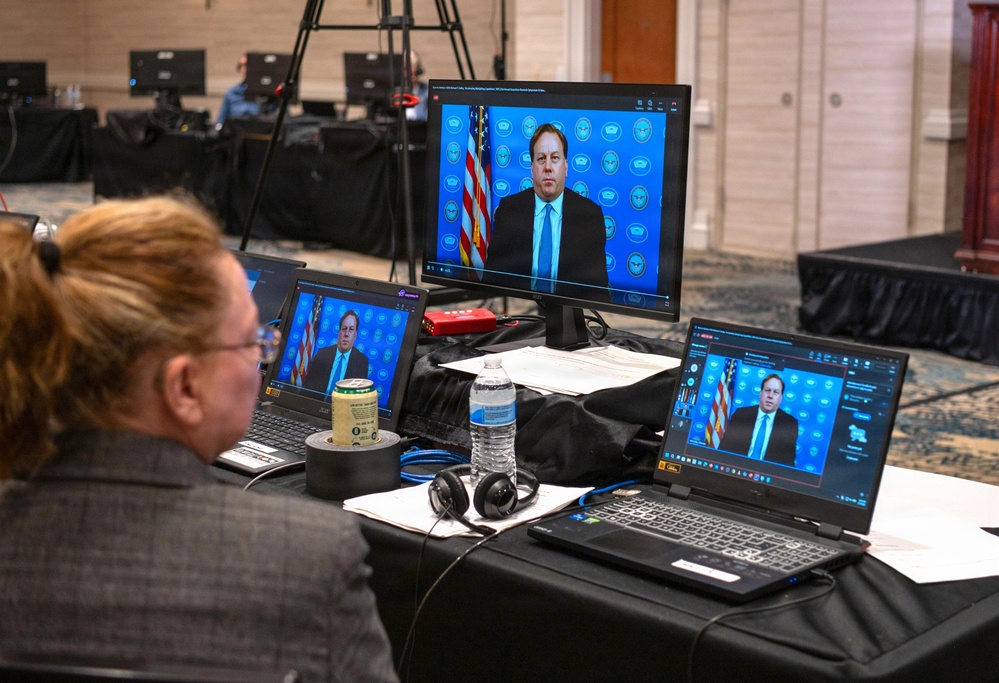
Photo By Seaman Zadi Watkins | The Honorable Michael P. Duffey, Under Secretary of War for Acquisition and...... read more read more
By MCSN Katherine Eldridge
The Naval Postgraduate School (NPS) brought together acquisition professionals, defense leaders, researchers, industry representatives and more from across the defense community for the 23rd Annual Acquisition Research Symposium and Innovation Summit, “Accelerating Warfighting Capabilities,” held virtually May 6-7, 2026.
The two-day event focused on how the U.S. Department of War can more rapidly transition emerging technologies and operational requirements into fielded capability for the warfighter. Discussions examined contested logistics, defense industrial base resilience, shipbuilding, munitions production, data-informed decision-making, and the long-standing challenge of moving innovation through the acquisition “valley of death.”
Opening the symposium, NPS president retired U.S. Navy Vice Adm. Ann Rondeau emphasized the importance of acquisition and logistics in addressing current global security challenges and sustaining future readiness.
“This is the time now to be thinking about the various aspects of what acquisition, procurement, and the entire world of logistics means for our nation and our globe,” Rondeau said. She stressed NPS’ role in developing the acquisition workforce, as well as the critical supporting research that informs acquisition policy, decision-making and sustainment.
The symposium featured keynote remarks from senior acquisition leaders in the Pentagon, including the Honorable Michael P. Duffey, Under Secretary of War for Acquisition and Sustainment, and Jason L. Potter, performing the duties of Assistant Secretary of the Navy (Research, Development and Acquisition). A parallel between both informative keynotes was the Pentagon’s ongoing efforts to modernize acquisition practices to improve the speed and adaptability of delivering capability across the department.
Kicking off day one of the symposium, Potter focused his keynote address on efforts to accelerate naval capability delivery, strengthen the maritime industrial base, and restructure Navy acquisition organizations to better support operational demands.
“We’re moving Navy acquisition from a compliance-based bureaucracy to an outcome-focused warfighting enterprise,” Potter said. He described ongoing initiatives to expand shipbuilding capacity, scale munitions production, and increase the use of robotic and autonomous systems across the fleet.
Potter also used his keynote address to highlight the U.S. Navy’s establishment of key portfolio acquisition executives, as well as the new Rapid Capability Office, as part of a broader acquisition reform effort aimed at shortening development timelines and increasing accountability. The Rapid Capability Office is intended to “solve the fleet’s hardest problems in a one- to three-year timeline,” he said, while new acquisition structures are designed to speed delivery of integrated capabilities to Sailors and Marines.
In the day two keynote, Duffey outlined the department’s transformational efforts to improve acquisition, emphasizing the need to accelerate delivery of capability through a more agile approach that accepts greater program risk to reduce operational risk.
“Technical advantage only matters if new capabilities can actually be acquired, fielded, sustained, and adapted in ways that meet operational and strategic needs, and that means at speed,” Duffey stressed.
He described initiatives to rebuild the industrial base, streamline acquisition processes and expand partnerships with industry, including efforts to increase production rates for key munitions and improve engagement with non-traditional vendors.
In a discussion with NPS Acquisition Research Program principal investigator Dr. Robert F. Mortlock, Duffey pointed out efforts to empower program leaders with greater decision-making authority, encourage faster development cycles, and expand the department’s use of digital tools to manage acquisition programs. He also highlighted continued work with industry partners to strengthen trust, increase capacity and incorporate commercial practices into defense procurement.
“We must transition from a culture that rewards process over outcomes to one that is singularly focused on speed and execution,” Duffey said.
Nearly 1,800 participants registered for the two-day symposium. In addition to keynote speakers and senior defense officials, the event included presentations from NPS faculty, researchers and alumni, along with contributors from government, industry and academia.
“This symposium continues to provide an important venue for research that informs acquisition decision-making across the department,” Mortlock said. “The work presented here helps connect analysis, operational needs and acquisition outcomes in ways that support the warfighter.”
Panel discussions and research presentations explored acquisition reform, risk management, technology transition, program execution and industrial capacity, among many others. Sessions also examined the role of the acquisition workforce in adapting to evolving operational demands and rapidly changing technological environments.
Across the event, presentations from defense acquisitions professionals, in the U.S. and across our allies, unilaterally emphasized the need to accelerate acquisition timelines while balancing integration, operational effectiveness and long-term sustainment. Panelists also discussed efforts to bridge the acquisition “valley of death,” including challenges related to integration, data sharing, export controls, industrial capacity and support for small businesses developing emerging technologies.
For more than two decades, the symposium has served as a platform for collaboration and discussion among defense acquisition professionals working to improve modernization efforts and strengthen national defense capabilities.
To learn more about defense acquisition research at NPS, and to watch select presentations from this year’s symposium, visit the NPS Acquisition Research Program online.
NPS, located in Monterey, California, provides warfighting-focused graduate education, including classified studies and interdisciplinary research, to advance the operational effectiveness, technological leadership, and warfighting advantage of the naval service. Established in 1909, NPS offers master’s, doctoral, and distance learning certificate programs to Department of War military and civilian students, along with international partners, to develop warfighters and leaders who can think critically, solve complex operational problems, and deliver mission-ready solutions through advanced education and research.
| Date Taken: | 05.19.2026 |
| Date Posted: | 05.19.2026 17:25 |
| Story ID: | 565715 |
| Location: | MONTEREY, CALIFORNIA, US |
| Web Views: | 61 |
| Downloads: | 0 |

This work, Annual NPS Symposium Explores Defense Acquisition, Innovation, by SN Katherine Eldridge, identified by DVIDS, must comply with the restrictions shown on https://www.dvidshub.net/about/copyright.


No keywords found.





