Total Force Integration: Reserve and Guard CCATTs boost Critical Care Readiness in joint training
Photo By James Bowman |
Reserve Airmen practiced loading simulated patients onto a C‑17 Globemaster III at......read moreread more
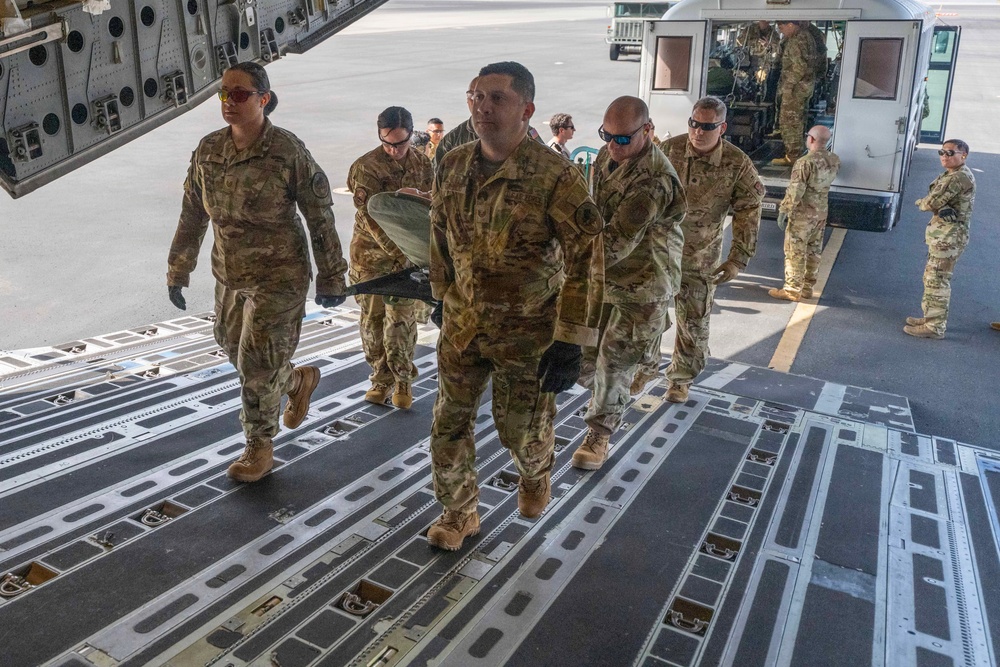
Photo By James Bowman | Reserve Airmen practiced loading simulated patients onto a C‑17 Globemaster III at Joint Base Pearl Harbor‑Hickam on March 6, 2026. The training helped medical members work as a team and understand safe patient movement. Twenty‑seven service members from five Reserve and Guard units joined active‑duty personnel for the five‑day Critical Care Air Transport Team event, which strengthened medical readiness and improved joint evacuation capabilities. see less
| View Image Page
JOINT BASE PEARL HARBOR-HICKAM, HAWAII, UNITED STATES
Total Force Integration: Reserve and Guard CCATTs boost Critical Care Readiness in joint training
Twenty-seven service members from five Air Force Reserve and Air National Guard units joined active-duty personnel March 3–9 for an intensive, five‑day Critical Care Air Transport Team training event designed to strengthen advanced medical readiness and seamless interoperability for real‑world patient evacuation missions.
Participants represented Niagara Falls Air Reserve Station’s 914th Aeromedical Staging Squadron; Travis Air Force Base’s 349th Medical Squadron, 349th Aeromedical Staging Squadron and Ground Training School; Davis-Monthan’s 943rd Aerospace Medicine Squadron; the 624th Aeromedical Staging Squadron in Hawaii; and the Washington Air National Guard’s 194th Medical Group. Active-duty En Route Patient Staging System members also took part.
“Marking my third year partnering with Maj. Deborah Lichota, on this Indo‑Pacific training program, I’m grateful for the opportunity to lead an initiative that directly strengthens operational readiness. Training in this environment is essential, it challenges our teams to adapt in resource‑limited, dynamic conditions while sharpening clinical decision‑making and improving patient outcomes,” said Lt. Col. Jessica Castro from the 349th Medical Squadron, CCATT member. “Readiness is never accidental; it demands deliberate preparation, realistic scenarios and exposure to the unexpected. Through this program, our members not only refine critical skills but also earn valuable, hard‑to‑obtain continuing education that reinforces both individual competence and mission capability.”
The training blended academic instruction with hands‑on, high‑fidelity simulation at Tripler Army Medical Center’s Simulation Center. Reserve Airmen reviewed key Clinical Practice Guidelines and refreshed their proficiency with specialized equipment used to convert cargo aircraft into flying intensive care units. Skills stations allowed teams to rehearse procedures required in austere environments and during complex patient movements.
The week culminated in a demanding capstone event: a full‑scale, four‑patient medical simulation aboard a static C‑17 Globemaster III. CCATT crews executed every phase of the mission, from configuring the aircraft to managing critically ill patients under realistic operational pressures.
"It is always a privilege to train with and learn from teams across the country. This event gave our team invaluable hands‑on experience with platforms we rarely encounter at home station, including the C‑17 and the Ambus,” said Capt. Daniel Ross from the 943rd Rescue Group, CCATT member. “We were also fortunate to secure high‑fidelity simulation time for our medical doctor as he prepared for the Center for Sustainment of Trauma and Readiness Skills validation, an opportunity that unquestionably elevated his readiness. Finally, our engagement with the Pacific Air Forces Patient Movements Requirement Centeroffered critical insight into the logistical challenges and tyranny of distance we may face on a future battlefield, enabling us to better incorporate those realities into our training moving forward."
Inside the aircraft, instructors introduced a series of in‑flight medical emergencies that required teams to communicate clearly, adapt quickly and perform life‑saving interventions. A major component of the scenario involved maintaining continuous coordination with the flight deck, a critical link in any aeromedical evacuation mission.
The simulation reached peak intensity during a “hot” patient transfer, with teams conducting movements while the aircraft’s engines were running to replicate the urgency and environmental challenges of real‑world operations. The event concluded with a coordinated patient handoff to an awaiting AMBUS, supported by the ERPSS team.
Leaders emphasized that the training was designed to be more than a routine refresher. The joint environment mirrored the operational dynamics of a major theater deployment, allowing reserve, guard and active‑duty personnel to integrate their unique capabilities and refine the full spectrum of the patient movement system.
By bringing together Total Force partners, the event strengthened individual proficiency, enhanced team‑level performance and reinforced the readiness of the broader aeromedical evacuation mission.
NEWS INFO
Date Taken:
05.19.2026
Date Posted:
05.20.2026 14:42
Story ID:
565710
Location:
JOINT BASE PEARL HARBOR-HICKAM, HAWAII, US
Web Views:
135
Downloads:
2
PUBLIC DOMAIN
This work, Total Force Integration: Reserve and Guard CCATTs boost Critical Care Readiness in joint training, by James Bowman, identified by DVIDS, must comply with the restrictions shown on https://www.dvidshub.net/about/copyright.