
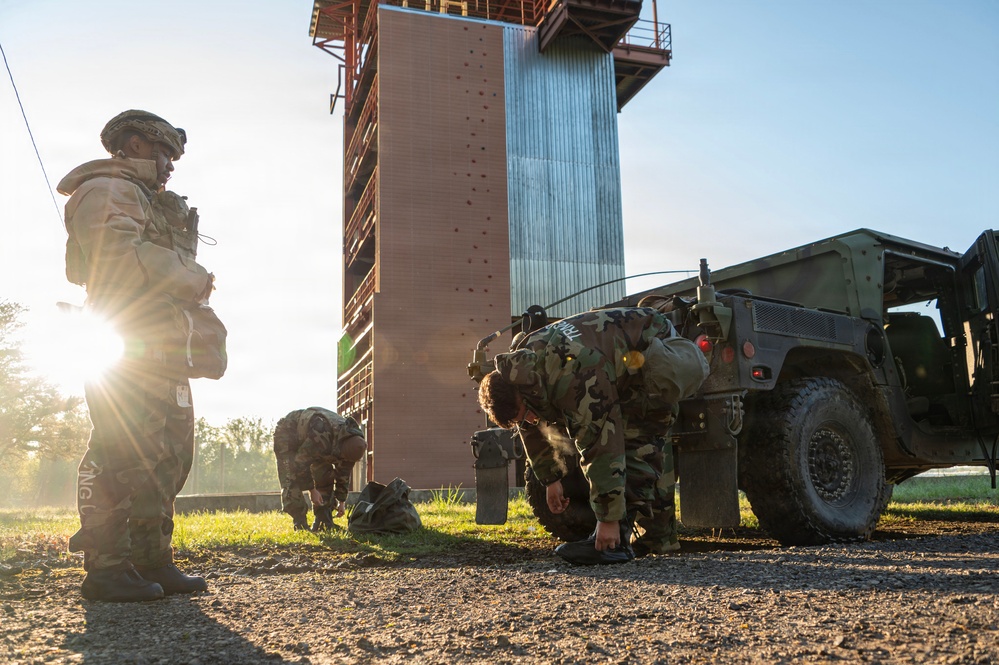
Photo By Tech. Sgt. Aubree Owens | U.S. Airmen assigned to the 316th Security Forces Group conduct perimeter security and...... read more read more
 Subscribe
Fort Indiantown Gap,Pa. -More than 200 Airmen from across the 316th Wing and tenant units from Joint Base Andrews, Maryland, participated in a week-long combat readiness exercise from April 27 to May 2, 2026. The event, known as Bivouac, served as one of five major combat readiness exercises designed to prepare Andrews Airmen for the wing’s 2027 Combat Readiness Inspection.
A bivouac is a temporary military encampment used to replicate deployed and austere living conditions. For the 316th Wing, the exercise was designed to immerse Airmen in expeditionary operations while testing their ability to adapt, survive, and execute mission requirements in a simulated deployed environment.
Throughout the exercise, Airmen trained alongside local units while wing inspection teams evaluated combat readiness skills, interoperability, leadership decision-making, and mission execution through realistic scenarios designed to mirror challenges faced in deployed operations.
This year’s iteration focused heavily on Agile Combat Employment concepts, emphasizing rapid airpower projection, contingency response operations, and integrated cross-functional teamwork. The exercise challenged Airmen to operate outside traditional day-to-day roles and reinforced the expectation that today’s force must be both technically proficient and operationally adaptable.
“This is what the current fight looks like,” said Christopher Schmidt, director of operations for the 316th Civil Engineer Squadron and Bivouac exercise planning lead. “We need people to be generalists and experts at the same time. Training and exercising in this fashion makes our Airmen more capable of handling the complex challenges we are currently seeing during deployments.”
Beyond tactical execution, the exercise placed a strong emphasis on leadership development. Capt. Brennan Bosworth, 316th Civil Engineer Squadron explosive ordnance disposal flight commander, served as camp commander throughout the exercise and was evaluated on leadership effectiveness, risk management, and decision-making while responding to simulated attacks and evolving operational challenges.
“I felt prepared, going into the exercise, to lead despite not knowing what was going to happen,” said Bosworth. “It really proved to me that the Air Force does a great job training all Airmen.”
For many participating Airmen, Bivouac provided their first exposure to realistic deployment-style operations. The training environment was intentionally designed to bridge the gap between home-station operations and the demands of operating in austere conditions, giving younger Airmen an opportunity to build confidence, develop new skills, and understand how their roles contribute to mission success in contested environments.
“The Airmen and new Lieutenants we are seeing today will be leaders in 10 years, and if they’re not understanding the capabilities that their Airmen have or what critical tasks need to be accomplished, then we will have greatly failed them,” Schmidt explained.
Senior leaders from across the National Capital Region visited the training site during the exercise, observing firsthand the effort invested in building a realistic training environment focused on preparing Airmen for future operations downrange.
“Your leadership had the foresight and the commitment to invest time, effort, and resources in making this week happen,” said Maj. Gen. Daniel A. DeVoe, commander of the Air Force District of Washington and the 320th Air Expeditionary Wing. “The team did it for each and every one of you [Airmen], knowing it would be more challenging to move this exercise to an out-of-state area that mimics an austere environment. They made it happen because our nation needs combat-ready teams.”
The exercise reinforced the Air Force’s commitment to building a force capable of operating in dynamic and contested environments. By training in realistic expeditionary conditions and responding to simulated real-world challenges, Andrews Airmen strengthened the skills necessary to remain ready to deploy, operate, and execute the mission whenever called upon.
| Date Taken: | 05.14.2026 |
| Date Posted: | 05.15.2026 15:23 |
| Story ID: | 565424 |
| Location: | PENNSYLVANIA, US |
| Web Views: | 20 |
| Downloads: | 0 |

This work, Joint Base Andrews Airmen Train for Real-World Scenarios in Bivouac Exercise, must comply with the restrictions shown on https://www.dvidshub.net/about/copyright.


No keywords found.




