
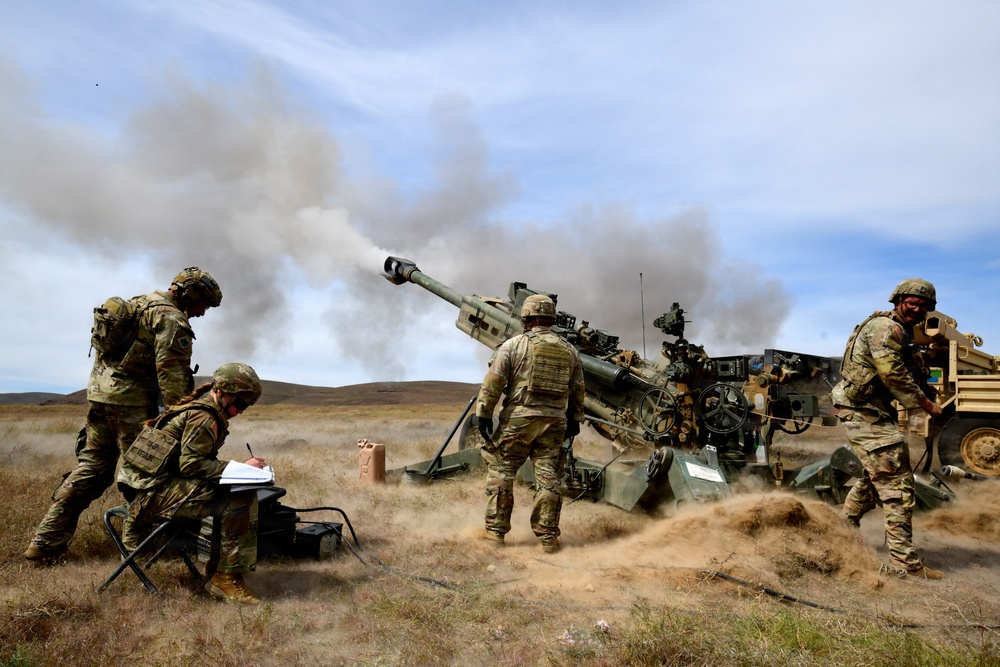
Photo By Spc. Christopher Chavero | U.S. Army National Guard Soldiers assigned to the 2nd Battalion, 146th Field Artillery...... read more read more
 Subscribe
WASHINGTON — Artificial intelligence-powered command and control, data interoperability among allies and decision-making speed will be key to achieving multi-domain dominance in the Pacific region, Army leaders said at the 2026 Land Forces Pacific Symposium and Exposition in Honolulu, May 12.
The I Corps, headquartered at Joint Base Lewis-McChord, Washington, recently completed its first Operation Courage Lethality, an exercise that tested Soldiers’ ability to deliver coordinated, lethal attacks across multiple domains, while limiting their digital footprint.
Units stationed at Washington, Hawaii, Alaska, Oregon, Australia and Idaho tested AI-enhanced capabilities across thousands of miles during the exercise in April. Soldiers simulated a long-distance battle scenario across the South China Sea using live data.
As part of the service’s broader transformation efforts, the 25th Infantry Division at Schofield Barracks, Hawaii, and the 4th Infantry Division at Fort Carson, Colorado, have partnered to pioneer efforts to make data more accessible, utilizing the next-generation command and control, or NGC2.
NGC2 uses AI-enhanced technology and advanced applications to enhance, but not supplant, an Army leader’s decision-making abilities.
“Let’s be clear: artificial intelligence is not designed to replace the commander,” said retired Army Lt. Gen. Neil Thurgood, former director of the Army's Rapid Capabilities and Critical Technologies Office. “It is designed to assist the commander in making better decisions and more timely decisions, with more data and information available.”
Speaking during a discussion on AI, machine learning and the future of command and control, Thurgood said warfighters should be aware of three trends. The first is the move from a linear kill chain, the process of identifying, attacking and destroying targets, to a network kill web or AI-enabled network that links sensors, shooters and command centers to track and hit targets.
Second, conflicts will be defined by decision speed. Finally, he said command and control is no longer a fixed system but rather a modular system that is continuously upgraded and always evolving.
Army Maj. Gen. Denise McPhail, commander of the U.S. Army Network Enterprise Technology Command, said that adversaries have used AI to exploit vulnerabilities in the civilian sector and that the Army must be prepared to counter such attacks.
“The future of AI is going to be to be able to secure at speed and to operate at speed,” she said. “AI empowers commanders. ... but it also allows us to do as humans, only what we can do, and that is critical thinking. All we can do is train the AI, but we have the ability to do the critical thinking, not the AI, so we can't be over-reliant on it.” McPhail said the service could benefit from the use of a digital twin, which will allow simulations that help commanders identify network outages and pitfalls. Commanders could assess potential problems in a matter of hours or days rather than months.
Army Maj. Gen. Matthew Cogbill, commander of 11th Airborne Division and U.S. Army Alaska, said in an environment saturated with more data than ever before, data literacy should be incorporated into each intelligence Soldier’s training. He added that exercises should be interesting and challenge Soldiers to problem-solve.
“You have to train everybody; we need a data-literate workforce,” he said. “The younger generation is much easier to [train] because they're digital natives and they’ve had computers in their pockets their entire lives. They want to know about the data; they want access to everything because that's how they’ve grown up. So I think you've got to train them like you train anything else, through reps and sets.”
| Date Taken: | 05.15.2026 |
| Date Posted: | 05.15.2026 09:31 |
| Story ID: | 565375 |
| Location: | HONOLULU, HAWAII, US |
| Web Views: | 172 |
| Downloads: | 0 |

This work, LANPAC 2026: Army leaders say AI empowers commanders, by Joe Lacdan, identified by DVIDS, must comply with the restrictions shown on https://www.dvidshub.net/about/copyright.

No keywords found.




