
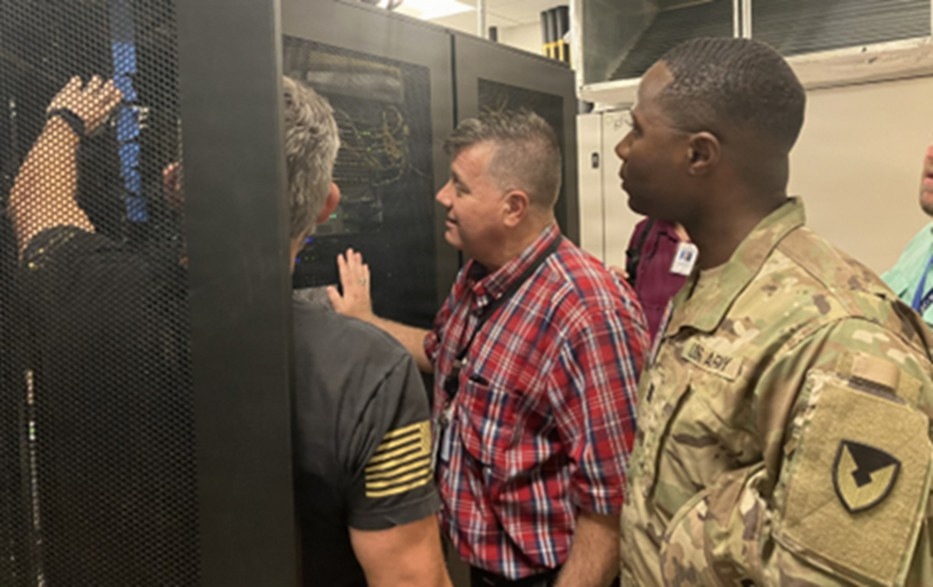
Photo By Sandra Rosario | USAISEC engineers, David Arvizu (left) and Capt. Tyler Taylor (right), survey a future...... read more read more
 Subscribe
By Dawson Nash, USAISEC
As the Army shifts its focus toward the demands of large-scale combat operations, the industrial infrastructure that has sustained our military since World War II is undergoing a radical digital transformation. The Army Materiel Command is spearheading a monumental, 15-year, more than $18 billion Modernization Implementation Plan to overhaul the 23 depots, arsenals and ammunition plants that comprise the Army’s OIB.
One way the Communications-Electronics Command supports the OIB Transformation is through the U.S. Army Information Systems Engineering Command’s infrastructure design recommendations for the industrial control network. USAISEC’s system engineering expertise is required to move the critical infrastructure of these WWII-era factories into the digital era of Industry 4.0 facilities.
Transforming the Army’s OIB
The Army's OIB generates readiness and operational capability by manufacturing, resetting and modernizing equipment at its depots, arsenals and ammunition plants. To ensure our forces can meet today's needs and prepare for future conflicts, the Army has committed to a historic modernization of these facilities to increase production capacity.
The Army’s OIB Transformation is organized across five primary lines of effort:
Network and cybersecurity: The “digital backbone”
While modernized buildings and new machines are visible signs of progress, USAISEC provides its infrastructure engineering expertise for the implementation of the industrial control network. This network is the invisible, digital backbone that makes Industry 4.0 facilities possible.
As these facilities adopt modern capabilities, they face new challenges. Historically, many OIB machines were safe from cybersecurity threats, because they were manual and not networked. As the Army’s OIB transforms with automated robotics, artificial intelligence and data analytics, ensuring these facilities have a secure, resilient network is paramount. The industrial control network is the foundational enabler for these capabilities, because without this network, the Army cannot achieve the secure, high-speed data required to connect the factory to the foxhole and achieve precision sustainment.
The practical application of USAISEC’s engineering expertise is already visible at many Army ammunition plants, arsenals and depots, such as the Corpus Christi Army Depot. At this depot, the industrial control network infrastructure is essential for distributing high-speed connectivity that will allow personnel to utilize real-time data and advanced diagnostic tools for rotary-wing aircraft maintenance to support our global warfighters.
A resilient industrial base
Ultimately, the Army’s OIB Transformation is about ensuring our Soldiers have the equipment they need to win on any battlefield. By replacing manual systems with digital connectivity, engineering partners like USAISEC are enabling a more efficient, secure industrial base. This allows our skilled civilian and military personnel to work alongside automated systems, providing the Army with operational equipment at the speed of relevance. As the OIB Transformation continues, the dynamic between AMC’s strategic vision and its technical experts ensures the Army of 2030 will remain the most lethal and technologically advanced military force in the world.
| Date Taken: | 05.11.2026 |
| Date Posted: | 05.12.2026 09:27 |
| Story ID: | 564976 |
| Location: | FORT HUACHUCA, ARIZONA, US |
| Web Views: | 132 |
| Downloads: | 0 |

This work, Supporting the digital foundation for the Army’s Organic Industrial Base transformation, by Sandra Rosario, identified by DVIDS, must comply with the restrictions shown on https://www.dvidshub.net/about/copyright.

No keywords found.




