
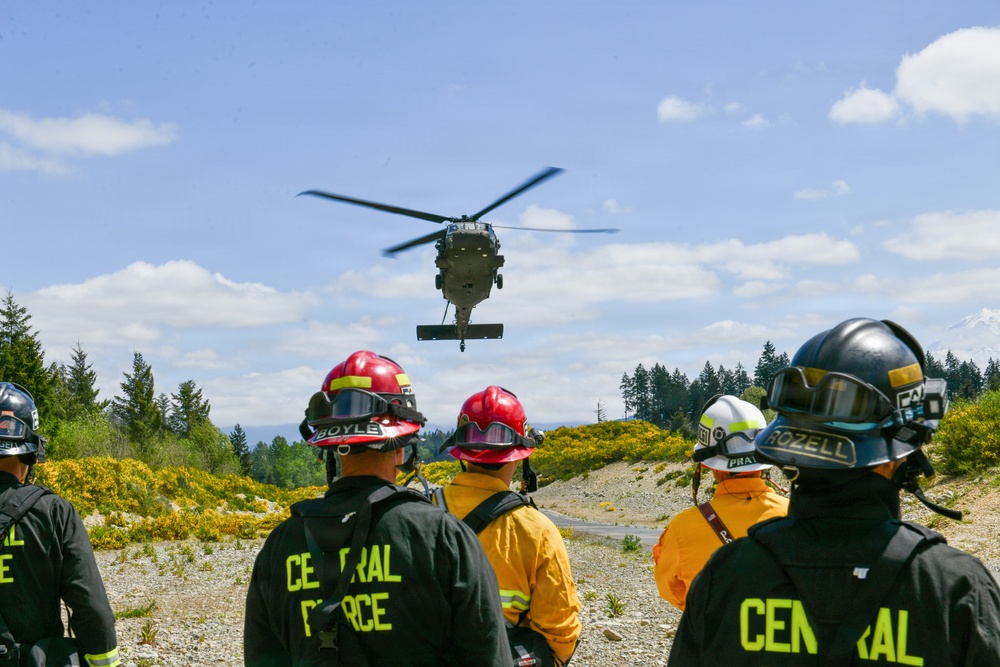
Photo By Capt. Andrew Phommavongsay | A UH-60 Black Hawk helicopter assigned to the 1st Battalion, 168th General Support...... read more read more
 Subscribe
PUYALLUP, Wash. — In preparation for Washington’s upcoming wildfire season, aviation crews assigned to 1st Battalion, 168th General Support Aviation Battalion, Washington Army National Guard, partnered with Central Pierce Fire and Rescue to conduct water bucket training near Puyallup, Wash., May 7, 2026.
Throughout the exercise, firefighters and aviation crews rehearsed aerial wildfire response operations, practicing bucket drops, air-to-ground communication procedures and coordination between firefighters and aircrews ahead of Washington’s annual fire season.
Using UH-60 Black Hawk helicopters, aircrews conducted multiple water bucket drops while firefighters on the ground coordinated target locations and evaluated the effectiveness of each drop. The training focused on communication, timing and precision in environments that can quickly become hazardous during wildfire response operations.
“Air assets have become a critical asset in fighting these fires,” said a representative from Central Pierce Fire and Rescue. “These are very fast-moving fires, especially when the weather’s playing into it with the wind, and it’s extremely difficult for us on the ground and extremely hazardous sometimes for us to get even close enough to attempt to extinguish these fires.”
Fire officials said helicopters and fixed-wing aircraft often provide firefighters additional access and suppression capabilities in areas that may be difficult or unsafe for crews operating on the ground.
U.S. Army Chief Warrant Officer 3 Jarin Trakel, company standardization instructor pilot (SIP), 1st Battalion, 168th General Support Aviation Battalion, Washington National Guard, emphasized the recurring partnership helps firefighters and aviation crews build familiarity and communication before responding to real-world emergencies.
“We kind of try to bridge that gap by putting a face to the radio before anything actually happens,” Trakel said. “That way they know what to expect when they call the Washington Guard.”
Trakel said the joint training also allows both organizations to better understand each other’s capabilities, communication procedures and operational limitations before responding to wildfire incidents together.
For Washington Army National Guard aviation crews, water bucket operations require annual certification and recurring proficiency training to ensure pilots and crew members remain prepared to respond when activated in support of wildfire suppression missions across the state.
Trakel described water bucket operations as one of the more demanding aviation mission sets conducted during domestic operations training.
“This is kind of the varsity league of training,” Trakel said. “The aircraft, we put it pretty close to its limitations when we’re picking water up, moving the aircraft around in tight spaces, at low airspeed with a high power setting.”
He added that the mission requires experienced crews, constant communication and coordination between pilots, crew chiefs and firefighters operating on the ground. During real wildfire responses, military aviation crews often integrate with multiple civilian rotary-wing aircraft operating from the same water sources and flight paths.
“It takes a lot of coordination,” said U.S. Army Chief Warrant Officer 3 Martin Hays, battalion aviation mission survivability officer (AMSO), 1st Battalion, 168th General Support Aviation Battalion, Washington National Guard. “You’re dealing with firefighters on the ground and additional weight with the water bucket.”
Hays said wildfire response operations remain one of the more demanding domestic operations mission sets conducted by Guard aviation crews due to terrain, smoke, wind conditions and the coordination required between ground personnel and aircraft.
During the exercise, firefighters and aircrews practiced identifying targets, coordinating water drop locations and maintaining positive communication throughout the operation.
“The first thing that we do is try to identify our ground contact to make sure we have positive communication with the crews,” said the battalion commander for Central Pierce Fire and Rescue. “Obviously, the priority is actually stopping any forward progress towards residential structures or life hazards.”
Fire officials said the partnership has continued to grow through recurring joint training opportunities between firefighters and Guard aviation crews.
“It’s extremely rare to find helicopters that are willing to train with us,” a firefighter said. “We decided this was a great opportunity for us to get some training out of this too.”
Since 2012, the Washington National Guard has supported wildfire suppression efforts alongside the Washington Department of Natural Resources throughout the state. In 2024 alone, aviation crews flew more than 75 firefighting hours and dropped nearly 300,000 gallons of water in support of multiple wildfire responses across Washington. According to the Washington Department of Natural Resources, 1.2 million gallons of water was delivered via aviation assets with an average response of 16 minutes in 2025.
Most years in recent history, Washington Army National Guard aviation crews have been activated to support wildfire response operations across the state.
“The more we get to go out and do this, the better,” Trakel said. “It just makes us safer, more capable to give back to the state when called upon.”
As Washington prepares for another wildfire season, Guard aviators and local firefighters continue building the relationships, communication and operational readiness needed to protect communities across the state.
| Date Taken: | 05.08.2026 |
| Date Posted: | 05.08.2026 16:40 |
| Story ID: | 564852 |
| Location: | PUYALLUP, WASHINGTON, US |
| Web Views: | 283 |
| Downloads: | 1 |

This work, Behind the Fireline: Washington Guard Aviation Trains for Wildfire Season, by CPT Andrew Phommavongsay, identified by DVIDS, must comply with the restrictions shown on https://www.dvidshub.net/about/copyright.


No keywords found.




